
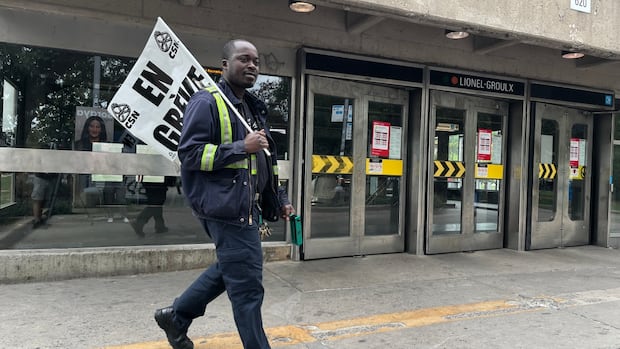
Commuting was difficult Monday morning in the Montreal area and elsewhere in the province as maintenance workers with the Société de transport de Montréal (STM) began their two-week strike, while truck drivers launched a protest and took to major roadway arteries to slow down rush-hour traffic.
Some truck drivers across Quebec gathered at specific meeting points at 5 a.m. and drove on major highways and bridges to protest the number of truck operators at the wheel without Quebec-approved permits, saying it poses a risk to road safety.
“There are more and more illegal [drivers] on the road, more and more accidents, as you’ve seen in recent weeks,” Steve Bourgeois, spokesperson for the Assez c’est assez movement, which is behind the protest, told Radio-Canada.
At around 8:30 a.m., truck drivers were protesting on Highway 13 South and Highway 20 westbound, causing major traffic.
Earlier this morning, at around 7 a.m., there were demonstrators on the northbound Décarie Highway in Montreal, slowly flashing lights and driving very slowly.
WATCH | A breakdown of the bus and Metro service hours during the strike: 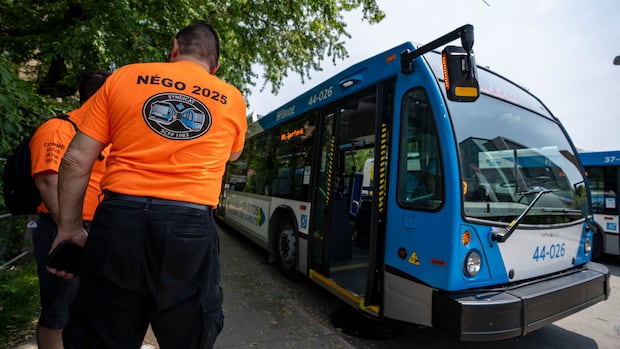
Use public transit? STM workers are prepared to strike again. Here’s what you need to know
Six strike days are slated to happen between Sept. 22 to Oct. 5. During those weeks, service will be limited on Mondays, Wednesdays and Fridays.
A demonstration planned in Gatineau, which was expected to slow traffic on the Macdonald-Cartier Bridge, was cancelled. The turnout for that protest was low.
As for the STM strike, commuters can expect bus and Metro service to be scaled back significantly.
 Syndicat du transport de Montréal workers holding signs outside the STM Frontenac Transportation Centre in Montreal on Monday. (Christinne Muschi/The Canadian Press)
Six strike days are slated to happen between Sept. 22 to Oct. 5. During those weeks, service will be limited on Mondays, Wednesdays and Fridays.
Maintenance workers also went on strike in June.
Four unions are currently in negotiations with Montreal’s public transit authority for the renewal of their employment contracts. The largest, that of bus drivers and Metro operators, with its 4,600 members, has a mandate to take pressure tactics that can go as far as an unlimited general strike.