
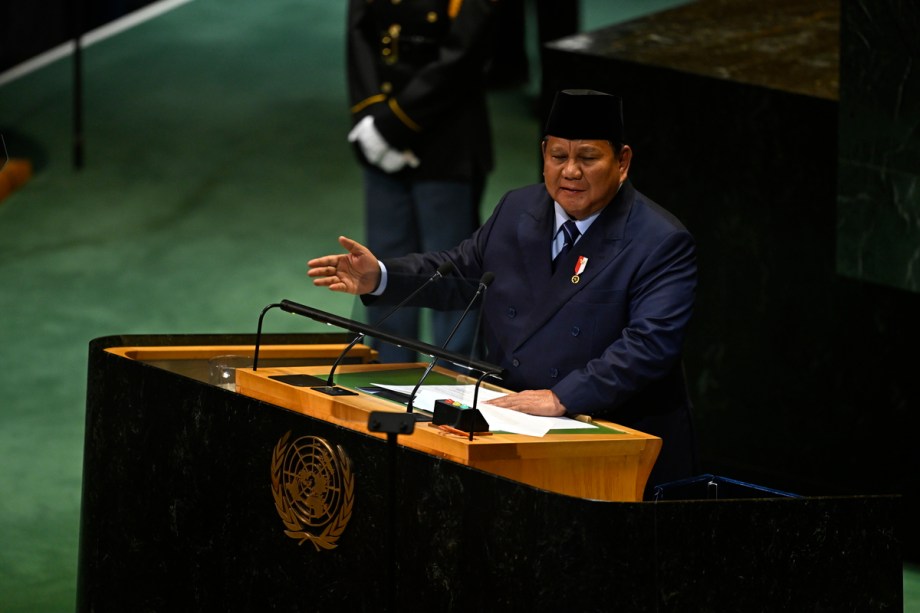
When Indonesia’s President Prabowo Subianto rose before world leaders at the United Nations yesterday, his voice carried the weight of history. He condemned the killing of civilians in Gaza, pledged humanitarian support, and reaffirmed Indonesia’s commitment to a two-state solution. The room rewarded him with applause.
Yet behind the dignified cadence of his speech, one could hear the echo of an old refrain — one that has been repeated so often in these halls that it risks becoming ritual rather than remedy.
For decades, world leaders have invoked the “two-state solution” as the inevitable endgame to the Israel-Palestine conflict. It is the diplomatic mantra par excellence: reassuring, symmetrical, and endlessly recycled. But on the ground, the conditions for such a solution have all but evaporated. Expanding settlements, the siege of Gaza, the fragmentation of Palestinian life, and the entrenchment of occupation have rendered the vision of two sovereign states coexisting side by side not just remote, but arguably obsolete.
Prabowo’s insistence that “only a two-state solution can bring peace” thus rings less as a bold declaration than as an echo from the past. To be sure, Indonesia’s steadfastness on this point has symbolic value. It signals that the world’s largest Muslim-majority democracy will not abandon Palestine. But symbolism alone will not stop bombs from falling on Gaza, nor halt the creeping annexation of the West Bank.
Where Prabowo struck a different note was in his pledge to deploy peacekeepers under a U.N. mandate. His military background lent a measure of credibility to the promise, giving his rhetoric a practical edge. In a crisis defined by famine, displacement, and mass civilian casualties, such commitments carry weight. Yet they are, by nature, stopgaps. Humanitarian convoys cannot substitute for political settlements, and blue helmets cannot remedy structural injustice. At best, these measures ease immediate suffering while leaving the roots of the conflict unresolved.
The same tension emerges in Prabowo’s praise for Western governments that have recently recognized the State of Palestine. France, Canada, Australia, Britain, and Portugal were singled out for applause. On the surface, this recognition is a diplomatic gain: it bolsters Palestine’s legal standing, expands its international legitimacy, and places pressure on Israel to acknowledge its counterpart.
But recognition without accountability risks becoming another empty gesture. Palestinians know well that declarations on paper do not dismantle checkpoints, unblockaded borders, or resurrect lives lost in Gaza. The risk is that Western capitals use recognition as a shield — a way to appease domestic outrage without altering the policies that sustain Israeli impunity. It is easier to proclaim “we recognize Palestine” than to sanction arms sales to Israel, review trade agreements, or back Palestinian cases at the International Criminal Court.
Here Prabowo’s speech fell short. He condemned civilian suffering but stopped short of naming Israel’s responsibility for what international jurists now openly call genocide. He applauded symbolic recognition but offered no demand for accountability mechanisms. Without justice, recognition is little more than diplomatic window dressing.
Yet it would be unfair to dismiss his intervention outright. Indonesia’s role in the “core group” promoting Palestinian recognition at the UN is not trivial. Each recognition, however symbolic, adds to Palestine’s international leverage. It helps shift the narrative away from a conflict between “two parties” and toward one between an occupied people and an occupying power. Over time, this accumulation of symbolic capital could become a tool for Palestinians to press claims in global forums.
The problem is not recognition itself, but recognition divorced from consequences. The true test lies in whether it is coupled with sanctions on settlement products, restrictions on arms transfers, or support for legal cases against Israeli officials. Prabowo’s speech did not bridge this gap.
To his credit, the Indonesian leader underscored the moral urgency of the moment. He reminded his audience that the credibility of the UN itself hangs in the balance. If the international system cannot stop a genocide that unfolds under its watch, its promise of “never again” rings hollow. That framing matters, it places Palestine not only as a regional issue but as a test of the global order’s integrity.
READ: Spain approves full arms embargo on Israel, warns Netanyahu over Gaza killings
But ultimately, the applause that greeted Prabowo’s speech may say less about its substance than about the world’s hunger for familiar words in the face of unbearable images. To speak of “two states” is to reassure, to send aid is to demonstrate compassion, to recognize Palestine is to strike a pose of justice. Yet none of these measures alone will alter the daily realities of dispossession, siege, and occupation.
What Palestinians demand — and what justice requires — is accountability. Recognition should come with sanctions on ongoing violations. Humanitarian aid must be paired with sustained political pressure. And the only sustainable horizon is a single state, where Palestinians and Jews live as equals under one law, with guaranteed rights, security, and sovereignty. Anything less risks prolonging the cycle of partition, dispossession, and broken promises.
President Prabowo has reminded the world that Indonesia stands with Palestine. For that, he deserves credit. But solidarity measured only in speeches and recognitions risks becoming a ritual of comfort for the powerful rather than a lever of change for the oppressed.
If Prabowo wishes his words at the UN to mark more than a diplomatic footnote, Indonesia must push the conversation beyond recognition and symbolism — toward accountability, justice, and the dismantling of impunity. Anything less leaves Palestine trapped in the same cycle: applauded in the halls of diplomacy, abandoned in the rubble of Gaza.
READ: Universitas Indonesia takes steps toward stronger solidarity with Palestine
The views expressed in this article belong to the author and do not necessarily reflect the editorial policy of Middle East Monitor.