

Yesterday, I reported on the Houston government’s introduction of omnibus legislation dubbed The Protecting Nova Scotians Act:
The act is a broad omnibus bill that creates one new piece of legislation and amends seven existing pieces of legislation. Introducing such omnibus bills limits the ability of opposition parties to debate every particular of the proposed legislation.
…
One piece of the Protecting Nova Scotians Act, however, is aimed not at correcting a past mistake but instead at peaceful forest protestors.
Last year, a group of activists occupied forest land in Cumberland County to prevent the aerial spraying of the herbicide glyphosate. And this month, a group of Mi’kmaw people are blockading roads near Tqamuoweye’katik (Hunter’s Mountain) in Cape Breton to prevent clearcutting.
In response, through the Protecting Nova Scotians Act, the Houston government is introducing changes to the Crown Lands Act that strengthen existing language that prohibits a “barricade” of a forest access road to make it illegal to “block, obstruct the uses of or impeded access” to forest access roads.
As well, current legislation requires 60 days notice to remove structures built on Crown land. This seems to have been mostly related to fishing and hunting camps, a long-standing Nova Scotia tradition, that may have blocked public access to a lake, for instance. But the changes do away with the notification completely, a change that is clearly and admittedly made to address the camps built by forest protestors.
Once proclaimed, the new legislation will allow the minister to “without notice, remove, demolish or otherwise dispose of a structure, together with the contents contained therein” if the structure “is being used in any way to facilitate the obstruction or impediment of the lawful use of Crown lands by any person.”
Anyone in violation of the new legislation can be subject to a fine up to $50,000 or six months in jail, or both.
Click or tap here to read “Houston government introduces “Protecting Nova Scotians Act” to crack down on forest protestors.”
I wasn’t able to attend reporters’ interactions with Premier Tim Houston later in the day, but Yvette d’Entremont attended virtually and took notes.
Both Houston and Natural Resources Minister Tory Rushton insisted that the provisions of the act aimed at forest protestors were not asked for by the timber companies or Port Hawkesbury Paper (which is attempting to log Hunter’s Mountain).
In response to questions, Houston said:
Yeah, like every single day in this province, we have conservation officers that are out there, working in rural areas and areas of the province. And we’re listening to them on ideas that they have that might help them fulfill their responsibilities. So it’s just something that filtered up to it and seemed to make sense so we’re gonna put it in.
…
…like the only people that need to worry about this are people that are doing or are planning on doing illegal activity. So if somebody has a structure on a Crown land that they’re not meant to, then we should be able to get that off there. We should be able to fine people to appropriate levels and seek some recovery of that. So it’s just that, these are just ongoing parts of governing.
With respect to the Hunter’s Mountain protests, the Houston government is butting right up against treaty obligations for consultation with Indigenous people. I doubt the protestors are just going to go away because of legally dubious legislation.
More broadly, the government is attempting to stifle protest. As NDP Leader Claudia Chender put it:
This is what happens when you don’t engage Nova Scotians in conversation and when you try to divide and distract. This is a government who won’t publish the glyphosate spraying schedule anymore. [I reported on that here]. Again, the given reason is so that protesters won’t know where that spray is happening. Who won’t engage communities on environmental matters, who won’t proclaim environmental legislation that is passed by all parties of this house. And so it comes to a boiling point where people’s only opportunity is to protest. And now they’re taking that away too. I think people should be concerned about that.
Broader still, the omnibus bill is crammed with so many disparate pieces of legislation that it curtails the democratic process, which is why I’ve included today’s Morning File in the Examiner’s “Dismantling Democracy” series.
Again, Chender:
There isn’t a role for an omnibus bill of this nature in a responsible government. Period. Nova Scotians have seen reduced access to the legislature, reduced information, reduced ability to make their voices heard and to protest, and this further undercuts the democratic process.
We have essentially, I lost count, seven or eight bills in one. They’ll go through in one time period. There will be one opportunity for public notice, not for public amendment. And we are already into late hours tomorrow night, which means second reading will be at suppertime instead of during the day when members and their constituents have had an opportunity to understand and share information and react to the bill.
This is sloppy legislating done in haste in order to keep the public in the dark.
The omnibus bill is part of a larger authoritarian impulse by Houston, ranging from his attempt to limit the ability of the auditor general to operate freely to taking transportation power away from the municipalities to failing to meet with reporters for nearly two months and much more.
With files from Yvette d’Entremont.
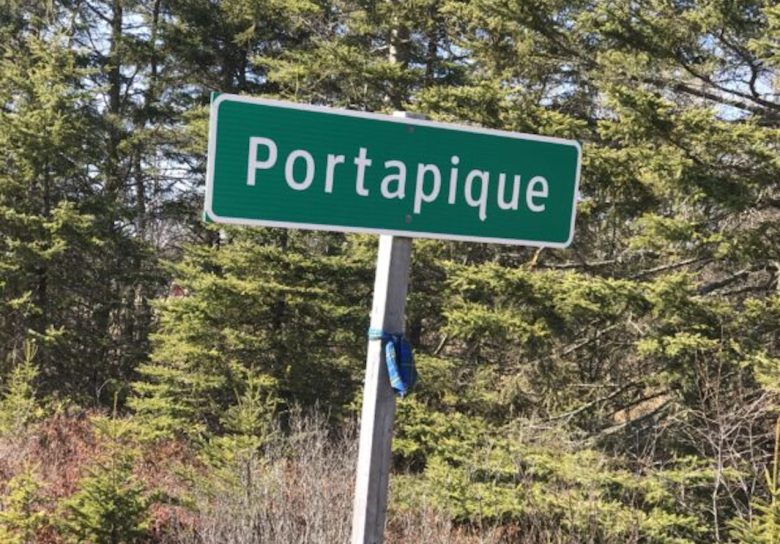 The Portapique sign on Highway 2 was adorned with a NS tartan sash following the mass shooting that began there on April 18, 2020. Credit: Joan Baxter
I made another point in yesterday’s article. I noted that:
Just as “every airline regulation is written in blood” — rules are put in place after lessons are learned from past disasters — the Protecting Nova Scotians Act is in large part addressing problems identified after-the-fact.
And so new legislation prohibits companies from collecting customers’ SINs after such data was lost in the Nova Scotia Power hack; regulations around bouncers are strengthened after a person died at the hands of a bouncer; funeral regulations are changing due to some very unfortunate mishaps that led to the mistaken cremation of a couple of deceased people.
I don’t fault the government for this kind of legislation. Sure, the horse is already out of the barn, but we must learn from past mistakes, and adopt policy and regulations as lessons are learned. In this respect, at least these parts of the legislation are good governance, albeit there’s no reason why each part couldn’t be its own bill and debated separately.
I wish we collectively had the same wisdom when it comes to policing. Every few years there is some terrible disaster — Mayerthorpe, Moncton, Portapique — that result in inquiries that produce detailed reports about what went wrong and why, and take those lessons learned and make a long list of recommended changes that should be made to prevent similar or other disasters from happening in the future.
But after a lot of promises to take the recommendations seriously, they mostly are ignored. Consider the Mass Casualty Commission (MCC), which led the inquiry into the mass murders of April 18 and 19, 2020 in Nova Scotia.
To their credit, both the federal and provincial governments have responded favourably to the MCC’s recommendations to increase funding for certain services, especially for agencies working on intimate partner violence and for rural mental health. But spending money is easy.
The most substantive change recommended by the MCC is its call to change how policing works in Canada. First, the RCMP should close the Depot training facility in Regina and instead create a three-year university program for all new recruits. Second, there should be a revamp of RCMP contracts with local governments, such that local communities have more control over policing.
These recommendations require a break with RCMP tradition and culture, and a radical reconstruction and perhaps dismantling of the RCMP. This is much harder than simply spending money.
Both recommendations have been rejected. The RCMP has made it quite clear that it has no intention of closing the Depot, and no federal politician has pushed the issue. And in Nova Scotia, rather than limit the powers of the RCMP over community policing, the Houston government is increasing the presence of the RCMP, further entrenching it in communities that can’t control it.
As a result, lessons will not be learned. The changes will not be made. There will be more disasters. And more people will die.
 A Sikorsky S-76 operated by the Galician Coast Guard. Credit: Sikorsky S-76
There were two other lessons not learned from Portapique.
One thing that has become clear in recent years is that mass murderers study each other. They read about previous mass murdering incidents on the internet and think about how they can “improve” on previous tactics.
It seems likely (to me, anyway) that the Nova Scotia murderer was aware of the Norwegian killer who disguised himself as a police officer in order to elude capture after his bomb attack and to gain access to the island where he shot and killed many, many children.
Unfortunately, the lesson that killers sometimes disguise themselves as police officers was not learned in Minnesota, where a man disguised as a police officer shot and killed a state legislator and her spouse, and shot and seriously wounded another legislator and his spouse. During the killing spree, an actual policer officer saw the killer but assumed he too was police; as a result, more people were shot.
There is, I fear, a second potential lesson from Portapique that was not even picked up by the MCC.
The Nova Scotia killer obtained much of his look-alike police car and various other assorted items through government surplus sales. The government has responded reasonably by limiting the police equipment that is sold as surplus, and with other regulations surrounding police paraphernalia. (But you can still buy a surplus RCMP horse).
Included on the list of surplus items that the killer bid on, however, is one item that is not covered by the recent regulations: a helicopter.
In particular, on Jan. 20, 2015, the future killer bid $235,000 for a 1979 Sikorsky S76A helicopter. The helicopter, I believe, had been used by Natural Resources Canada to inspect mines and forestry operations.
Thankfully, the killer was outbid. But this has stayed in my mind ever since: imagine if in April 2020 he had used a helicopter and not a fake police car. How much more damage might he had done? What if instead of using a hotel room, the Las Vegas killer had a helicopter full of automatic weapons flying over the concert?
I don’t have deep knowledge of how the sale of air craft is regulated. I assume any company that designates itself as involved in mining or offshore supply or tourism or such can buy one, and with dedication, any determined person can learn to fly one, either legitimately licensed or not.
And I don’t see that any policing organization is preparing for an airborne murderer.
They should prepare for it.
(To send or post this item, copy the website address at the top of this page.)
NOTICED
1. Still more allegations of child sexual abuse

Last week, the RCMP charged Donald Douglas Williams with 66 offences related to the alleged sexual abuse of boys at the Nova Scotia Youth Centre in Waterville between 1980 and 2015. Williams was a swimming instructor at the facility.
The news did not surprise me; I’ve read dozens of civil lawsuits claiming sexual abuse by a Waterville swim instructor. I’m confident that many of the litigants were additionally interviewed as part of the police investigation.
Is it really possible that a man sexually abused dozens and dozens of children over a 27-year period and no adult suspected a thing? No, it is not.
I’ll repeat what I wrote last week:
In all the cases that I’ve followed, the perpetrator was known by other adults to be criminally sexually preying on children, but those adults did nothing, or at least not enough, to put an end to the abuse.
…
The full story of child sexual abuse is not just a story of individual monsters and their victims. Rather, it’s a story of the cowardice of normal adults who refuse to stand up for children, and a society that refuses to acknowledge that basic truth.
I wrote that last week as I was reporting on a lawsuit from C.S., a man now living in western Canada, who is suing Scouts Canada for what he claims was sexual abuse experienced at a scouting event in 1979 near Halifax.
There is now another lawsuit against Scouts Canada for alleged sexual abuse by a man I’ll designate as D.T., who also lives in western Canada. Besides Scouts Canada, D.T.’s lawsuit additionally names the Attorney General of Nova Scotia.
D.T. was a resident of the Nova Scotia School for Boys in Shelburne from 1962-65. He says that he was abused by Patrick MacDougall. MacDougall was convicted of 11 charges of sexual misconduct involving 10 complainants and, notes the 2002 Kauffman Report:
MacDougall’s case had also attracted notoriety based on the evidence at his trial that, even after the allegations against him had surfaced, his transfer had been arranged by Government officials to the Sydney Children’s Training Centre to work as a night watchman.
Once again, other adults knew about the abuse but were too cowardly to confront it directly.
MacDougall, says D.T., was a boy scout leader for a troop that “originated” out of the School for Boys.
Like, C.S., D.T. is represented by Liam O’Reilly of Wagners Law Firm. The allegations contained in the lawsuit have not been tested in court, and neither Scouts Canada nor the Attorney General have filed a response with the court.
And, I say with exasperation, there was yet another lawsuit filed this week alleging the sexual abuse of a boy that occurred in the year 2000 at a school in northern Nova Scotia. The lawsuit claims that the abuser was a school janitor and school bus driver, and names him. But I can give no further details at this time as doing so could possibly identify the alleged victim. I’ll see if I can better report on it in the future. This case is being handled by lawyer Mike Dull.
(Send this item: right click and copy this link)
2. As we know, ships sometimes collide with each other
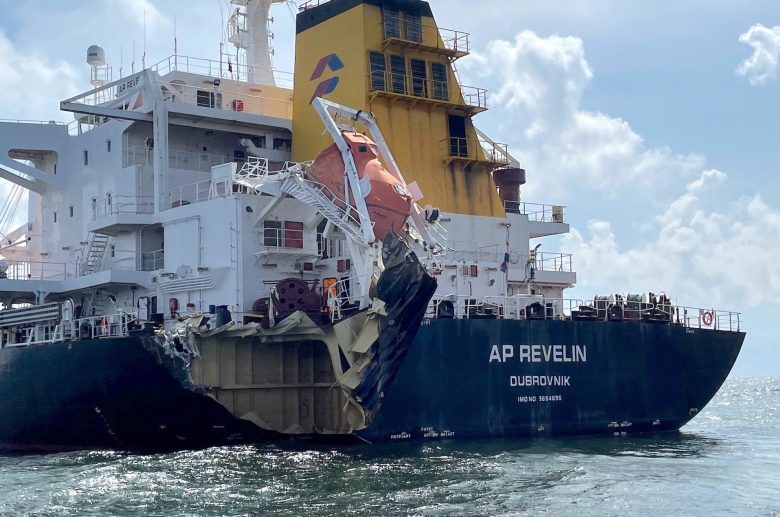 The AP Revlin as seen after it collided with another ship off Texas. Credit: U.S. Coast Guard
Today at around noon, a “dead ship,” the Croatia-flagged bulk carrier AP Revelin, will be towed into Halifax Harbour by the tug Ezra Sol. The AP Revelin has no propeller.
I don’t know the cause of AP Revelin’s current misfortune, but back in 2022, it was involved in a collision with the Netherlands-flagged cement carrier Damgracht in the Sabine Pass, a shipping channel that leads from Port Arthur, Texas to the Gulf of Mexico.
The National Transportation Safety Board issued the following report about the collision:
The incident
On August 21, 2022, about 1045 local time, the cargo ship Damgracht was inbound in the Sabine Pass Outer Bar Channel en route to Beaumont, Texas, and the cargo ship AP Revelin was outbound when the two vessels collided near Port Arthur, Texas. There were no injuries to the Damgracht’s 16 crewmembers nor to the AP Revelin’s 19 crewmembers, and no pollution was reported. Damage to the AP Revelin was estimated at $3.4 million, and there were no reported damage costs for the Damgracht.
Analysis
With the abrupt loss of propulsion, while transiting at 15 knots, the Damgracht began veering to port into the path of the outbound AP Revelin, which was about a half mile away and was transiting about 10 knots.
The pilot aboard the Damgracht immediately took steps to notify nearby vessels and maneuver the vessel—he broadcast the loss of propulsion over VHF radio, directed the captain to sound the “danger” signal, and ordered the rudder hard to starboard.
However, he was unable to alter the vessel’s heading, since his rudder commands were unable to counter the vessel’s veering to port due to the lack of propeller wash passing over the functioning rudder and the disabled bow thruster.
Without a means for the pilot to maneuver the vessel, the Damgracht continued to head across the channel and into the path of the AP Revelin. Upon hearing the VHF broadcast, the pilot aboard the AP Revelin immediately took action to avoid the approaching Damgracht.
However, because there was only a half mile between the two vessels, there was not enough time for the AP Revelin pilot’s evasive actions to be effective in avoiding a collision. About 2 minutes after the Damgracht’s engine failure, its bow struck the port quarter of the AP Revelin.
The previous afternoon, the Damgracht’s main engine had alarmed (due to low cooling water pressure and high cooling water temperature) and shut down, causing a loss of propulsion. The crew anchored the vessel, and that evening, the engine crew cooled down the main engine, disassembled the no. 6 cylinder head, and found a failed cylinder head gasket.
When the cylinder head gasket failed, high-temperature, high-pressure gas likely escaped from the combustion chamber into the crankcase and into the cooling water system, reducing the effectiveness of the cooling system and causing the engine to overheat.
The gasket failure also likely allowed products of combustion and cooling water to leak into the cylinder from the cylinder liner’s cooling water passages and contaminate the engine’s lube oil system.
After the repairs, the crew used the engine’s cooling water system to preheat the engine and put online the lube oil purifier (with its heating system). The crew tested the engine for about 30 minutes and again opened the crankcase for inspection. The engine went through several temperature changes throughout the evening and following morning due to operational conditions during maneuvering, as well as being cooled for maintenance, operated for testing, cooled down for inspection, and then heated the morning before departure. Temperature changes can cause water vapor to condense and change back into a liquid and form droplets, which can collect in the lube oil sump.
Due to the ambient air conditions the engine was exposed to during repairs and cooling water that had likely leaked into and contaminated the lube oil from the failed gasket, it is likely that higher levels of water entered the crankcase than could be removed overnight by the lube oil purifier or evaporate from the heat of the running engine in the short time it was tested post repair.
When the OMD indicated a high oil density alarm during the casualty transit the following morning, the chief engineer verified that there were no elevated bearing temperatures or high crankcase pressure, opened the OMD measuring chamber cover, wiped the sensing glass, reset the unit, and restarted the engine. Any abnormalities or impurities on the sensing glass may have been an indication of actual high oil density.
However, the chief engineer found none while wiping the sensing glass; the main engine operated without incident after he restarted it, and the vessel transited without issue to the anchorage. Additionally, after the collision, routine maintenance was performed on the OMD, including cleaning, filter changes, and air pressure verification, and about 25% of the lube oil in the main engine sump was replaced.
The OMD was successfully tested, and no issues were reported. (Routine maintenance on the OMD had been completed 4 days before the collision with no issues reported.)
Therefore, it is likely that the OMD had triggered a false alarm after sensing water vapor that had condensed in the sample. The water vapor was likely present from cooling water that had entered into the lube oil system after the gasket failed the day before and from the ambient air conditions (high humidity) during the maintenance completed the previous evening to repair the gasket.
Conclusions
The National Transportation Safety Board determines that the probable cause of the collision between the cargo vessel Damgracht and the cargo vessel AP Revelin was the Damgracht’s loss of propulsion caused by an automatic shutdown of the main engine due to a false alarm, likely triggered by water vapor sensed by the oil mist detector shortly after engine maintenance was completed to replace a failed cylinder head gasket during high-humidity conditions.
You can read the full report here. (The report was written before President Donald Trump ordered the renaming of the Gulf of Mexico).
The AP Revelin is owned by Atlantska Plovidba, a Croatian shipping company that operates 12 ships. Two months after the collision, the company issued a statement saying the AP Revelin was back in service after being repaired at a Mississippi shipyard. So the current problem may be something entirely unrelated to the 2022 collision.
The ship will be parked at Anchorage #12, which is in Bedford Basin just off Magazine Hill.
I guess its presence here can serve as a reminder that sea traffic isn’t always completely safe. It’s a lesson hard-earned in Halifax.
(Send this item: right click and copy this link)
THE LATEST FROM THE HALIFAX EXAMINER:
1. Halifax council votes to move ahead on bylaw amendments for Dartmouth Cove
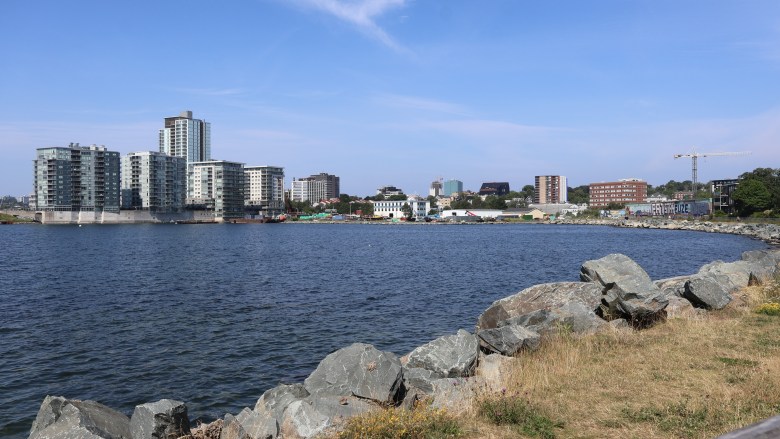 Dartmouth Cove with King’s Wharf in the background on July 28, 2025.
Suzanne Rent reports:
Halifax regional council has voted in favour of moving ahead on bylaw amendments for Dartmouth Cove, which means the public will have its chance to speak on the issue at a public hearing in October.
As we reported on Sept. 10, council deferred a vote on a staff report that recommended a delay in creating a bylaw to protect Dartmouth Cove from infilling. Staff recommended the delay until plans for the Dartmouth Waterfront Revitalization Plan were back at council. That plan won’t be back at council until sometime in 2026.
Instead, Coun. Sam Austin asked that staff return to council in two weeks with an alternative that would give Dartmouth Cove “the full Northwest Arm treatment.” Austin was referencing a November 2023 vote by council in favour of a bylaw restricting infilling in the Northwest Arm.
Click or tap here to read “Halifax council votes to move ahead on bylaw amendments for Dartmouth Cove.”
(Send this item: right click and copy this link)
2. Halifax council debate over Laura White’s parking motion shows urban, suburban divide
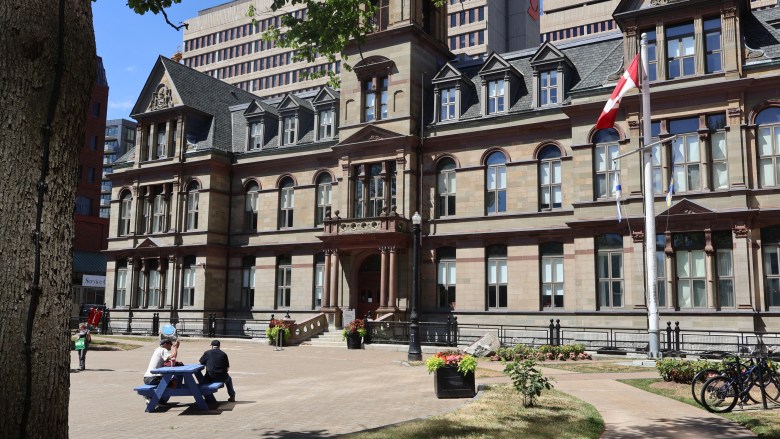 Halifax City Hall on Aug. 19, 2025. Credit: Suzanne Rent
Suzanne Rent reports:
Halifax regional council will consider parking benefit districts and dynamic parking but the debate over the concepts clearly showed an urban-suburban divide over parking in Halifax Regional Municipality (HRM).
At council’s meeting on Tuesday, Coun. Laura White introduced her motion to request a staff report on parking benefit districts and dynamic parking. White said both concepts have been implemented in other districts.
…Coun. Trish Purdy said it will be tough to convince a suburban councillor these would be good ideas. She said she already hears from her constituents who say they don’t drive to downtown Halifax because of the cost of parking.
So suburban residents don’t drive downtown because the cost of parking is too high, and now they’re going to not drive downtown even harder?
Honestly, I don’t understand why anyone drives downtown. Just park for free on the street in front of my house in Dartmouth and take the bus over for three bucks.
Click or tap here to read “Halifax council debate over Laura White’s parking motion shows urban, suburban divide.”
(Send this item: right click and copy this link)
Government
City
Wednesday
Board of Police Commissioners (Wednesday, 1pm, HEMDCC Meeting Space and online) — agenda
Heritage Advisory Committee (Wednesday, 3pm, online) — agenda
Public Information Meeting – MPSA 2024-00338 (Wednesday, 7pm, Brookside JH School) — details
Thursday
Transportation Standing Committee (Thursday, 12:30pm, City Hall and online) — agenda
Province
No meetings
On campus
Dalhousie
Wednesday
PhD Defence: Industrial Engineering (Wednesday, 9am, hybrid) — Dawne Skinner will defend “Optimizing Circular Supply Chains For Novel Food Production Processes – A Case Study Of Cellular Agriculture”
Advancing Health Equity: Disability-Inclusive Practices for Transformative Health Science (Wednesday, 11:30am, hybrid) — Birgit Prodinger will talk
Dal Demo Day (Wednesday, 12pm, Strug Concert Hall) — details
Thursday
Reclaiming Power + Place: The Final Report (Thursday, 12pm, Indigenous Student Centre and online) —group read; repeats weekly to April 30, 2026
The Future of Global Health: Grave Risk and Persistent Hope (Thursday, 7:15pm, Auditorium, Rowe Management Building and online) — Stephanie Nolen, Global Health Reporter with the New York Times; Zoom link here
NSCAD
Wednesday
No events
Thursday
Harvest Feast (Thursday, 4pm, Treaty Space Gallery) — details
Saint Mary’s
Pandemics, Plagues and Pestilence in Early Byzantine Thebes (Wednesday, 4pm, Atrium 101) — Maria Liston will talk
Literary Events
Wednesday
The Illogical Adventure (Wednesday, 7pm, Halifax Central Library) — King’s MFA Book Club discussion with James MacDuff and Mirriam Mweemba.
Thursday
Canada Alone: Navigating the Post-American World (Thursday, 6pm, Halifax Central Library) — author Kim Richard Nossal will talk
In the harbour
Halifax
03:30: STI Queens, oil tanker, arrives at Imperial Oil from Antwerp
05:00: Contship Cup, container ship, arrives at Fairview Cove from New York
08:00: Algoma Vision, bulker, arrives at Gold Bond from Belledune, New Brunswick
08:00: Seven Seas Splendor, cruise ship with up to 829 passengers, arrives at Pier 20 from Saint John, on an 11-day cruise from New York to Montréal
09:00: CMA CGM T. Jefferson, container ship, arrives at Pier 41 from Colombo, Sri Lanka
09:00: Liberty of the Seas, cruise ship with up to 4,414 passengers, arrives at Pier 22 from Saint John, on a nine-day roundtrip cruise out of New York
10:30: Oceanex Sanderling, ro-ro container, arrives at Autoport from St. John’s
11:00: CMA CGM Paranagua, container ship, arrives at Pier 42 from Montréal
12:00: AP Revelin, bulker, with Ezra Sol, tug, arrives at Bedford Basin anchorage from the Sabine Pass (see Noticed #2 above)
13:30: Contship Cup sails for sea
16:30: Seven Seas Splendor sails for Sydney
16:30: Oceanex Sanderling moves to Fairview Cove
17:30: James Cook, research/survey vessel, arrives at BIO from sea
17:30: CMA CGM Paranagua sails for sea
20:00: Liberty of the Seas sails for Sydney
03:00 (Thursday): CMA CGM T. Jefferson sails for New York
Cape Breton
05:30: Zuiderdam, cruise ship with up to 2,364 passengers, arrives at Government Wharf (Sydney) from Halifax, on a 14-day roundtrip cruise out of Boston
07:15: Majestic Princess, cruise ship with up to 4,272 passengers, arrives at Liberty Pier (Sydney) from Halifax, on a 10-day cruise from Boston to Québec City
07:30: Volendam, cruise ship with up to 1,718 passengers, arrives at Sydney anchorage from Halifax, on a seven-day cruise from Boston to Montréal
07:30: Crystal Serenity, cruise ship with up to 1,070 passengers, arrives at Sydney anchorage from Corner Brook, on a 23-day cruise from Liverpool, England to New York
14:30: Monte Serantes, oil tanker, sails from EverWind for sea
15:30: Zuiderdam sails for Charlottetown
15:30: Seliger, oil tanker, arrives at EverWind from Az Zawiyah, Libya
16:30: Volendam sails for Charlottetown
16:30: Crystal Serenity sails for Halifax
17:30: Majestic Princess sails for Charlottetown
Footnotes
Four cruise ships in Sydney today, with potentially over 9,000 passengers.