
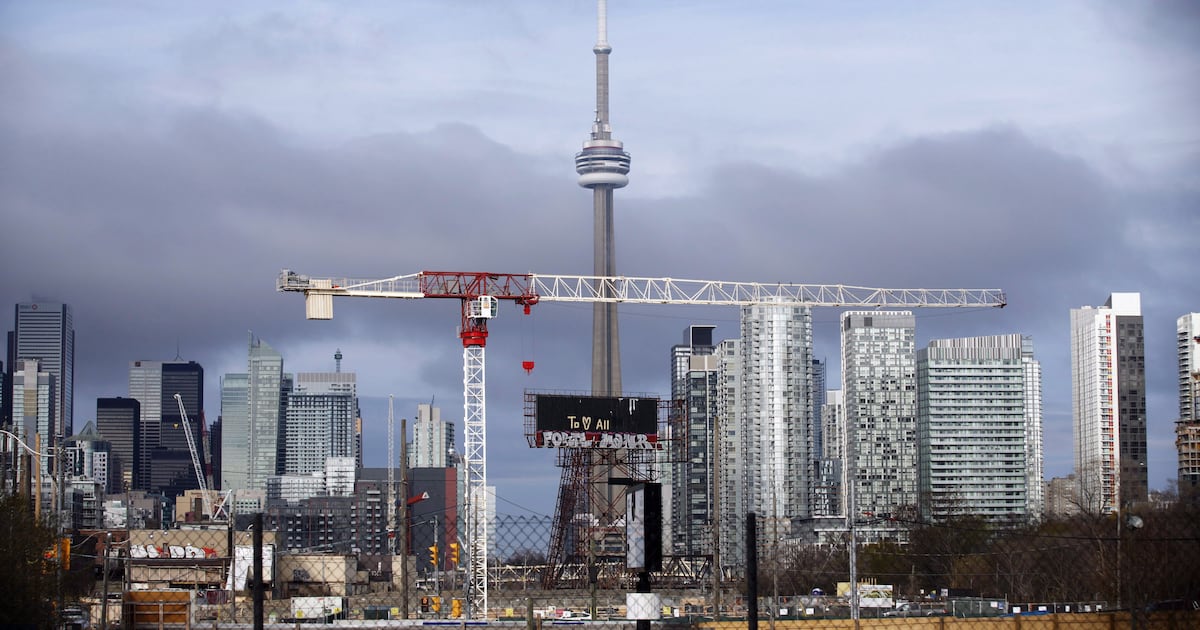
Toronto’s weakening condo market may feel similar to the crash of the 1990s, but a new report points to several factors suggesting history may not repeat itself.
The Canada Mortgage and Housing Corporation (CMHC) published a report on Wednesday, highlighting how condo sales are dwindling, inventories are rising, and a growing number of investors are experiencing financial distress due to the falling costs of condominiums.
The CMHC says there are numerous key differences from what’s happening with the condo market in the present than it did over 30 years ago, pointing to the current economy, stricter lending rules and an underlying shortage of homes as factors.
Toronto’s economy rebounded after the pandemic, primarily in the finance, healthcare and technology sectors, CMHC says, much like how the economy did in the late 1980s following a recession.
“In both periods, economic expansion and tight labour markets contributed to rapid, immigration-led population growth in the Toronto CMA,” the report reads.
In 1989, Toronto’s population was growing by 3.3 per cent, a pace that wasn’t surpassed until 2023. Then, in 2024, a record 268,911 people moved to the Toronto area, reflecting a 3.9 per cent increase to the population, according to Statistics Canada.
In both the late ‘80s and now, strong population growth led to higher demand, and right as inflationary pressures started to reach a boiling point.
Between 2020 and 2021, the CMHC says the annual growth for real home prices averaged at 13 per cent, while prices doubled in four years by 1989.
“Rapid price growth bolstered investor enthusiasm for the condominium market, especially in the late 1980s. To tame inflation, the Bank of Canada (BoC) began raising interest rates,” the report reads.
By rising interest rates, CMHC says it weakened the market and investors struggled to sell condos at a profit. Simultaneously, condo sales dropped, and the number of unsold units rose.
While interest rate hikes slowed Toronto’s economy, the CMHC notes that it did not push the city into a recession—though it does forecast a mild one on the horizon with a modest impact on the local housing market.
In the early 1990s, however, there was a “severe” two-year-long recession triggered by BoC’s interest rate hikes, the report reads, leading to constrained fiscal spending and “the steepest employment drop since the Great Depression.” After the recession eased, CMHC says the city still faced stagnant job growth in private sectors.
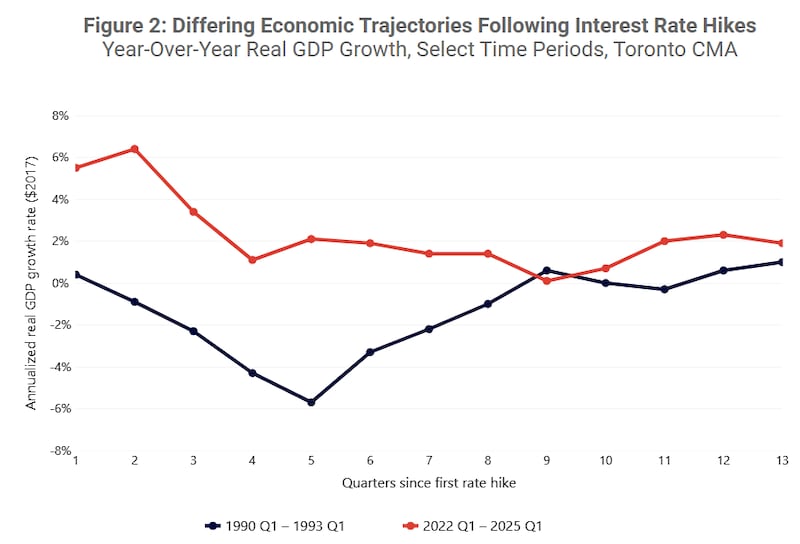 CMHC graph The varying economic trajectories following Bank of Canada’s interest rate hikes in 1990 and 2022. (CMHC)
Toronto’s current condo market benefits from a “more stable economic backdrop,” as well as having stricter lending standards enacted following what happened during the 1990s and the 2008 sub-prime mortgage crisis in the U.S.
Nowadays, a condo developer has to sell at least 70 per cent of pre-construction units before they can obtain funding, a far higher minimum requirement than the 1980s, where it was as low as 50 per cent. CMHC’s analysis reveal developers typically sell 80 per cent of units and in the most recent fiscal quarter, more than 90 per cent were sold.
The mortgage stress test is also easing the effects of a major downturn, as it maintains lower levels of mortgage delinquency.
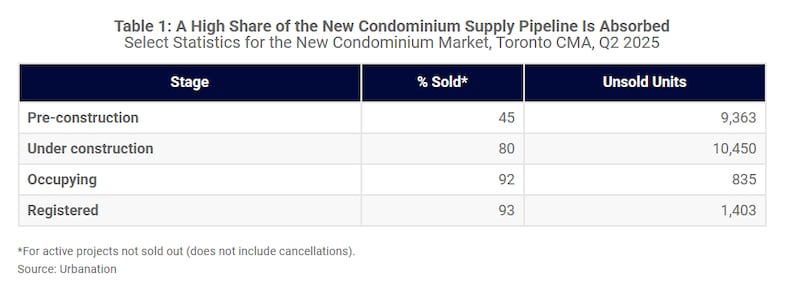 CMHC graph A table breaking dow the percentages of the number of condo units sold in Toronto. (CMHC)
The CMHC concludes Toronto’s present-day condo market is far different from what it was like in the ‘90s, adding it does not believe the city is being overrun with new builds as it was back then.
“The Toronto condominium market is no stranger to ups and downs. Periods of rapid price increases have been followed by declines, especially when interest rates fluctuate,” the repot reads.
In fact, the CMHC forecasts a more balanced market over the next few years as the recent decline in condo starts means there will be some units up for sale after 2026.