
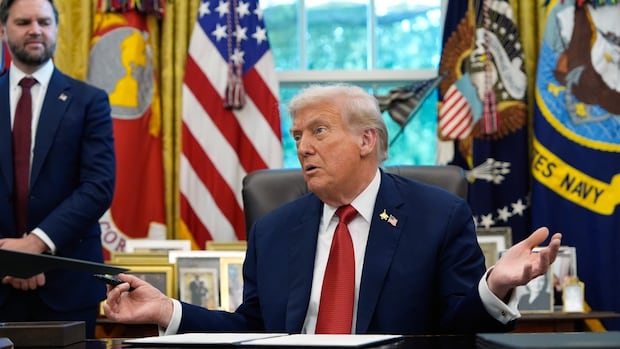
U.S. President Donald Trump said Thursday that he will put import taxes of 100 per cent on pharmaceutical drugs, 50 per cent on kitchen cabinets and bathroom vanities, 30 per cent on upholstered furniture and 25 per cent on heavy trucks starting on Wednesday.
The posts on his social media site showed that Trump’s devotion to tariffs did not end with the trade frameworks and import taxes that were launched in August, a reflection of the president’s confidence that taxes will help to reduce his government’s budget deficit while increasing domestic manufacturing.
But the additional tariffs risk intensifying inflation that is already elevated, as well as slowing economic growth, as employers getting used to Trump’s previous import taxes grapple with new levels of uncertainty.
Trump said on Truth Social that the pharmaceutical tariffs would not apply to companies that are building manufacturing plants in the United States, which he defined as either “breaking ground” or being under construction. It was unclear how the tariffs would apply to companies that already have factories in the U.S.
In 2024, America imported nearly $233 billion US in pharmaceutical and medicinal products, according to the Census Bureau. The prospect of prices doubling for some medicines could send shockwaves to voters as health-care expenses, as well as the costs of Medicare and Medicaid, potentially increase.
Trump said that foreign manufacturers of furniture and cabinetry were flooding the United States with their products and that tariffs must be applied “for National Security and other reasons.”
The new tariffs on cabinetry could further increase the costs for homebuilders when many people seeking to buy a house feel priced out by the mix of housing shortages and high mortgage rates.
Trump said that foreign-made heavy trucks and parts are hurting domestic producers.
Manufacturers such as “Peterbilt, Kenworth, Freightliner, Mack Trucks, and others, will be protected from the onslaught of outside interruptions,” he wrote.
Dismisses economic fears
Trump has long maintained that tariffs are the key to forcing companies to invest more in domestic factories. He has dismissed fears that importers would simply pass along much of the cost of the taxes to consumers and businesses in the form of higher prices.
He continues to claim that inflation is no longer a challenge for the U.S. economy, despite evidence to the contrary. The consumer price index has increased 2.9 per cent over the past 12 months, up from an annual pace of 2.3 per cent in April, when Trump first launched a sweeping set of import taxes.
Nor is there evidence that the tariffs are creating factory jobs or more construction of manufacturing facilities. Since April, the Bureau of Labor Statistics has reported that manufacturers cut 42,000 jobs and builders have downsized by 8,000.
“There’s no inflation,” Trump told reporters Thursday. “We’re having unbelievable success.”