
Of all the titles conferred on Anthony Albanese, statesman might be the one which comes least naturally.
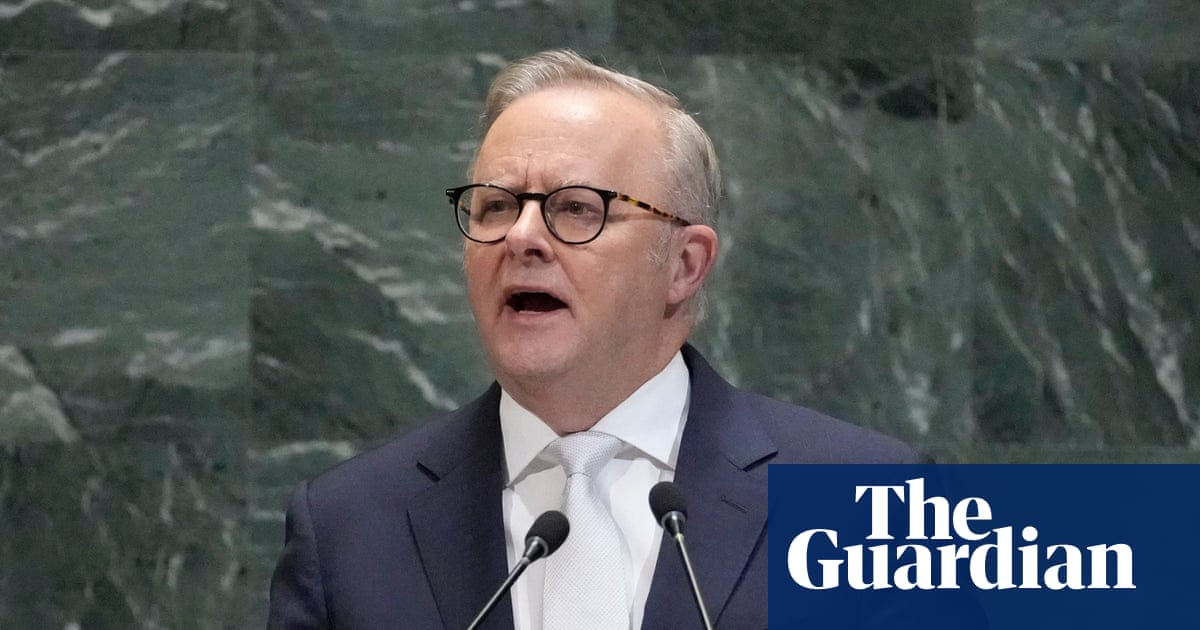
Nearly three decades a member of parliament, Labor leader since 2019, and three years and three months as prime minister, Albanese stepped cautiously back on to the global stage this week, addressing the UN general assembly for the first time.
With wars raging and Donald Trump upending whatever is left of the global order, the prime minister joined leaders recognising Palestine’s sovereign statehood, talked up Australia’s new 2035 climate targets and urged countries to follow on a social media ban for children under 16.
Sign up: AU Breaking News email
The 80th session of the general assembly brought together leaders from 140 countries, plus hordes of activists, protesters and journalists. The US president’s bellicose speech dominated headlines and rattled partners in the room, and across the globe, but it only served to highlight the growing divide with leaders like Albanese.
At a special climate meeting convened by the UN secretary general on Wednesday, the prime minister promised Australia would “do more than just guard against the very worst” and said no nation could go it alone.
Across town for a New York Times conference a few hours later, he appeared after Trump’s energy secretary, Chris Wright, and the California governor and presidential hopeful, Gavin Newsom, urging China to move faster to bring down its emissions, including through curbing development of new coal-fired power stations.
A glossy profile in the paper dubbed Australia “the country pushing through climate partisanship”. It fell to Albanese himself to acknowledge the anti-net zero debate currently roiling the Coalition, even as he detailed careful cooperation with the Pacific and outlined why he views the challenge as an economic opportunity for the world’s 14th largest economy.
But, compared with Trump – who called climate change “the greatest con job ever perpetrated on the world” – Australia is viewed as moving in the right direction, in part enabled by the government’s landmark parliamentary majority. “This is the decisive decade for acting on the environmental challenge of climate change,” Albanese told the stylishly produced event, “and seizing the economic opportunities of clean energy.”
This week he stressed the UN framework for dealing with the crisis was likely the only way through the challenge and warned of “a rise in nationalism and individualism” around the world, just as climate change risked more refugee movement and national security instability in the immediate period.
Selling Australia’s bid to host the Cop31 summit in Adelaide next year, a joint project with Pacific Island countries, one immediate challenge is Turkey’s rival claim for the conference.
To that end, the climate change and energy minister, Chris Bowen, was on Manhattan’s glitzy Upper East Side on Wednesday, appearing with Turkey’s first lady, Emine Erdoğan, considered a driving force behind the bid. Albanese’s request to meet the president, Recep Tayyip Erdoğan, has so far not borne fruit, pushing the outcome closer to the default option of Bonn in Germany.
It’s possible that in years ahead the domestic political debate will be shown not to have given enough credit to Albanese, Bowen and Labor figures for their work on climate internationally, even if they’re already being recognised overseas for making badly overdue process. Asked about Cop31, Bowen calls negotiations “a work in progress”.
After a well-attended event on the social media ban, Albanese and the European Commission president, Ursula von der Leyen, heaped praise on one another. Australia is negotiating a new defence and security agreement with the EU, as well as a badly delayed free trade deal, and the two leaders are in regular contact. “When it comes to the EU-Australia relationship, there is no distance between democracy,” von der Leyen said. “The same goes for good ideas.”
In his national address to the UN, Albanese revived Australia’s plans to seek a temporary seat on the security council in 2029-30. First announced by Julie Bishop in 2015, the foreign affairs minister, Penny Wong, has been quietly making the case for the past three years. Currently only two candidates are declared for two seats, Australia and Finland, meaning the bid might go uncontested.
Albanese heads to London on Friday, meeting with the UK prime minister, Keir Starmer, as well Mark Carney of Canada. A loose coalition of progressive moderate leaders, the group will meet to discuss how they can better cooperate, even as much of the west feels a distinct pull to the right. Concerns about immigration, housing costs and the state of the economy will test most countries.
Albanese, Starmer and Carney, who are set to hold talks with other European leaders at a thinktank conference before heading to 10 Downing Street, want the discussions to be about alternative power bases, and not antipathy or hostility to the US. Albanese will also meet Tony Blair and King Charles while in the UK.
Statesmanship might be harder than domestic politics or leading Labor but Albanese’s week at the UN general assembly has undoubtedly been a success. Next comes the challenge of making his foreign policy vision into a reality.
Tom McIlroy is chief political correspondent for Guardian Australia