
AP Photo/Heather Khalifa
Bottom Line Up Front
Rumors persist that a potential security agreement is nearing finalization between Israel and Syria, although details remain unclear.
Even as the details remain somewhat opaque, any potential agreement would be circumscribed, dealing with territory that Israel has seized and occupied since December and not extending to any broader territorial issues.
What happens in Syria will impact the balance of power in the ongoing conflict between Israel and Iran.
It is almost certain that the Islamic State in Syria will seek to capitalize upon any deal, painting al-Sharaa as an Israeli and American stooge and denigrating him in the group’s propaganda.
Rumors persist that a potential security agreement is nearing finalization between Israel and Syria, although details remain unclear. Still, Syrian President Ahmad al-Sharaa seems optimistic and has suggested that a deal could come soon. Israel’s Minister for Strategic Affairs, Ron Dermer, and Syria’s Foreign Minister, Asaad al-Shaibani, have been working with U.S. Envoy Tom Barrack to hash out a solution that aims to assuage Israel’s security concerns while preserving Syrian sovereignty. Since the collapse of the Assad regime in December 2024, Israel has launched hundreds of airstrikes on Syrian territory, which simultaneously undermine al-Sharaa’s authority while destabilizing the country at a critical time, as it seeks to rebuild the economy and get a handle on sectarian violence. Israel claims that its attacks are intended as counterterrorism measures and ostensibly to protect the Druze minority in al-Suwayda. But at other times, strikes have targeted the Syrian capital of Damascus, including close to al-Sharaa’s presidential palace.
Even as the details remain somewhat opaque, any potential agreement would be circumscribed, dealing with territory that Israel has seized and occupied since December and not extending to any broader territorial issues or negotiations related to normalization. The two countries have been officially at war since 1948. Israel seized the Golan Heights in the 1967 Six-Day War, although in 1974 an armistice agreement was reached which established a United Nations-patrolled buffer zone following the 1973 Yom Kippur War. But Israel has occupied towns and villages in southern Syria for the past ten months and seems unwilling to relinquish certain areas, particularly a military outpost constructed on Mount Hermon. Israeli Defense Minister Israel Katz posted on X, “We’re not moving from the Hermon,” accompanied by a photo of Israeli soldiers posing on the summit. This may prove to be a sticking point in the negotiations.
Al-Sharaa and his inner circle are likely wondering what value an agreement with Israel even holds, considering Israel’s recent strikes in Doha. After all, Qatar has been acting as a mediator in an effort to end the conflict in Gaza, yet it was not spared from the Israeli military acting with impunity throughout the region. Israel has launched repeated strikes in Lebanon, Iran, and elsewhere throughout the region since the Hamas terrorist attacks of October 7, 2023. The intelligence failure that preceded the Hamas attack is likely to reverberate for years to come and makes it highly unlikely that Israel will ever trust the intentions of al-Sharaa, a former leader of al-Qaeda in Syria, attempting to transition to a statesman. So far, al-Sharaa’s ability to handle himself on the world stage has been apparent, as he navigates meetings with politicians and heads of state from around the globe. However, some Syrians express concern about al-Sharaa’s eagerness to enter the geopolitical sphere and worry that he could go too far in offering concessions, especially considering Syria’s weak bargaining position as it endeavors to emerge from an economic crisis. They raise the question of whether these deals may ultimately compromise Syria’s sovereignty in the long term.
Given Iran’s influence in Syria during the tenure of Bashar al-Assad, where advisers from the Islamic Revolutionary Guard Corps helped advise Hezbollah militants fighting as ground forces alongside Syrian shock troops in the civil war, Tehran maintains a vested interest in keeping a toehold in the country. The Syrian authorities have made numerous arrests and weapons seizures linked to Hezbollah fighters operating in the country. What happens in Syria will impact the balance of power in the ongoing conflict between Israel and Iran. Accordingly, one of the outcomes Israel is reportedly seeking to negotiate as part of any potential deal is a series of demilitarized zones as well as a designated no-fly zone stretching from southwestern Damascus to the Israeli border. Israel aims to maintain a strategic aerial corridor to Iran. There are likely disagreements within the Israeli military’s senior ranks about which territories should be retained for strategic depth, and which can be forfeited as part of any negotiated deal.
There are still many open-ended questions, including what kind of force would patrol the demilitarized zones and whether the Israelis would actually cease launching attacks on Syrian soil. Yesterday at the United Nations General Assembly (UNGA), U.S. envoy Tom Barrack stated that any agreement would call for Israel to stop striking Syria. The United States is reportedly pushing hard for a deal behind the scenes. At the same time, Syria would not be able to position any heavy military equipment near the border. Al-Sharaa, as he has discussed this week at UNGA, is focused on rebuilding Syria after 13 years of brutal civil war and decades of autocratic rule by Bashar al-Assad and, before him, his father Hafez. There are definite risks for al-Sharaa, including how Syrians will respond to the contours of any deal, stirring political opposition, particularly among groups within Syria that are vocal about Israel still being an occupying force or adversary. It is almost certain that the Islamic State in Syria will seek to capitalize upon any deal, painting al-Sharaa as an Israeli and American stooge and denigrating him in the group’s propaganda. ISIS will, in turn, seek to recruit new members among hardliners with enduring socio-political and religious grievances.
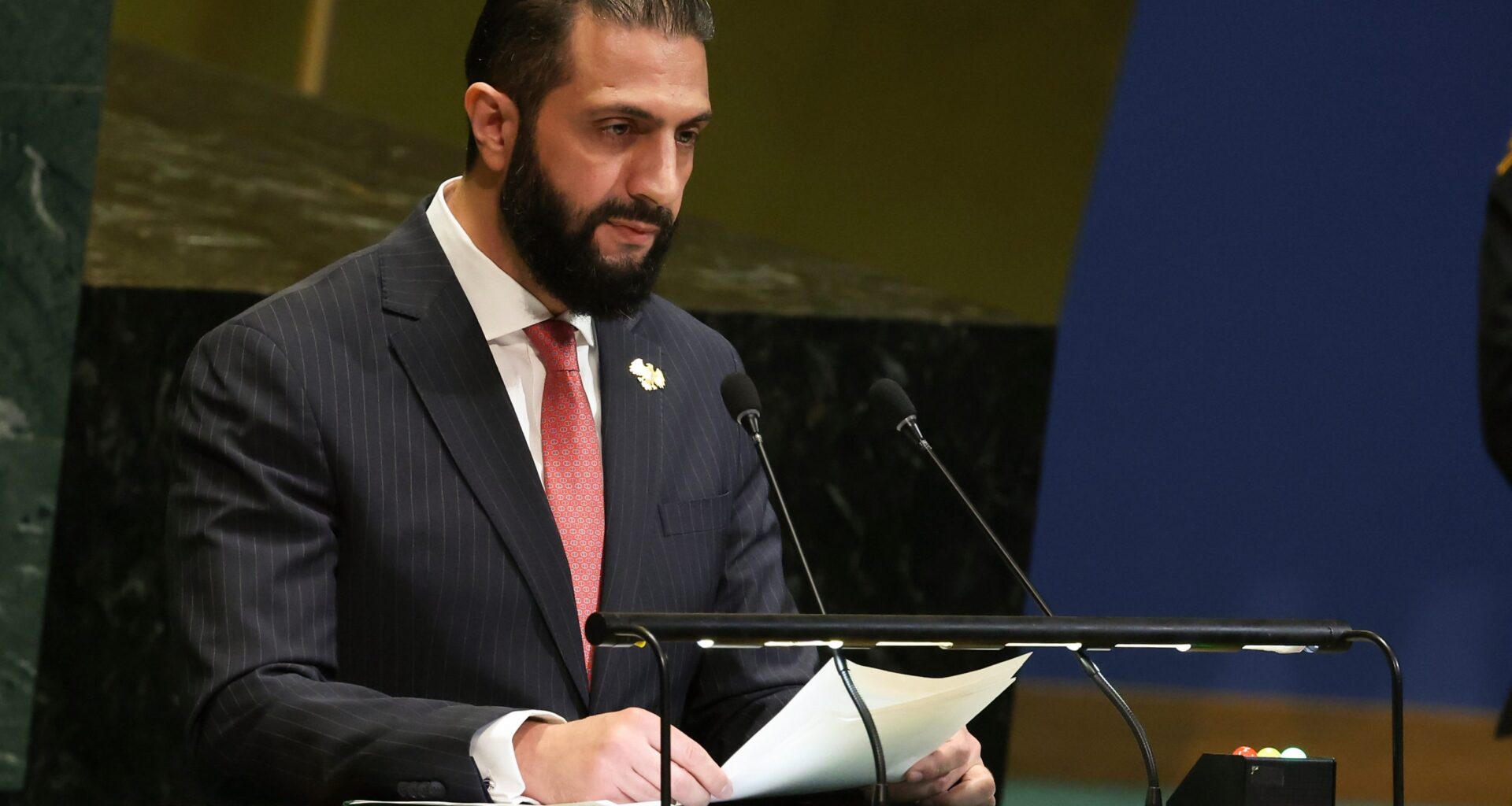
Al-Sharaa delivered a speech at UNGA representing Syria yesterday, focusing on his commitment to rebuilding the country. However, he did mention Israel and its strikes on Syrian territory in his brief remarks. He stated: “Israel’s policies contradict the international supporting position for Syria, which threatens new crises and struggles in our region,” Despite this, he claimed that “Syria is committed to dialogue and is committed to the disengagement of forces agreement of 1974.” Although the remarks offer little insight into the status of the security deal, his mention of a commitment to dialogue with Israel could suggest that something may be underway.