
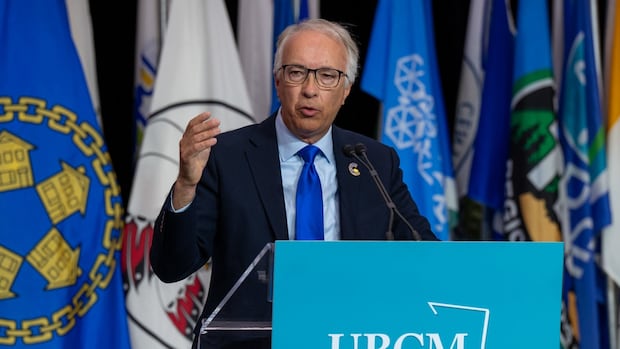
B.C. Conservative Leader John Rustad is making a new proposal for Metro Vancouver’s oft-criticized regional government: eliminate it entirely.
“I can tell you this morning that the Conservative government — we will actually get rid of Metro Vancouver,” Rustad said Thursday at the Union of B.C. Municipalities (UBCM) convention, during the annual opportunity for the Opposition leader to give a speech to the hundreds of mayors and councillors in attendance.
“[We’ll] turn it into what it’s supposed to be, which is a water, sewer and garbage utility,” he said. “We don’t need that extra bureaucracy and cost in our system.”
British Columbia has 27 regional districts that cover the entire province, which are responsible for governance in rural areas without incorporated municipalities, along with water, wastewater and sewage operations in bigger population centres.
Rustad said that if elected as premier, he would change the community charter to completely abolish Metro Vancouver while retaining every other regional district, and take provincial control of its functions via a new Crown corporation.
“We need a different model for metro, which is why we think it should be a utility, not an [elected] governance structure,” said Rustad, who said he had not estimated the cost savings of such a transition, but predicted it would be significant.
“It’s expanded into too many issues, and has caused too much grief and friction amongst the municipalities. It’s not needed.”
Metro Van a unique regional government
In recent years, Metro Vancouver has been criticized for the building of a wastewater treatment plant that is currently years behind and billions of dollars over budget, along with debates over remuneration and travel expenses for board members.
Its model is also unique in British Columbia: while most regional governments are overseen by fewer than 20 directors, many of which come from rural electoral areas, Metro Vancouver is overseen by more than 41 directors, all but two come from the region’s 21 municipalities.
As a result, many of the conversations around reforming Metro Vancouver have focused on its governance model, and a committee is currently studying recommendations from an external review.
Coquitlam Mayor Richard Stewart said he had faith the committee would produce results — and that Rustad’s proposal wasn’t plausible.
“It’s not running very well right now, and I’ve got enormous challenges with the way it runs, and the governance structure,” he said.
“It will be difficult, but it’s worth fixing, not blowing up.”
When asked whether a Crown corporation could provide better accountability, he rolled his eyes.
“Because Crown corporations are way better than public bodies for oversight, right?”
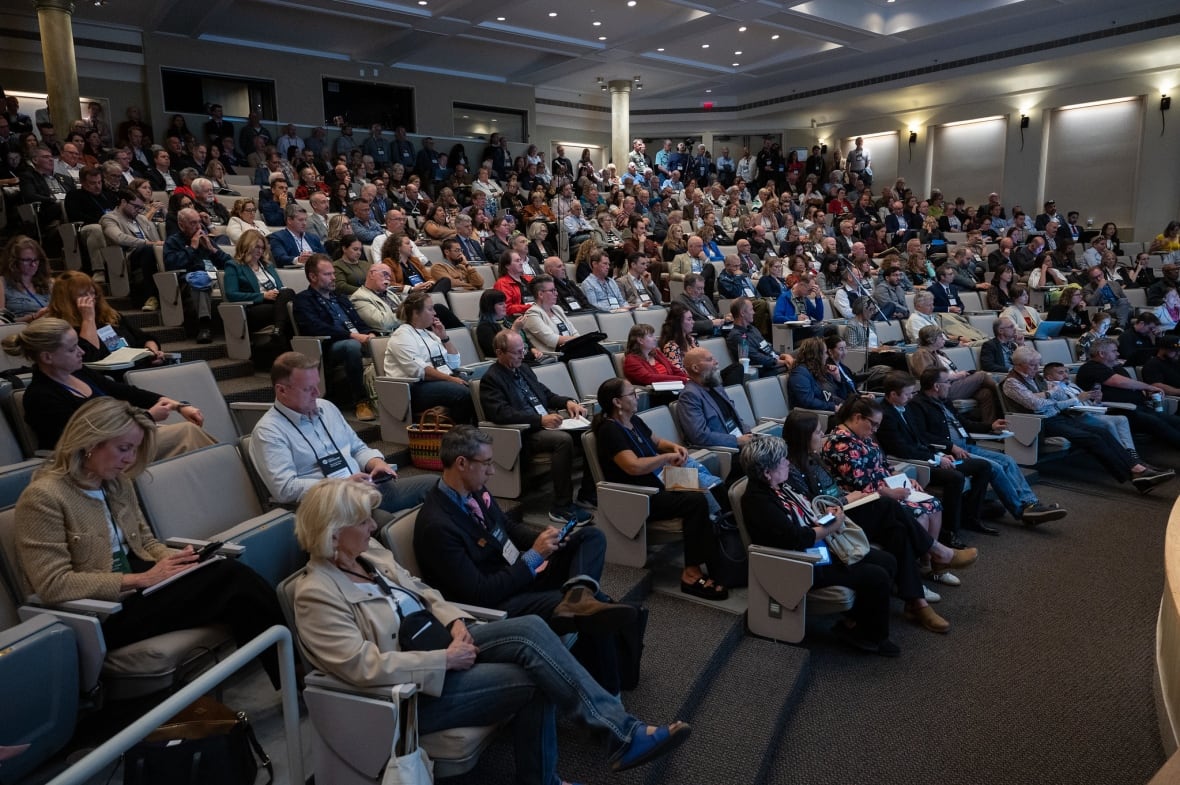 A session at UBCM about the recent Cowichan Tribes B.C. Supreme Court decision attracted hundreds of municipal politicians eager to figure out its ramifications. (Scott McAlpine/UBCM)UBCM focus on Cowichan Tribes ruling
Aside from Metro Vancouver, Rustad’s speech focused on the B.C. Supreme Court’s Cowichan Tribes ruling, which gave them Aboriginal title to 7.5 square kilometres of land in Richmond, ruling that previous land titles for private property were invalid.
“Do we protect private property rights in British Columbia?” he said. “There is negotiation that is needed, but you can’t have two codes.”
An overflow crowd of UBCM delegates packed a theatre for an information session about possible ramifications of the ruling, which is under appeal by all seven groups involved in the case, all appealing for different reasons.
On The Island8:14How will the landmark Cowichan Tribes court ruling affect BC towns and cities – we spoke with a lawyer
Gregor Craigie spoke Reese Harding, a lawyer, and partner at Young Anderson, with extensive experience advising local governments on UNDRIP and its implications for local governance.
“One of the most important things that came through was that it’s not cause for panic, it is time for thoughtful consideration,” said Richmond Coun. Alexa Loo.
“There was a lot of interest because there’s a lot of curiosity, because every municipality has some jurisdictional elements that will be impacted by this.”