
The truth is that a Palestinian state already exists under international law. Recognition is a political gesture that the vast majority of U.N. member states—157 of the 193 members—have already made. Politically, there is a process to implement a two-state solution under the recently endorsed New York Declaration. Italy participated in these efforts, co-chairing one of the working groups on security, alongside Indonesia, leading to its adoption.
Still, the U.S. position could block any Italian move. Rome is keen for recognition to have an impact, but is aware that Israel will not adjust its position without pressure from Washington. For Italy, this means recognizing Palestine will not have a serious impact.
Italy is also carefully watching Germany’s posturing. If Rome or Berlin change their position, it would be a massive break with these countries’ histories. On the other hand, Arab Gulf states—whose relations with Italy have grown under Meloni—have voiced their desire to see a more constructive Italian role in steering EU action.
In this regard, on July 15, the EU Foreign Affairs Council met to decide whether to revisit its ties with Israel, considering its actions in Gaza. The EU presented ministers with several options, ranging from full suspension of the Association Agreement to a suspension of preferential trade and research pillars, an arms embargo, sanctions on Israeli ministers, halting visa-free travel for Israeli citizens to the EU and ceasing trade with Israeli settlements. Frustratingly, due to only a few member states, the EU failed to take action. Two weeks later, the EU also failed to approve more symbolic components like suspending Israel from research funding under the Horizon Europe program.
With Von Der Leyen’s announcement, that discussion has been revamped. Italy should not blink. Amid EU and global shifts spanning the past few months, with France, the United Kingdom, Australia and Canada—among others—recognizing the state of Palestine, some question Italy’s lack of action. Even Germany announced a partial arms embargo, leaving Italy alone in the moment.
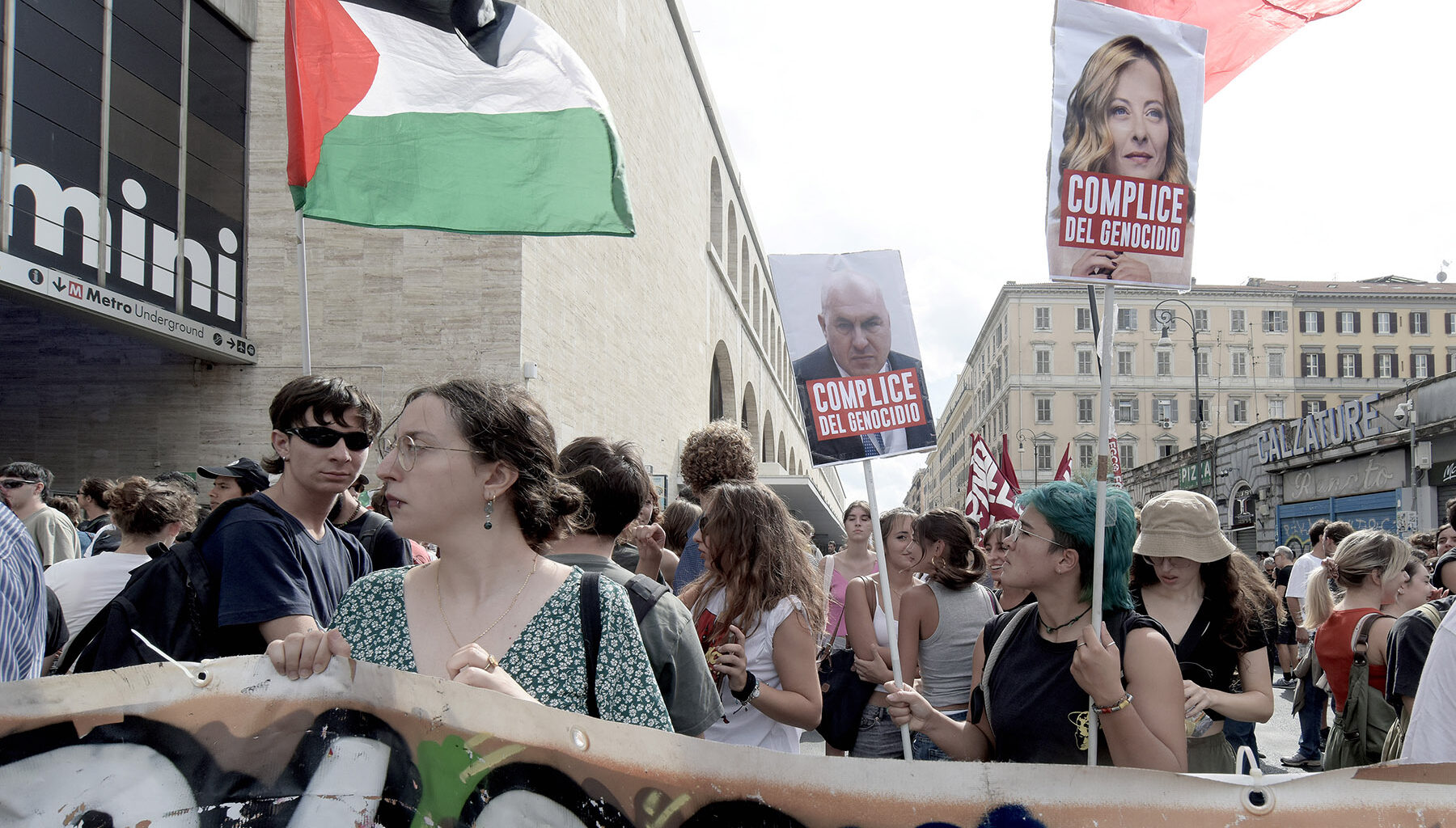
Rome may be receiving the message. At the UN General Assembly, Meloni said that “Israel has crossed the line,” labelling the ongoing mass atrocities as “unacceptable.” She unofficially acknowledged that Israel is committing genocide in Gaza, saying, “I work on the Palestinian genocide every day.” In August, Italian Defense Minister Guido Crosetto made some of the harshest comments against Israeli actions so far by a member of the Meloni government, condemning Israeli attacks on the humanitarian aid operation, Global Sumud Flotilla. Italian Foreign Minister Antonio Tajani has said Italy and Germany are carefully assessing the EU Commission’s proposals, expressing support for some measures, like sanctioning Israeli settlers.
But Italy can do more. It should immediately stop blocking EU action to suspend the trade clause of the EU-Israel Association Agreement. By continuing its block, Italy is shooting itself in the foot, harming its efforts to deepen ties with regional actors while risking its domestic security, as Rome itself has argued. Italy should also join other G7 countries in recognizing Palestine without conditions. This is an essential move if Italy is concerned about protecting not just a Palestinian state and its people, but Israelis, as it would further cement the internationally agreed-upon consensus on the two countries, boosting prospects for a ceasefire and subsequent political process.