
Unlock the Editor’s Digest for free
Roula Khalaf, Editor of the FT, selects her favourite stories in this weekly newsletter.
Ukrainian President Volodymyr Zelenskyy’s controversial move to take control of his country’s anti-corruption bodies poses a risk to European funding and Kyiv’s path to EU accession, top European officials have warned.
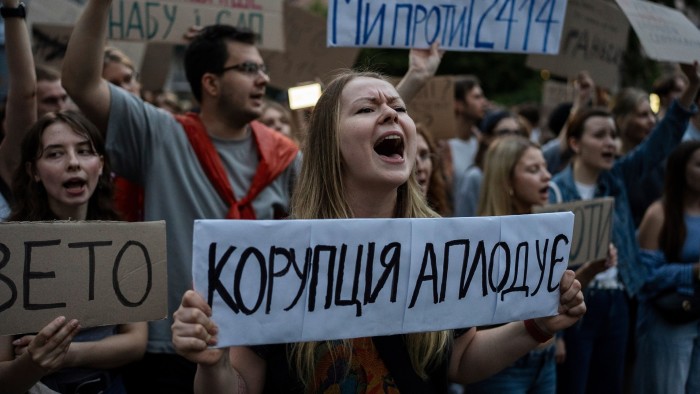
Zelenskyy on Tuesday signed a law that puts the prosecutor-general, who he appointed, in charge of two independent anti-graft organisations. The move, which the president said was aimed at rooting out Russian spies, has sparked condemnation from the EU and G7 members, and the biggest protests in Kyiv since the war with Russia began.
EU economy commissioner Valdis Dombrovskis, who oversees financial assistance to Ukraine, told the Financial Times the two bodies “are crucial to Ukraine’s reform agenda and they must operate independently to fight corruption and to maintain public trust”.
“Our current financial assistance to Ukraine is conditional on transparency, judicial reforms [and] democratic governments,” he said. “The same is true concerning Ukraine’s path towards EU accession that also will require strong capacity to combat corruption.”
Corruption and judicial independence have long been two of Brussels’ biggest concerns over Ukraine’s candidacy to join the bloc, which is the country’s biggest financial supporter. Its accession is currently frozen due to Hungary’s opposition.
French President Emmanuel Macron and European Council president António Costa, who represents the bloc’s 27 leaders, spoke with Zelenskyy this week to urge him to rethink the reform, people briefed on the discussions told the FT.
The G7 ambassadors in Kyiv issued a joint statement on Tuesday saying the group of advanced economies were “closely following” the issue, and that they have “serious concerns and intend to discuss these developments with government leaders”.
In a late-evening diplomatic blitz on Tuesday, first deputy prime minister for European integration Taras Kachka and other top Zelenskyy officials began calling and texting western diplomats to try to justify Kyiv’s position and assuage fears of a presidential power grab, according to officials briefed on the calls.
In a statement on X, he said he had “confirmed Ukraine’s commitment to the rule of law and anti-corruption” on a call with Marta Kos, EU commissioner for enlargement, and said the new legislation did “not intend to threaten the institutional independence” of the two bodies, the National Anti-Corruption Bureau (Nabu) and the Specialized Anti-Corruption Prosecutor’s Office (Sapo),
“There will be no compromise on anti-corruption — Ukraine takes this responsibility seriously,” he said.
On Wednesday, Zelenskyy said he had held a “frank and constructive” meeting with the heads of Ukraine’s law enforcement and anti-corruption agencies, telling them “we all share a common enemy: the Russian occupiers”.
“Defending the Ukrainian state requires a strong enough law enforcement and anti-corruption system — one that ensures a real sense of justice,” he said.
Ukraine was granted EU candidate status in 2022, but has struggled to advance on its path to membership due to opposition from Hungary, the EU’s most Russia-friendly member, which has repeatedly vetoed any progress in its formal accession.
Recommended

At a recent gathering of the EU’s 27 leaders, all but Hungary’s Viktor Orbán commended Kyiv’s for the “significant progress achieved” on accession-related reforms. They invited Ukraine to take “next steps” in the accession process, which will involve negotiations on “fundamental” EU values, including democratic checks and balances, financial controls and other anti-corruption requirements.
The goal was to advance progress despite the Hungarian veto, in the hope that once Budapest relented, Ukraine would be further along the path of EU integration.
But Kyiv’s recent move undermined that effort, EU officials said.
“It’s like herding cats in a pen. It doesn’t really help if 26 cats are already wary of moving forward” without Hungary, said one senior EU official, adding: “It’s not a good look.”
Video: ‘Film me!’: Russia’s executions of Ukrainian POWs point to a policy | FT Film