
Stay informed with free updates
Simply sign up to the Aerospace & Defence myFT Digest — delivered directly to your inbox.
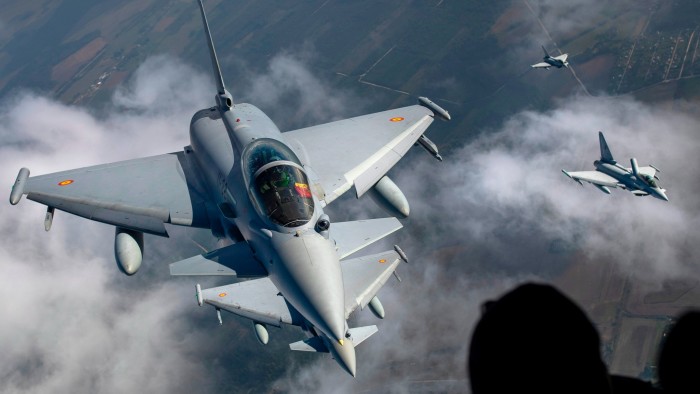
Britain and Turkey have signed a preliminary multibillion-pound deal for the sale of Typhoon jets to Ankara, after Germany dropped its opposition to the sale of the jointly produced aircraft to Recep Tayyip Erdoğan’s government.
UK officials confirmed that its “Eurofighter partner nations are supportive, including Germany”, clearing the way for a final deal with Turkey, which both sides said they wanted to conclude “as soon as possible”.
Britain and Turkey’s defence ministers on Wednesday signed a memorandum of understanding that brought them “one stop closer to a comprehensive agreement on the Typhoon”. Industry sources said Ankara could buy as many as 40 jets.
The previous German government, a three-way coalition that included the Greens, blocked the sale of Typhoons to Ankara after Turkey announced its interest in buying them in 2022, citing political and human rights concerns.
A Turkish court this month sentenced Erdoğan’s main political rival, Istanbul mayor Ekrem İmamoğlu, to a year and eight months in jail, pending appeal. As many as 13 other mayors and more than 200 officials from İmamoğlu’s opposition Republican People’s party are also under arrest, pending trial.
The Typhoon agreement followed talks between UK Prime Minister Sir Keir Starmer and German Chancellor Friedrich Merz in London last week, in which both sides agreed to pursue “joint export campaigns for jointly produced equipment”.
A German government spokesperson said he could neither confirm nor deny a report by Der Spiegel that the country’s security council — which meets in secret — had approved the sale.
The aircraft are jointly produced by the UK, Germany, Spain and Italy. Export deals are led by the country that has the closest ties to the purchasing nation but require approval from partners.
Turkish defence minister Yaşar Güler hailed the memorandum of understanding with the UK as a “positive step”, stressing the two countries’ “shared determination to finalise the necessary arrangements as soon as possible”.
The preliminary deal is a sign of growing defence co-operation between Turkey and its Nato allies in Europe as the region seeks to boost its defence industry after Russia’s invasion of Ukraine in 2022 and to reduce its reliance on the US.
Turkey traditionally operates US-made F-16s and its pilots have little to no experience flying Eurofighter Typhoons. As a result, adding the advanced model Tranche 4 Eurofighters will entail extra cost for the Turkish military.
However, Turkey’s air force is rapidly becoming outdated and the Nato member urgently needs a stop-gap solution until its own advanced fighter jet, the Kaan, is fully available from the mid-2030s.
The country is currently barred from buying fifth-generation F-35 jets by US sanctions imposed in 2020 after Ankara bought two Russian S-400 air defence systems, and an outstanding order for six F-35s has been withheld as a result.
Analysts said that, without a Eurofighter deal, Turkey’s military could be left at a disadvantage at a time of rising regional tensions between Israel and Iran, as well as recent Israeli air strikes on Damascus and southern Syria.
Greece, which has tense relations with Turkey, has advanced French Rafale jets and has ordered 20 F-35s with an option to buy 20 more.
Last year, Turkey scaled back plans to spend $23bn on 40 newer model F-16 fighter jets, as well as F-16 modernisation kits for its existing fleet, amid uncertainties about US approval.
Tom Barrack, the US ambassador to Ankara and a close friend of US President Donald Trump, has said he believes a solution to lifting the US sanctions, which would require an act of Congress, might be found as soon as the end of this year.