
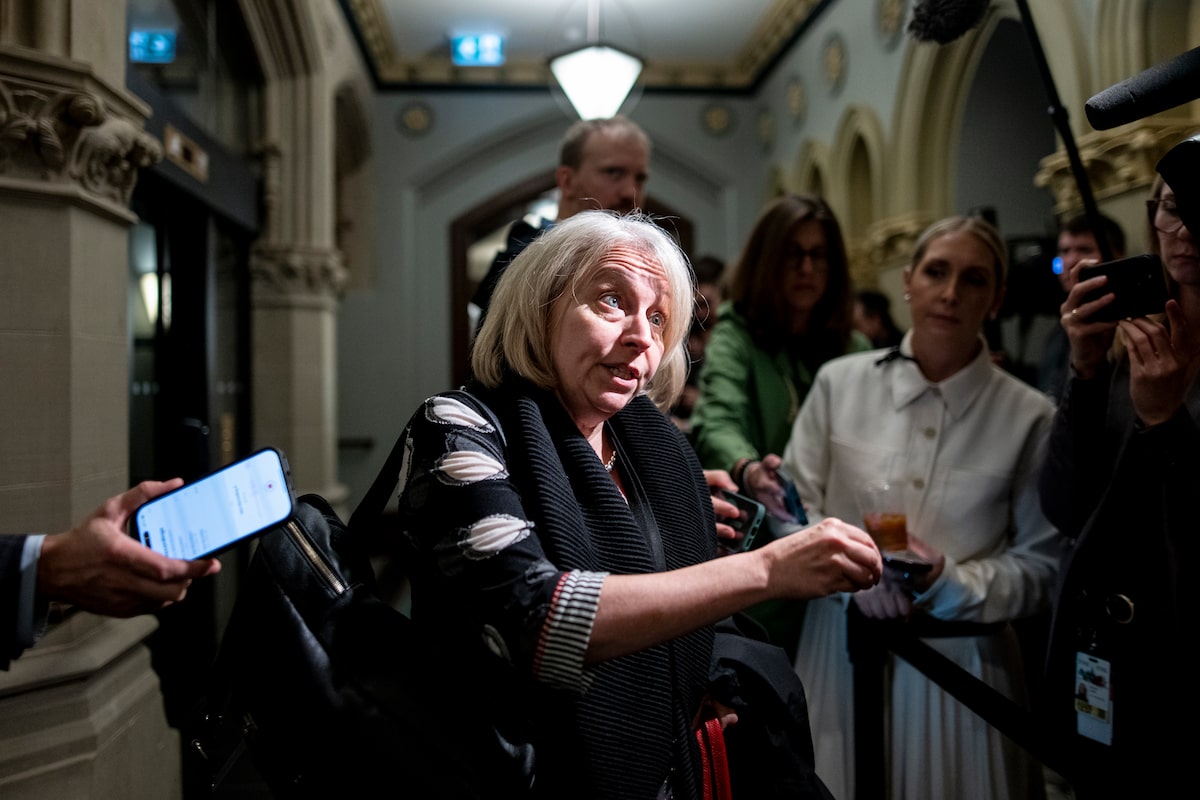
National security and intelligence adviser Nathalie Drouin on Parliament Hill in Ottawa on Thursday. She says India has committed to share information to assist Canadian police investigations.Spencer Colby/The Canadian Press
India has committed to co-operate and share information with Canadian police investigations, Prime Minister Mark Carney‘s national security and intelligence adviser said Thursday.
Nathalie Drouin, who met with counterparts in New Delhi last week, said that as a result of what she called “very productive meetings,” Canada and India have re-established some channels of communication to talk about their respective concerns.
This is part of a thawing between India and Canada after a significant diplomatic rupture in 2023 when then-prime minister Justin Trudeau publicly accused the Indian government of playing a role in the gangland-style slaying of Sikh activist Hardeep Singh Nijjar. He was shot dead by gunmen in Surrey, B.C., earlier that year.
Canada, India appoint new envoys in sign of improving relations
Hardeep Singh Nijjar, the B.C. plumber whose murder became the catalyst in a geopolitical crisis
Canada-India relations were further fractured in October, 2024, when the RCMP announced they had clear evidence that Indian government agents had been linked to homicides, extortions and other violent criminal activities in Canada. Ottawa followed up by expelling India’s high commissioner and five other diplomats.
It’s not clear, however, how the recent entente between Canada and India will alter New Delhi’s conduct in the investigation of Mr. Nijjar’s killing. The Indian government, which has denied any role in the slaying, has repeatedly said that it has been given no evidence to support Mr. Trudeau’s allegations.
Mr. Nijjar, a Canadian citizen, had been active in promoting the idea of turning what is now the northern Indian state of Punjab into Khalistan, a separate Sikh homeland. India sees Khalistani separatists as a threat to its sovereignty and security, and it has long been concerned about their activities.
The slaying, and another failed plot to kill a Sikh activist in New York, sparked serious concern among Canada and its allies about the possibility India was engaging in extrajudicial violence in Western countries.
When asked if India had committed to do more in co-operating with Canadian police in continuing investigations, Ms. Drouin said “absolutely.”
“I think it is in their interest and also in our interest to see better safety in our streets. And that message was clearly passed to India,” she said.
Ms. Drouin declined to discuss the Nijjar investigation.
Canadian authorities continue to investigate alleged transnational repression targeting Sikh activists domestically, with four Indian nationals now facing charges in the Nijjar case.
The Indian government wants Canada to remand accused criminals back to India more expeditiously. “They also talked about extraditions, as they want Canada to be faster in responding to their requests. So that was mainly the conversation,” Ms. Drouin said.
This co-operation is more evidence that the federal government under Mr. Carney is trying to turn the page on Canada-India relations and focus on building two-way trade.
“I think that we have found a way, as I said, to address mutual concerns and for leaders to be able to talk about trade relationship,” Ms. Drouin said.
In August, both countries appointed new diplomatic envoys to serve in each other’s capitals. Christopher Cooter has been posted to New Delhi as Canada’s high commissioner – the first since September, 2023.
India has long complained that Canada provides a haven for Khalistan advocates. Canada is home to about 770,000 who reported Sikhism as their religion in the most recent census, comprising 2.1 per cent of the population. A small but influential number of these Sikhs support the idea of Khalistan.
Ms. Drouin said India wants assurances from Canada that Ottawa supports a single Indian state.
“I think that we have a common understanding and a common goal here. They want us to be very clear in terms of the one India and the respect of the integrity of their territory, and what we want is safer streets in Canada.”