
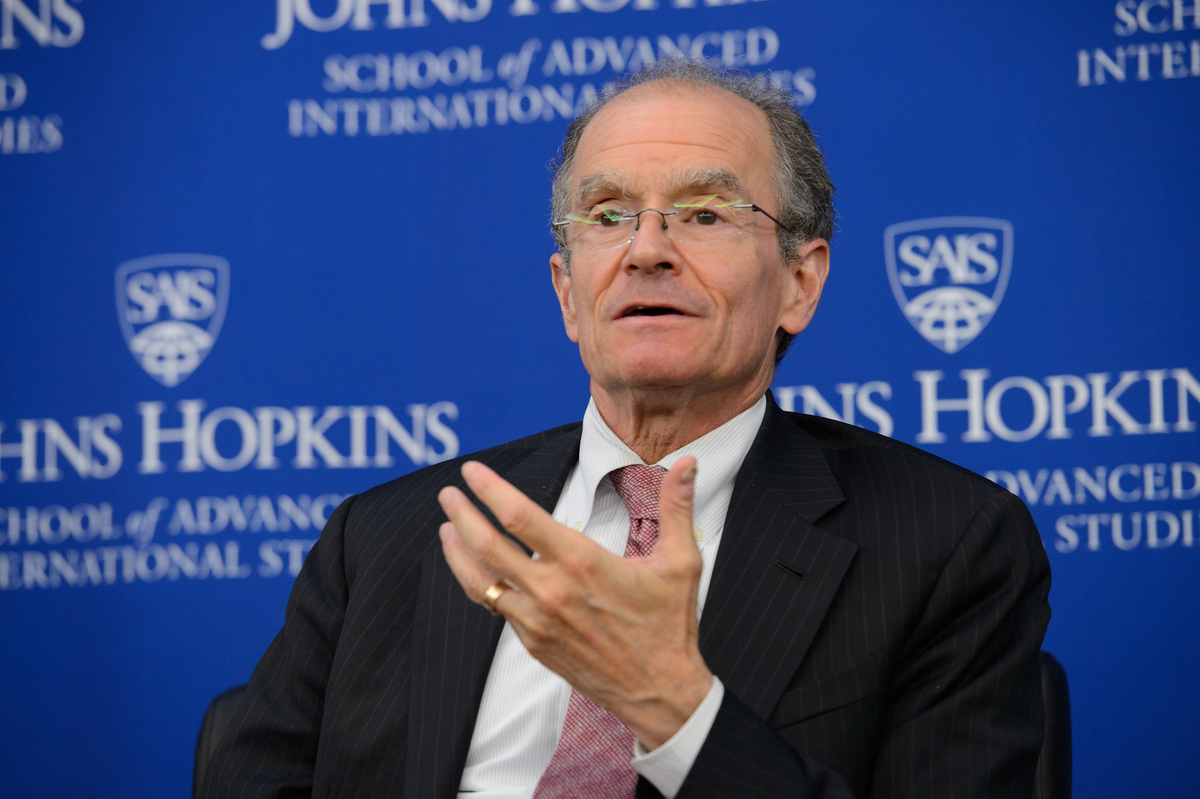
WASHINGTON DC – Veteran US diplomat Daniel Fried, who was instrumental in shaping American policy in Europe following the collapse of the Soviet Union, has issued a call for NATO to adopt a more aggressive posture against persistent Russian military violations of Alliance airspace.
Speaking exclusively to Kyiv Post on Thursday, Fried, a former Assistant Secretary of State for European and Eurasian Affairs and now a fellow at the Atlantic Council, suggested the time for tolerance is over, arguing the alliance should be prepared to “start shooting down Russian airplanes” if they violate NATO territory and fail to comply with orders to leave.
JOIN US ON TELEGRAM
Follow our coverage of the war on the @Kyivpost_official.
Escalating pattern of Russian provocations
Fried’s comments come amid a notable escalation in Russian provocations across Europe, a pattern that includes drones violating Polish and Romanian airspace, fighter-bombers over Estonia, and unidentified aircraft grounding flights at major airports in Denmark and Norway.
This striking spate of incursions, often met with Moscow’s “implausible deniability,” amounts to a broader military and political test.
The sheer volume of recent headlines – Russian drones over Poland and Romania, Russian aircraft buzzing a German naval frigate, and unidentified drones over Copenhagen and Oslo airports – “tells its own tale,” according to analysts.
These operations, while distracting from Russia’s slow progress in Ukraine, are clearly probing the West’s military response mechanisms and, more crucially, its political will.
Other Topics of Interest
WATCH: Ukraine’s Steel Border Unit Repels Russian Assault in Kursk, Eliminates Two Soldiers
Ukraine’s Steel Border unit repelled a Russian assault in the Kursk sector, killing two enemy soldiers with an artillery strike as they tried to storm Ukrainian positions.
“Turkish precedent” and new rules of engagement
Fried described the diplomatic and military steps he would take if still in government, citing the 2015 incident where Turkey shot down a Russian warplane as the relevant “precedent.”
“If I were in government, I would be sending private messages to the Russians to tell them to knock it off and to tell them that, in light of the evidence of Russian sabotage and drones, we are going to change our rules of engagement [ROE],” he emphasized.
His suggested course of action is unambiguous: “I would be prepared to start shooting down Russian military planes, if they flew over, if they intruded into NATO territory, and did not respond to requests to leave.”
Fried added:
“I think the time has passed where we should tolerate this kind of behavior. They are engaged in a war in Ukraine and engaging in sabotage, and I think we ought to put them on notice. We won’t tolerate it. So, yeah, basically Turkey showed – Turkey established a precedent.”
The recent airspace violations illustrate the cost of inaction. Drones come cheap, yet forced Denmark to suspend flights from its largest airport for four hours, and compelled Poland to spend millions scrambling fighters and employing air-to-air missiles, one of which scored an “own goal” on a rural civilian structure.
Russia is testing whether Europe will “hold its nerve in supporting Ukraine—and perhaps others in the future—when faced with nuisance or worse,” Fried warned.
Moscow’s test: Splitting the alliance
Asked whether Moscow is primarily testing America’s mettle, Fried offered a nuanced interpretation, saying the objective is broader and aimed at the foundation of the transatlantic pact.
Fried explained:
“What I would say is that Moscow is testing whether NATO is capable of acting as an alliance, or whether they can split Europe from the Americans. That’s what I think this is about.”
The former diplomat emphasized that the US must not leave the responsibility solely to European allies on NATO’s eastern flank, a point underscored by the recent string of violations.
“I think, therefore, that President Trump ought to back up NATO and see to it that whoever’s planes are operating in the airspace of NATO’s eastern flank, that America stands with them… We shouldn’t simply put this on the Europeans.
“We need to show that we stand with the Alliance and we’re not going to tolerate Russian aggression like this any longer.”
The incursions are also plainly “testing US intentions.” The fact that these airspace violations followed a red-carpet welcome for a leader like Putin, accompanied by ambiguous rhetoric, feeds Russian confidence that Washington intends to further disengage from European security, rather than to bolster support.
Beyond airspace: Russia’s multi-domain strategy
The airspace breaches are not isolated military matters, Fried and analysts suggest, but rather elements of Russia’s broader “multi-domain strategy.”
This comprehensive security threat covers civilian infrastructure, involving either enlisted agents or enabled non-state actors, and presents a far more complex challenge than military-to-military confrontation.
This broader picture of risk includes repeated damage to undersea communications cables in the Baltic Sea, with Moscow suspected of involvement, and cyberattacks, including the one that gave Russian hackers control of a dam in Norway.
British intelligence previously warned that Russia’s GRU was on a “sustained mission to generate mayhem on British and European streets: we’ve seen arson, sabotage and more.”
The challenge of mounting a unified response to the airspace incidents is a stark reminder of the difficulty inherent in crafting a coherent defense against these diverse and often less-attention-grabbing threats.
Trump factor: Deeds over words
The discussion of deterrence inevitably led to Trump’s rhetoric, with Fried acknowledging that he would “prefer good words from Trump to bad words,” but stressing that the focus must be on concrete action.
“It’s not a question of whether the US says the right thing. It’s a question of whether we are prepared to act. And I think the speculation about a major shift in US policy is premature… I would prefer action overall.
“And I haven’t seen that yet… I think that Trump needs to actually back up his words with deeds.”
Fried advised European allies to proactively push for specificity, rather than waiting to be blamed, noting that “President Trump certainly wants the Europeans to carry more of the burden.”
He added:
“But if I were the Europeans, I would try. I would be pressing for more specifics about what we can do together. Offer, not forcing the Americans to take the lead in all cases, but making sure the Americans are actually there in reality, not just rhetorically.”
Fried concluded by urging the US to avoid making European actions a “prerequisite” for its own steps against Russia, citing a concern that Moscow would leverage any hesitation for inaction.
Summing up, Fried said:
“I don’t know why we would make Hungary’s decision a prerequisite for our actions. I thought that was a mistake, but I think it’s a good thing to start talking with countries that are still purchasing Russian oil and trying to get them to stop.
“That’s better than simply appearing to use European purchases of Russian oil as an excuse for US inaction.”