
An English soldier’s Victoria Cross-earning gallantry on September 28, 1918, would become notorious years later for the soldier he purportedly didn’t shoot.
Private Henry Tandey took out a machine gun nest before leading a bayonet charge against “an overwhelming number of Germans”.
Despite being wounded twice, he refused to be evacuated “until the fight was won”.
 Private Henry Tandey earned a Victoria Cross for his exploits. (Public Domain)
During that day, a wounded German walked into his line of fire.
But Tandey did not take the shot, lowering his rifle and allowing the soldier to go free.
This act of generosity would be remembered as part of Tandey’s courageous story.
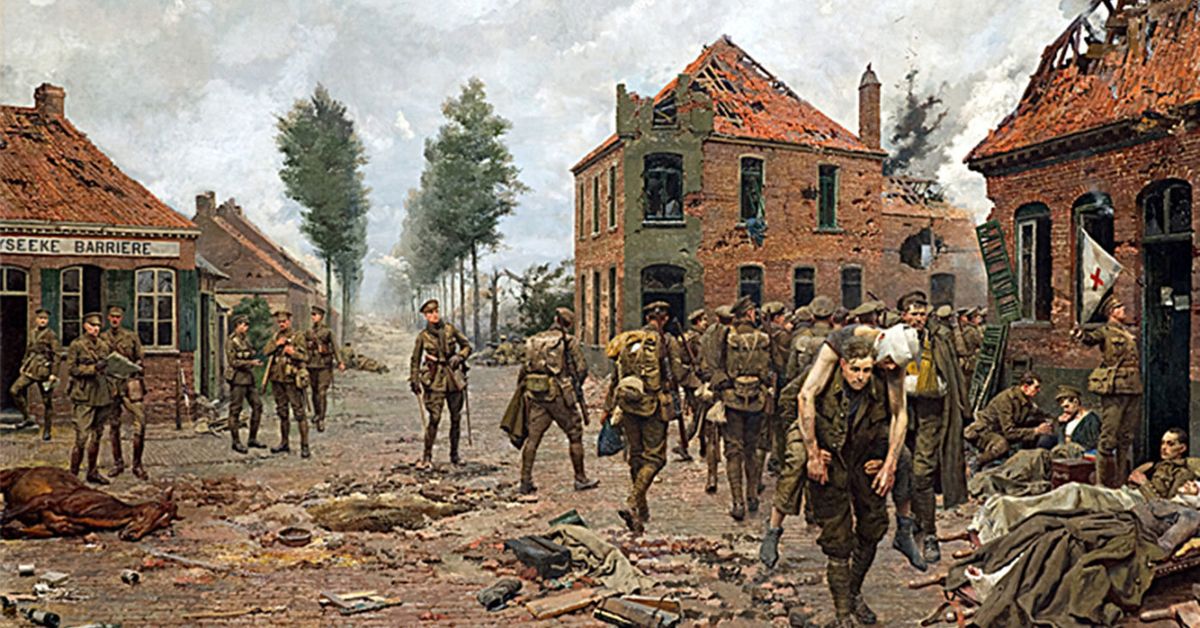
Italian artist Fortunino Matania would later immortalise Tandey’s courage that day with an oil painting.
 Fortunino Matania painted this artwork of Henry Tandey’s exploits that day. (Public Domain)
Then, in 1938, British Prime Minister Neville Chamberlain visited Adolf Hitler’s holiday home for negotiations.
Chamberlain was struck by the fact a copy of a painting of British soldiers was hanging on Hitler’s wall.
Hitler pointed out Tandey in the painting and said: “That man came so near to killing me that I thought I should never see Germany again; Providence saved me from such devilishly accurate fire as those English boys were aiming at us.”
 Adolf Hitler claimed dubiously that Henry Tandey spared his life. (Public Domain)
According to Hitler’s version of events, he was the soldier Tandey declined to shoot.
When the Second World War broke out, Tandey was asked how he felt about sparing Hitler’s life.
“If only I had known what he would turn out to be,” he lamented.
“When I saw all the people and women and children he had killed and wounded I was sorry to God I let him go.”
But there’s very good reason to disbelieve Hitler’s claims.
Records show that Hitler, then a lance corporal, was on leave on September 28, 1918, and would not return to the front until the following day.
He would be wounded two weeks later, but by mustard gas that temporarily blinded him.