
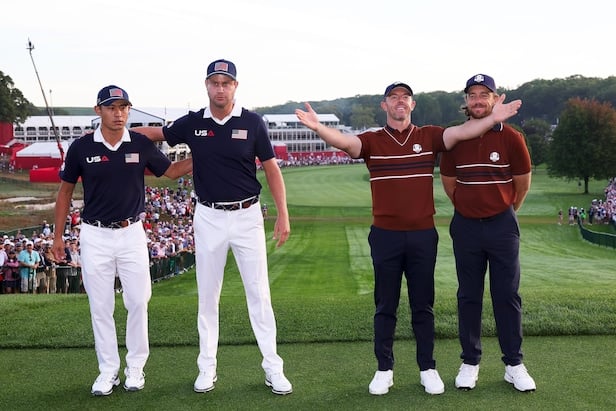
Collin Morikawa’s head was down before the ball was halfway to the cup, knowing it would not reach its intended target. The missed attempt for par put Morikawa and Harris English 3 down after seven holes to Rory McIlroy and Tommy Fleetwood on Saturday morning at Bethpage, a day after the American pair was waxed, 5&4, by Fleetwood Mac. A rogue “C’mon boys!” request shot through the air as Morikawa looked upwards, understanding his fate and that it could not be changed and that it was on their shoulders. Responsibility lies with competitors at the Ryder Cup and to a degree that’s true. Morikawa and English played poorly. But they deserved better.
RELATED: The subtle way Europe has cracked the code to motivating its players
This is the Hindsight Cup, where every captain’s decision faces endless, and sometimes needless, dissection. But occasionally a choice is so obviously flawed that it demands scrutiny both in the moment and long after. Rarely, though, does such a decision serve as anything more than an indictment of a captaincy, perhaps even an entire system. That assessment may seem harsh, but it captures the reality of Keegan Bradley’s choice to send Morikawa and English back out for Saturday morning’s foursomes session – a decision that marched them straight towards their Ryder Cup demise.
It’s difficult to overstate just how monumentally poor this decision was, and how predictably it backfired. DataGolf, a widely respected analytics site, published data early in the week showing English–Morikawa as the worst possible American foursomes pairing among 132 potential combinations. When writers and fans salivate over the idea that they know better than those making the actual decisions, it’s usually misguided optimism. But when a captain steps on a rake despite seeing it clearly beneath his feet, the criticism becomes justified. Bradley’s choice to deploy this pairing on Friday was puzzling at best.
Before going further, context matters. English and Morikawa weren’t facing just anyone – McIlroy and Fleetwood represent two battle-tested Ryder Cup veterans whose partnership has become a reliable European weapon. English remains a very good player, while Morikawa is a two-time major champion who performed admirably at Whistling Straits in 2021. All of which makes the outcome even more damning. In the immortal words of Denny Green: English and Morikawa were who we thought they were.
There were red flags and they were waving hard. English had never played foursomes, a format requiring seamless partnership and shared strategy. Morikawa was arguably the most out-of-form American player, historically the type better suited for fourball where he could play his own game. Neither player excels off the tee, a critical weakness at a course where driving prowess reign supreme. Their opponents? Fleetwood, a very good player who becomes transcendent at Ryder Cups, paired with McIlroy, arguably the finest golfer Europe has ever produced. The mismatch was so glaring it resembled those early-season college football games where a powerhouse pays a mid-major school to show up for target practice.
RELATED: Keegan Bradley is under ultimate pressure
McIlroy and Fleetwood went 5 up through eight holes and cruised to a 5&4 victory, never remotely threatened.
What happened next defied logic entirely. Bradley, facing a three-point deficit after Day 1 – a margin requiring a historic American comeback – had a chance to learn from his mistake. Instead, he compounded it. He sent English and Morikawa back out on Saturday morning against the exact same European pair that had dismantled them. When pressed on this decision – why would he ignore every piece of data suggesting this was a terrible, horrible, no-good, very-bad choice – Bradley offered only deflection:
“Well, we have a plan of what we’re going to do,” Bradley said. “They beat us today, but you know, we’re really comfortable with our plan. We’re really comfortable with those two players. Excited who they are playing tomorrow. Be an exciting match, and we’re sticking to our plan. We’re not going to panic. We’re not going to panic and make those sort of mistakes. We’re going to stick to what we know. We have a lot of confidence in them.”
A follow-up asked if the Americans’ data set said something different or if this was a gut feeling, Bradley offered, “I would say it’s a little bit of both. They were really bummed out that they lost their match today. They were eager to get back out on the course, and that’s why we did that.”
Well, OK then. For those scoring at home, that eagerness, that plan and those numbers didn’t prevent Friday’s disaster from repeating itself. English and Morikawa fell 4 down through eight holes on Saturday morning. The Americans at least put up a fight on the back nine, but it was too little, too late, losing 3&2. It’s extraordinarily rare to witness someone score an own goal, fish the ball out of the net and then immediately kick it right back in. Yes, that’s a soccer reference – Americans have forfeited the right to football analogies after this performance.
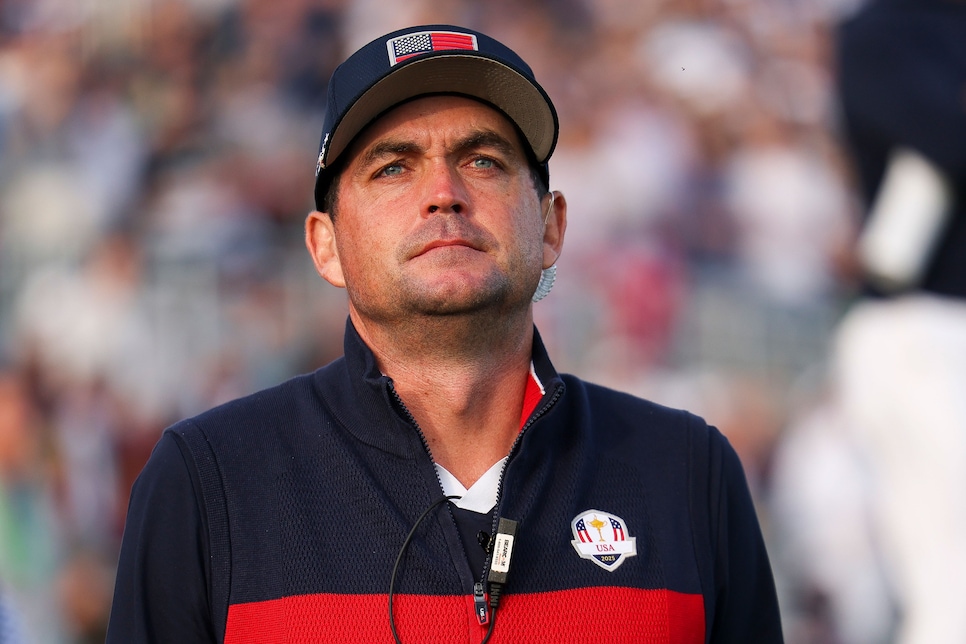
Photo: Andrew Redington
The question that lingers is simple: why? We reached out to sources within the American team, asking whether their internal statistics showed something the rest of us couldn’t see. The response? Mostly shoulder shrugs. (For context, Europe was delighted that the Americans never deployed J.J. Spaun with Scottie Scheffler, or that Ben Griffin sat in several promising combinations.)
Set Friday aside and focus on Saturday’s decision. The most charitable interpretations are twofold: Bradley made the move as a show of faith in two struggling players, or he essentially sacrificed them, believing McIlroy and Fleetwood were unbeatable regardless. The first explanation lacks support but carries emotional logic – anyone who’s played team sports understands the power of conviction and mutual belief. The second interpretation, however, raises uncomfortable questions. With respect to the Europeans, Fleetwood was, until recently, known more for his inability to close than his clutch performances. You’re conceding points to that?
Golf fans spend considerable time discussing the imperfect science behind Europe’s approach to Ryder Cup strategy. Their fusion of statistics, chemistry and intangibles that goes into team construction. It doesn’t always work (Europe has lost three of the past four away Cups, helped by an American meltdown in Chicago in 2012), but it does represent a pursuit of an ideal. To watch that thoughtful approach met by either obliviousness or overthinking genuinely deflates enthusiasm for this event. Because those appear to be the only explanations for Bradley’s decision-making. He either ignored overwhelming data because of a gut feeling, or he somehow Jedi-mind-tricked himself into believing the numbers were wrong.
Why the US system lacks the checks and balances present in with the European team is worth serious discussion after this week. Europe benefits from analytical minds like Edoardo Molinari and vice-captains who serve as voices of reason when captains lose perspective. America’s system, by contrast, seems built for exactly these kinds of unforced mistakes. There’s also been considerable outcry arguing, “This is what happens when you name a distracted captain,” the theory being that Bradley wasn’t fully invested as manager because he was simultaneously trying to make the team as a player. That criticism misses the mark. The job isn’t that complicated, which makes decisions like these even more maddening. What’s closer to truth is what made Bradley an excellent player may be precisely what’s making him a questionable captain. His career was built on proving doubters wrong, a mindset that elevated him to top-10 status in his profession. But there’s a crucial difference between using slights as motivation and simply refusing to accept feedback. Running English and Morikawa back out represents an error born of pure arrogance.
What’s unfolding through three sessions isn’t entirely Bradley’s fault. The world’s No.1 player went winless on the opening day. Bryson DeChambeau proves himself a masterful showman but perhaps not the competitor this format demands. The captain’s selections have largely failed to deliver.
Still, Ryder Cup margins are razor-thin, leaving no room for such obvious strategic blunders. The Morikawa-English pairing represents exactly that – a self-inflicted wound that couldn’t be afforded. The Americans appear to be barreling toward another defeat, which will inevitably trigger familiar soul-searching about why one team consistently “gets it” while the other stumbles through the dark. The tragedy is that this had all the ingredients for the first truly competitive Ryder Cup in years – talent on both sides, compelling storylines and genuine uncertainty about the outcome. We’ll never know if that competitive balance would have materialised. Bradley made sure we’d never find out.