
Australia’s military has ambitious plans to expand its ship-to-shore capability. However, the army is relying upon ageing and limited numbers of amphibious assets to land them on beaches, as the delivery date of new landing craft faces serious delays.
This amphibious connector capability gap was apparent during Exercise Talisman Sabre 2025, held from 13-27 July, as multiple nations conducted amphibious operations.
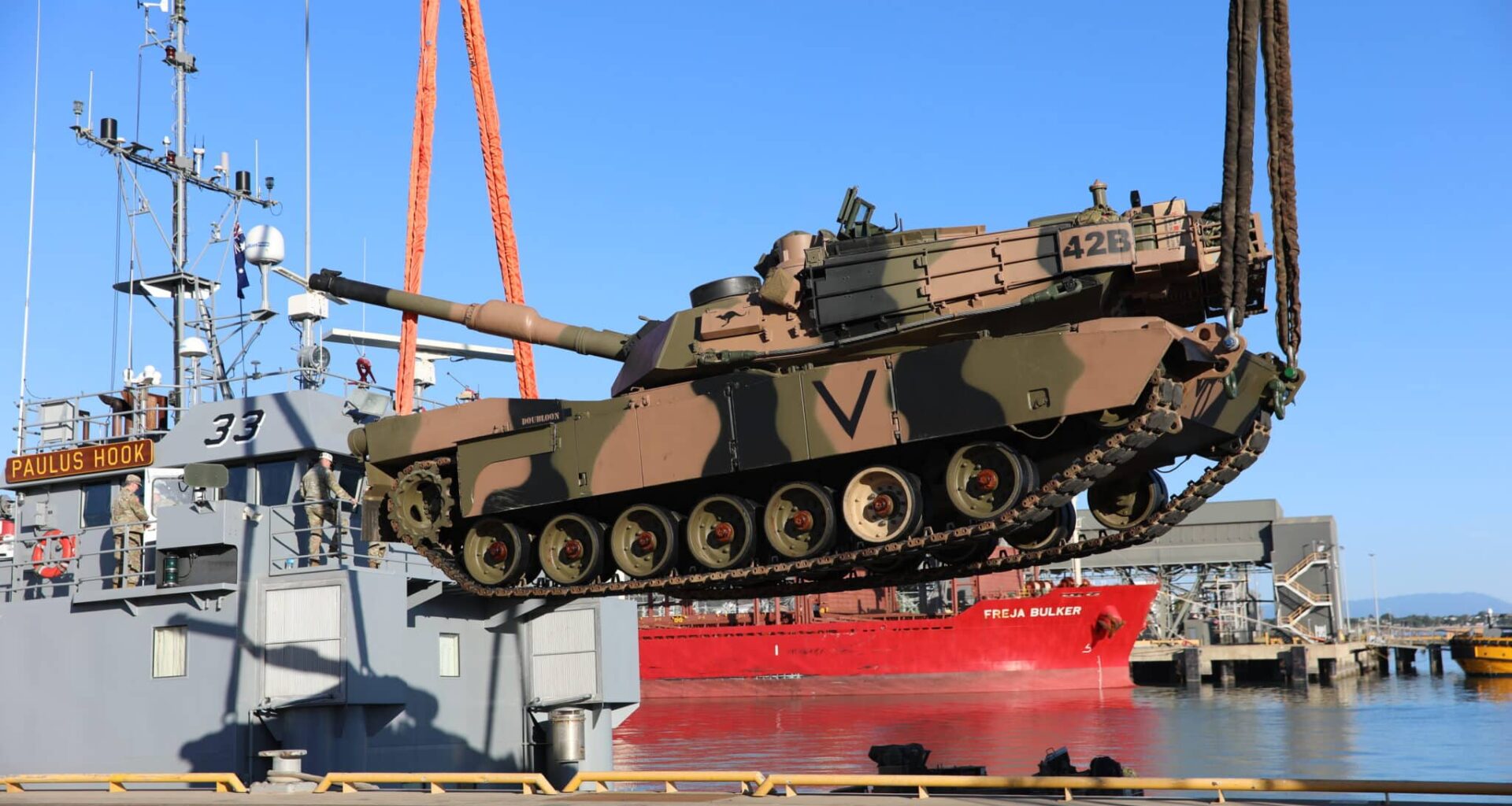
On 19 July, a US Army landing craft utility (LCU) loaded up with four M1A2 SEPv3 Abrams tanks and an M88A2 armoured recovery vehicle at the port of Townsville in northern Queensland. The vessel, USAV Paulus Hook, was then to transport the vehicles to Gladstone as one of 800 collective activities occuring during Talisman Sabre 2025.
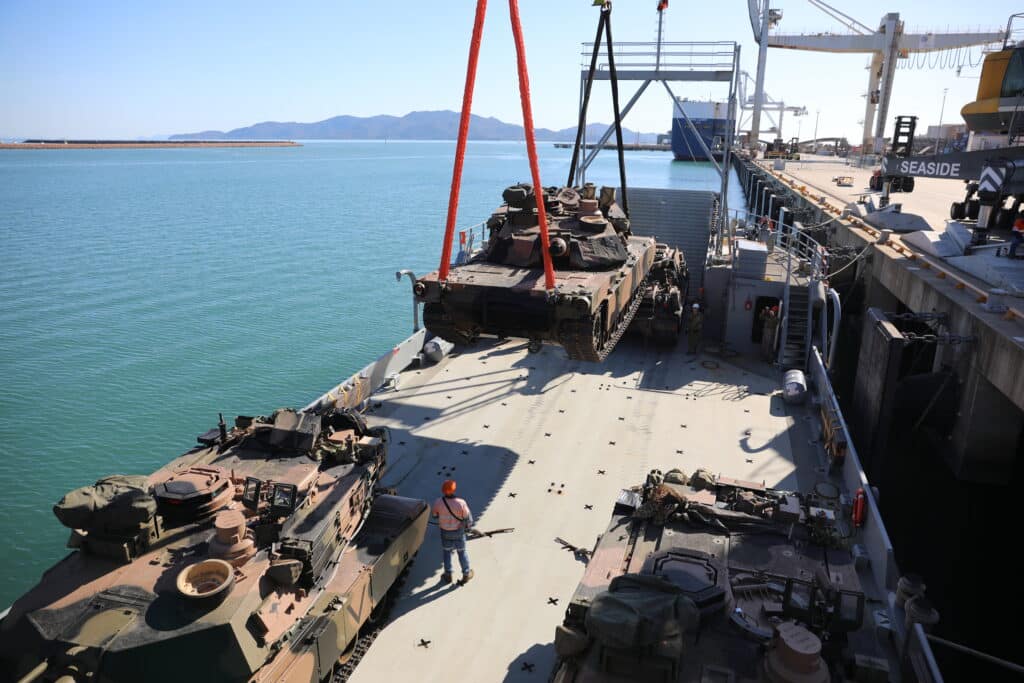
The American LCU sailed from Japan to Australia, a voyage of 22 days, for Exercise Talisman Sabre 2025. (Gordon Arthur)
Long voyage
USAV Paulus Hook sailed all the way from Yokohama in Tokyo to Australia, a journey that took 22 days sailing at speeds of 10-12kt. The coastal craft usually sails within 200nm of land. It belongs to the US Army’s 5th Transportation Company, (Composite Watercraft Company or CWC), which was activated in Japan on 7 February 2024, as the US military forward deploys more logistics and amphibious assets in the Indo-Pacific region. Furthermore, there is talk of the US Army positioning landing craft in Australia.
This American 584-tonne LCU is capable of landing vehicles on beaches, but on this occasion the armoured vehicles were loaded aboard at Townsville using a crane. Its cargo approached the LCU’s 318-tonne maximum payload capacity. To put this in perspective, and to emphasise the necessity of maritime vessels for logistics, this equates to the combined payloads of eight C-17 aircraft.
Warrant Officer 1 Chad Arness, the master of USAV Paulus Hook, told Naval News that his company, the first CWC unit to be deployed outside the USA, has five such landing craft. The US Army also operates the larger Logistics Support Vessel, one of which recently moved from Hawaii to Japan. USAV Lt. General William B. Bunker departed Pearl Harbor on 20 June.
Lieutenant Eugene Lynch, a troop commander from D Squadron, 2nd Cavalry Regiment of the Australian Army, explained the tank movement activity occurred to “test, prove and develop our capability to manoeuvre the tanks in a littoral environment”.
Later in Talisman Sabre, after offloading the tanks, Paulus Hook will carry up to 250 infantry personnel in an amphibious lodgement.
Capability gaps
However, neither the Australian Army nor the Royal Australian Navy (RAN) possesses any capability similar to that offered by Runnymede-class LCUs like the Paulus Hook. The army owns old LCM-8 landing craft dating from the Vietnam War era. These are incapable of carrying tanks, although the LCM-1E landing craft attached to the RAN’s Canberra-class landing helicopter docks are rated to carry M1A1 Abrams tanks.
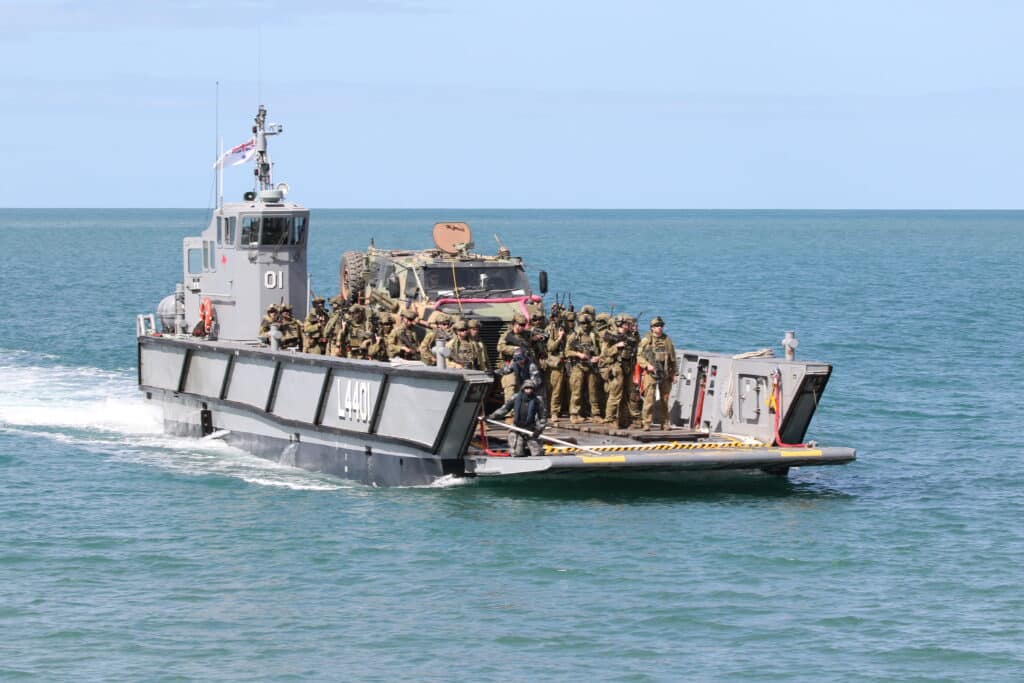
This is an LCM-1E belonging to the Royal Australian Navy, here conducting an amphibious landing at Cowley Beach in northern Queensland. (Gordon Arthur)
Of course, the army has replaced those tanks with the latest M1A2 SEPv3 Abrams, which are several tonnes heavier. This means qualifications must be conducted before LCM-1Es are approved to carry the new tanks.
Furthermore, Australian plans to induct two new landing craft classes have already hit stormy waters, with delays reported. Project Land 8710 Phase 1A is to introduce 18 Landing Craft Medium (LCM), while Phase 2 encompasses eight Landing Craft Heavy (LCH).
The first of the 18.49m-long LMV-Ms was supposed to be ready by 2026. Austal will build them according to a Birdon Group design possessing a 90-tonne payload capacity. Last year the government announced delivery was being accelerated.
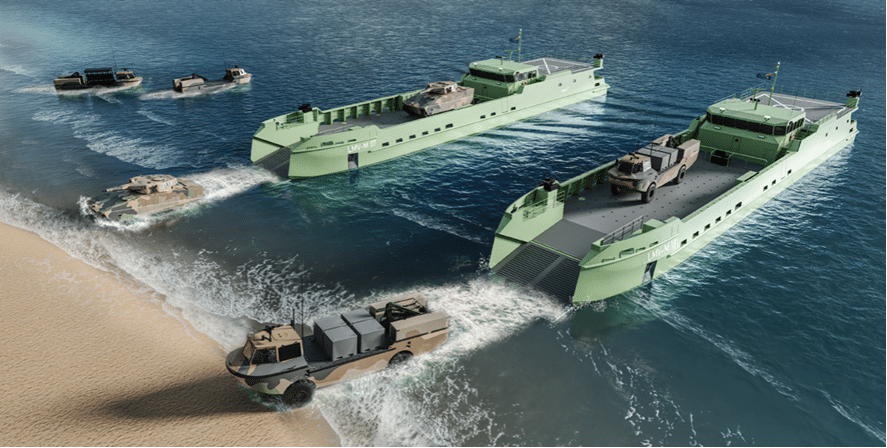
The selected LCM design from Birdon will be constructed for the Australian Army by Austal in Henderson, Western Australia. (Commonwealth of Australia)
Indeed, Lieutenant General Simon Stuart, Australia’s Chief of Army, said late in 2024, “Our plan is to have the first medium in the water by the end of 2026, the first heavy by the end of 2028. That means we’ve got to work with industry and make sensible compromises to get the capability, which will be a step change above anything we’ve currently got.”
Birdon was announced as the LCM’s preferred designer in November 2023, and Austal and Birdon were working under an initial contract to mature the LCM design. However, a contract has still not been signed, jeopardising all the above pledges.
In fact, the ABC reported in June that the LCM project is facing delays of up to two years. It quoted an industry source as saying, “They’re about to go into preliminary design review with an immature design and lots of risk. They still haven’t given the bad news to the [defence] minister, and they’ve had to bring in a retired British admiral to broker a deal between Defence, Birdon and Austal to try and get it all on track.”
With no contract, construction cannot commence and the 2026 delivery date appears unattainable, especially considering that the first-of-class LCM needs to undergo end-user sea trials. This delay will have knock-on effects for construction of LCHs and other vessels too.
Austal is to build all eight 3,900-tonne LCHs, supposedly beginning the first LST 100 next year. In November 2024, Defence had announced selection of the LST 100 design from Damen Shipyards. Possessing bow and stern ramps, it is 100m long and can carry at least a 500-tonne payload.
LCMs and LCHs are pivotal to the ADF’s ambition of operating in littoral environments and delivering “impactful projection”. Project Land 8710 Phase 1B is also supposed to give the army 15 Amphibious Vehicle Logistics to replace LARC-Vs dating from the 1960s. Birdon is the preferred tenderer, but no contract announcement has been issued there either.
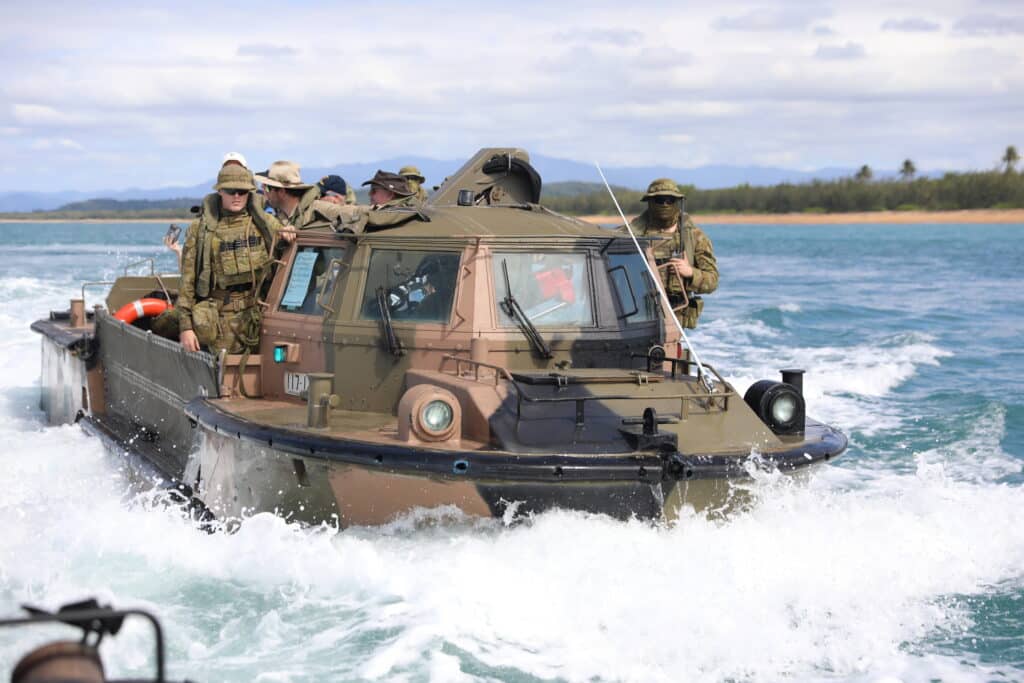
Elderly LARC-Vs of the Australian Army’s 10th Force Support Battalion also need to be replaced as soon as possible. (Gordon Arthur)
Learning opportunity
The amphibious requirements are very real. Alluding to the LCMs and LCHs, Defence stated: “They will support a strategy of denial, which includes deploying and sustaining modernised land forces with long-range land and maritime strike capabilities across our region.”
Also asked if it is important for Australia to rehearse such amphibious movements, Lynch responded, “It’s extremely important. Our focus is on the Indo-Pacific region, and our near region is characterised by archipelagos and the littoral environment. So, it’s absolutely essential to our ability to project force into the region for defence for Australia’s strategic interests.”
Despite delays in its own programmes, the presence of USAV Paulus Hook was a good opportunity for the Australian Army to observe American utilisation of its own medium landing craft, and to rehearse for the day when it receives its own.
Some Australian soldiers have been training at Fort Eustis in Virginia, and others will join the Orient Shield exercise in Japan later this year to gain experience on US landing craft. Arness said Australian personnel were “visiting our schoolhouse to get tips of the trade”.
He added: “We’re excited to be down here for Talisman Sabre 25 testing our capabilities as a new company, and obviously sharing the knowledge and working in conjunction with our partners.”
Talisman Sabre 2025 is thus giving the Australian Army a sneak preview of what it can expect to be able to do in the future, although it remains vague as to when that might be.