
It took less than a minute for a city prosecutor to toss out nearly 3,000 charges in a downtown Toronto courtroom.
The cases, covering Highway Traffic Act offences from careless driving to running a red light, had languished too long in a backlogged system and had to be withdrawn to free up space for other charges to proceed.
This mass withdrawing of road safety-related charges earlier this month has become routine, the result of an overwhelmed court system that is leaving millions in fines on the table and letting dangerous drivers off the hook.
“Instead of people being held accountable … these charges are disappearing,” said Trish MacKenzie, the CUPE Local 79 representative for the city’s prosecutors.
An injured victim unaware charges dropped
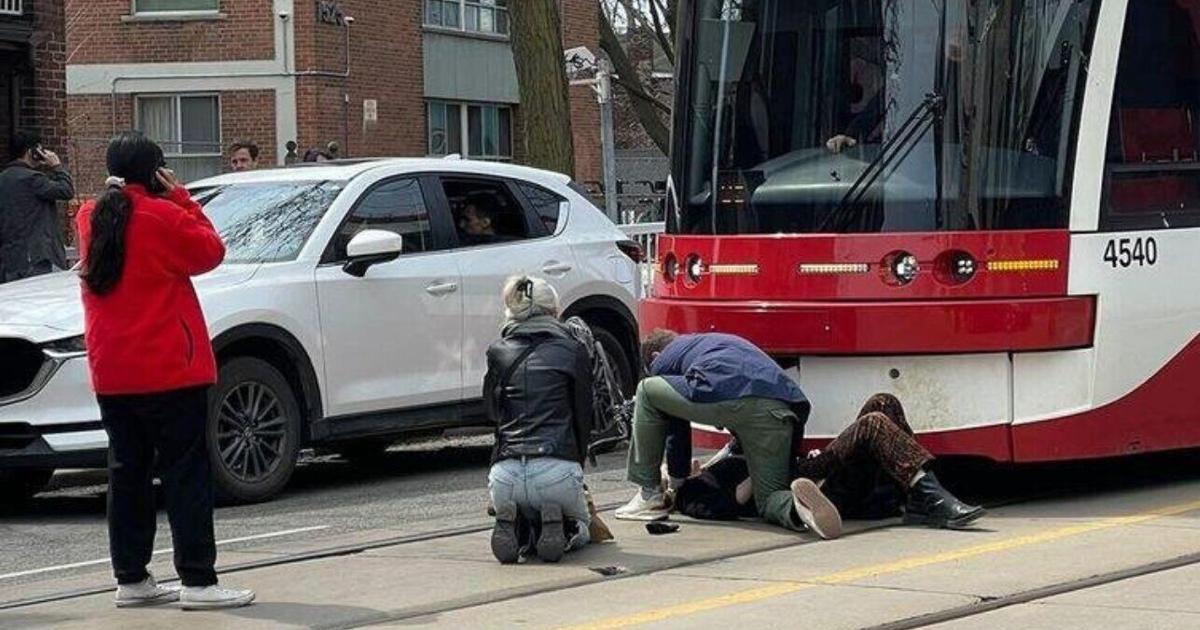
Among the tens of thousands of charges withdrawn in the past year was one against the driver who opened a car door as Megan Franklyne biked past him on Dundas Street West in April 2023. She landed in front of a moving streetcar.
The actual Highway Traffic Act offence, opening a door without taking precautions, carries a fine of $365 and three demerit points. For the 41-year-old cyclist, however, it meant concussion, broken arms, injured hip and shattered teeth after being dragged by the 505 streetcar.
“I am lucky I didn’t die,” she said. Her life is nothing like it used to be. The ongoing pain from her injuries makes it harder to work, socialize and travel. It makes her irritable, which takes a toll on her relationships. She no longer goes to concerts or runs, two things she once loved to do.
Franklyne became deeply anxious seeing people bike around the city after that. Taking cabs to get around made her even more aware of how vulnerable cyclists really are, she said.

On a wet and miserable day, reporter Mark Colley created a vigilante speed trap as Doug Ford
“Driving is something … that kills a lot of people,” she said. “People just need to treat it more seriously than they do.”
Franklyne, like most victims in a Highway Traffic Act case, had no idea the charge was dropped. She only learned about it when her civil lawyer David Shellnutt, who specializes in road safety cases, checked.
Shellnutt said he has seen several cases with strong evidence, like Franklyne’s, withdrawn by prosecutors, which can make it harder for victims to sue in civil court because the insurance company can say the driver was never convicted.
“At the very bare minimum, the slap on the wrist should be applied and taken seriously.”
A growing problem
In 2019, there were 13,520 Highway Traffic Act charges withdrawn before trial — about five per cent of the cases that came in that year, according to statistics published by the Ontario Court of Justice. Between April 2024 and March 2025, that number had ballooned to 165,973, about 20 per cent of all the charges that came in that year.
The highest number of charges dropped were speeding, running a red light and driving without a permit, but they also included stunt driving, distracted driving and driving with a suspended licence.
The statistics do not include why charges were withdrawn, which could include not just delay, but other reasons such as lack of evidence.
Highway Traffic Act offences must get to trial in less than 18 months, as set by the Supreme Court of Canada’s landmark R. v. Jordan case. But more and more cases have been taking longer, forcing prosecutors to pre-emptively withdraw them or have them tossed out by a justice of the peace.
“If prosecutors don’t withdraw those cases and they come up, we win them on a Charter challenge anyway,” said Jason Davie, a Toronto-based paralegal. “I’m successful with at least five a week.”
In 2018 and 2019 a more serious traffic offence would reach trial on average in just under a year, according to Ontario Court of Justice statistics. Between April 2024 and March 2025, it took on average 611 days — over the 18-month limit.
‘System in shambles’
Earlier this year, Justice of the Peace Robert Shawyer called Toronto’s provincial offences court a “system in shambles” as he stayed careless driving charges due to delay in a case where an elderly pedestrian was killed and another injured by a left-turning driver.
Shawyer cited several issues: a lack of judicial resources, a huge number of charges coming in, a failure by the city to install internet access in courtrooms until recently, a file management system “held together by some ‘bailing wire and twine’ with a hope and prayer thrown in for good measure,” and a wildly inefficient process of getting the evidence collected by police — known as disclosure — to prosecutors and the accused person.
Provincial prosecutors typically handle the most serious traffic offences while the majority are dealt with by city prosecutors.
According to union representative MacKenzie, another major part of the problem is that there simply aren’t enough city prosecutors to handle the increasing volume of cases in the required time.
Trish MacKenzie, representative for the prosecutors union, said there is an emotional toll to having to drop a charge where a person was injured or killed. “I’ve had people break down crying in court,” she said.
R.J. Johnston Toronto Star
The number of Highway Traffic Act charges laid in Toronto has tripled in the past six years, according to the Ontario Court of Justice statistics. This is largely due to a spike in speeding tickets from the automated cameras brought in by the Ford government in 2019 and which the premier is now seeking to ban.
Though speed camera tickets are now handled administratively outside the court system, the backlog for other provincial offences in court is still so great, staff handling tickets for parking, speeding or red-light cameras are being pulled into court to help with the staffing shortage, even acting as prosecutors, MacKenzie said.
City prosecutors have told her there are no clear instructions from management at the city’s legal division on how, when and which charges to toss to alleviate the backlog. In other words, it’s up to the lawyers’ discretion, making the prosecutorial arm of the justice system seem “incoherent” when it’s supposed to act and speak with “a single voice,” MacKenzie said.
“It’s frankly also unfair for the people appearing in those courts to have it depend upon what location and which prosecutor you appear before,” MacKenzie said.
Taking an emotional toll
Then there is the emotional toll of having to drop a charge where a person was injured or killed. “I’ve had people break down crying in court,” said MacKenzie, who was a prosecutor before she took on the union position.
Prosecutors are also overwhelmed by the amount of video evidence, which they must vet and redact personal information from before providing it to the accused person, she said.
“Prosecutors will watch the videos at double speed, or fast forward through parts where no one is talking in order to get videos done as expected,” she said. “This inevitably means that things get missed and mistakes get made.”
Failing to provide disclosure quickly enough is a common reason for traffic charges to be tossed.
“Sometimes we go to a first court date and it’s already nearing 18 months … but (prosecutors) may not have all the evidence yet,” paralegal Davie said.
The city, however, cites other reasons for the current state of the court system.
“The city of Toronto prosecutors have not had to withdraw cases for lack of prosecution resources for court,” a city spokesperson said in a statement. “The city continues to work through a heavy case load within the Provincial Offences Court since the court closures during COVID, the reduction in court capacity post-COVID, and a lack of reform of the Provincial Offences Act processes to modernize and alleviate some of these pressures.”
The Ministry of the Attorney General said the province has added more justices of the peace this year, with the aim of reducing court backlogs.
Retaining staff a problem
Toronto’s prosecution ability is further hampered by trouble recruiting new staff and retaining them due to a “toxic and hostile” workplace culture, MacKenzie said.
Jason Davie, a Toronto paralegal, says failing to provide disclosure of evidence fast enough is a common reason for traffic charges to be tossed.
R.J. Johnston/Toronto Star
About 20 members of the city’s legal team have left in the last decade, mainly prosecutors, citing overwork, low salaries, a lack of resources, lack of development training and frustrations with management, MacKenzie said.
Workplace complaints, some to the human rights tribunal, have taken even more prosecutors out of commission, she said.
The downtown prosecutor office is currently short six or seven prosecutors of 16, which means borrowing staff from the west and east end in turn understaffing them as well, she said.
The city did not respond to questions about MacKenzie’s comments regarding workplace and staffing issues.
Coun. Jon Burnside said when he was a police officer two decades ago, it typically took less than a year to have a traffic-related charge go through the courts. The current delays tell him the city doesn’t take traffic safety seriously, he said.
“We love the big speeches about how much we care,” Burnside said. “But when the rubber hits the road … there is nothing.”
The city is also losing potentially millions in revenue from fines, not just from withdrawn charges, but also more serious charges pleaded down to minor offences.
“If you think you can drive with impunity, a lot of people are going to do that. And then we have politicians scratching their heads, wondering why no one drives properly anymore,” said Burnside.
Matt Moyer, acting superintendent of Toronto police’s traffic unit, said his division won’t allow the courts’ backlog to become a factor in whether officers issue tickets and lay charges.
“Our job is to look out for the front end and that’s public safety,” he said. “But it’s deflating. When we issue a ticket, there’s a very good reason we’re not giving a warning. To see the ticket go south is disheartening.”