
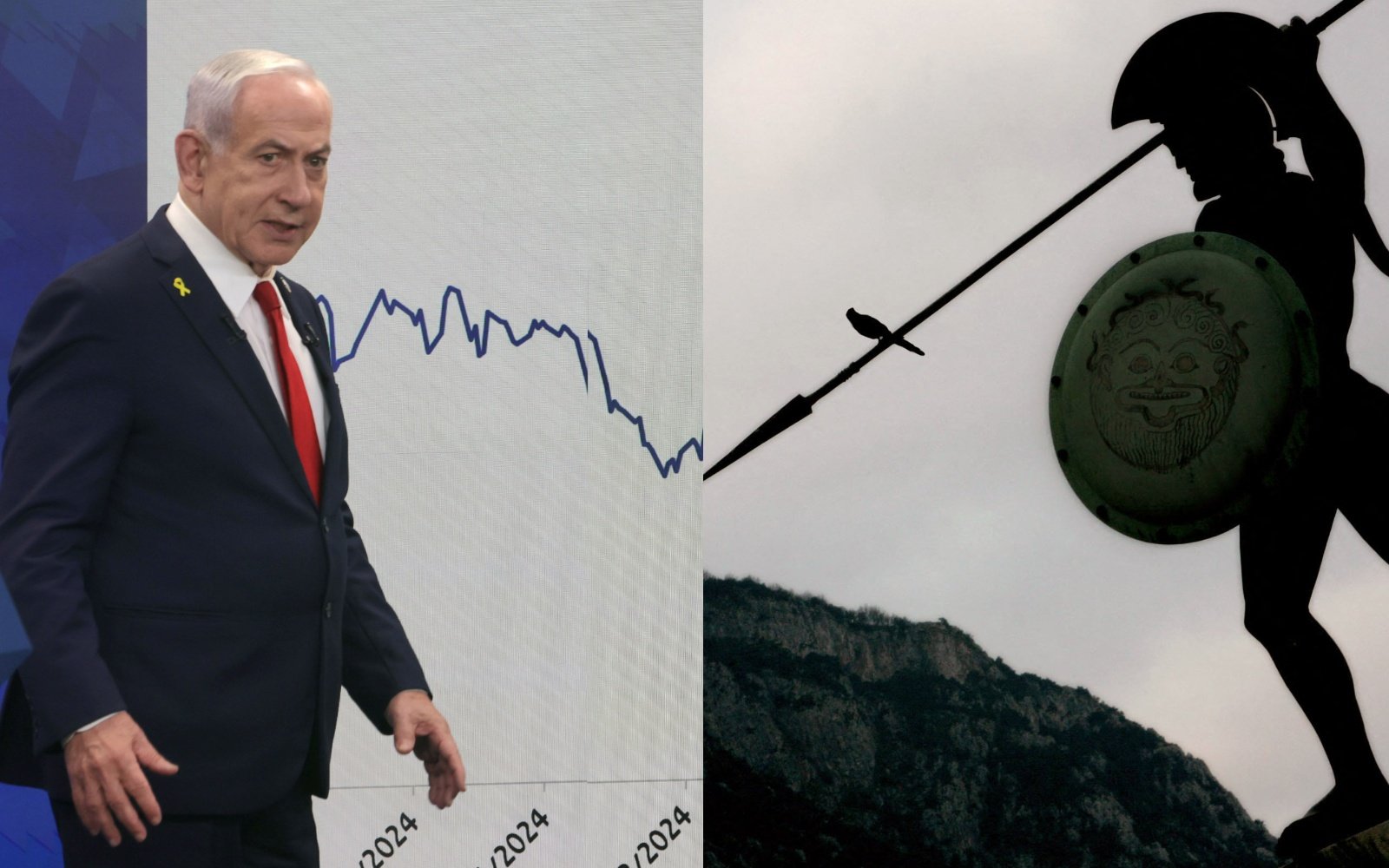
Just a week before the Jewish New Year, Prime Minister Benjamin Netanyahu predicted a future of economic and diplomatic isolation and continuous warfare.
Proclaiming that Israel had no other choice but to adapt and become a self-reliant economy with “autarkic characteristics,” Netanyahu said that Israel — known globally for the tech prowess that earned it the title of Startup Nation — must aspire to turn into a 21st-century “super-Sparta” as it braces for an era of trade sanctions and boycotts.
Not surprisingly, the vision sent shockwaves through local financial markets, leaving investors and the tech community stupefied. After a fierce response from business and tech leaders, Netanyahu quickly backtracked, saying that his comments were focused on the defense industry and the need for security independence. But his clarification did little to calm worries over the fate of the broader economy.
“It’s an unacceptable vision. No one is buying that [super-Sparta vision], as it’s irrelevant for Israel,” said Avi Hasson, the CEO of Startup Nation Central, an organization that tracks the local tech ecosystem. “Israel is not a superpower like China or the US — our economy as a whole relies on raw materials, and certainly for our tech economy, global connectivity is like our oxygen.”
In recent weeks, European countries have ramped up pressure on Israel over fighting against Hamas in Gaza, warning of sanctions and downgraded trade ties alongside arms embargoes already going into effect.
Sign up for the Tech Israel Daily
and never miss Israel’s top tech stories
By signing up, you agree to the terms
Earlier this month, the European Commission threatened to suspend part of a trade arrangement affecting about 5.8 billion euros ($6.78 billion) of Israeli exports to the European Union, its largest trading partner.
“All of us were in shock about Netanyahu’s speech,” said Moran Chamsi, managing partner at Amplefields Investment Fund. “The past two years have been very challenging.”
In ancient Greece, the leading city-state of Sparta is remembered for its self-imposed isolation, meant to preserve its militaristic way of life. The English adjective “spartan,” which often carries negative connotations, recalls the popular conception of the city’s austere lifestyle.

An anti-austerity demonstrator wears a T-shirt in Athens showing a cinematic depiction of a Spartan battle, on June 15, 2011. (AP/Kostas Tsironis)
While Israel may in practice be discreetly behaving like Sparta since the outbreak of war post-October 7, 2023, “it’s totally different when the prime minister says that out loud,” Chamsi said.
Beyond the official embargoes and warnings, Hasson told The Times of Israel that it seemed more and more Israeli companies with business abroad were already feeling the effects of global anti-Israel sentiment.
“We should be careful [not] to take anecdotes and create data out of them,” said Hasson, a former founding chairman of the Israel Innovation Authority. “Having said that, the anecdotes are piling up.”

Prime Minister Benjamin Netanyahu holds a press conferene at the Prime Minister’s office in Jerursalem, September 16, 2025. (Marc Israel Sellem/POOL)
“It’s hard to determine whether people decide not to do business with or invest in a company because of that extra risk that Israel entails, or whether it’s ideological, or whether it’s because employees or customers are not going to be happy,” he said.
Netanyahu’s admission that Israel faces increasing isolation sparked a panicked reaction from investors, sending shares on the previously robust Tel Aviv Stock Exchange down, though they rebounded this week after the US rolled out a fresh proposal to end the war.

Start-Up Nation Central CEO Avi Hasson. (Miri Davidovitz/Courtesy)
“When it comes to leadership, there’s a difference between a CEO feeling or knowing something and saying [it], let alone a prime minister who makes such statements that are heard not just in the UN — they are heard in the boardrooms, large companies, and in partners’ meetings of the large private equity investors,” said Hasson. “That was a very harmful comment to a lot of people… the people in the trenches, those who are fighting, the startups, and the industrials.”
Despite fighting across multiple fronts and ballooning war costs, the performance of the leading stock indexes on the Tel Aviv bourse this year has repeatedly broken records, outperforming the world’s leading stock exchanges.
Over the past year, the TA-35 index of blue-chip companies jumped by about 43 percent and the TA-90 index soared by about 48% as investors bet that Israel’s military achievements against Iran’s nuclear program — alongside the significant weakening of Iranian proxies in Lebanon, Syria and Gaza — would reduce risks to Israel’s security and economy.
But Netanyahu’s comments popped bullish expectations that a ceasefire and an end to the fighting could be achieved in a matter of weeks, kicking off a period of accelerated postwar economic growth.
Much of the hoped-for recovery would be driven by Israel’s tech sector, a pillar of the country’s economy that contributes about 20% of local GDP, makes up about 50% of total exports, and generates significant tax revenue.

Moran Chamsi, managing partner at Amplefields Investments. (Merav Ben Loulou)
For years, Israel has developed a reputation for scientific and technological innovation built on the foundations of a free market economy, rule of law, and globalization. The Israeli tech industry is highly reliant on foreign capital, as about 80% of venture capital investments in local tech startups are generated from foreign funds.
“From the beginning of 2025, the tech industry, with many startup founders, entrepreneurs, and employees on and off on reserve duty in Gaza, has been working very hard to remain resilient, and we see some recovery in investments, as the ecosystem has been preparing for the day after,” Chamsi said.
“However, now some investors will likely decide to hold their investment process in Israel as they will want to wait out current developments, and others will be more hesitant for political reasons, which will create a delay in investments,” he added.
Despite the ongoing war, investment in the Israeli tech market hit a three-year high in the first six months of this year, as funding difficulties hampering the local industry during last year’s more intense fighting on multiple fronts started to recede in late 2024.

CyberArk staff and Nasdaq officials celebrate the 10-year anniversary as a publicly-traded company in 2024. (Courtesy Vania Savic)
In July, Palo Alto Networks, founded by American-Israeli entrepreneur Nir Zuk, bought Israeli firm CyberArk in a deal valued at a staggering $25 billion. It was the biggest acquisition of an Israeli company after Google’s $32 billion purchase of Israeli-founded cybersecurity unicorn Wiz earlier this year.
“There are certain investors who are actually doubling down on Israel, so activity hasn’t stopped, but it is under the radar and very selective,” said Hasson. “When investors map the world for innovation, Israel stands out as there are not so many places with a mature, sophisticated ecosystem that combines talent and entrepreneurship, and repeatedly delivers and continues to show unique capabilities of resiliency to shocks.”
In July, Nvidia announced plans to build a massive multibillion-dollar tech campus in Israel’s north, which is expected to provide thousands of jobs, in a major expansion of the US chip giant’s operations in the country.
However, Hasson, a former chief scientist at the Economy and Industry Ministry, acknowledged that “if you are not a cybersecurity company or an AI-related company, which are tech areas where Israel is a global leader, life is tough.”
“In Israel, that means hundreds, if not thousands, of companies that are suffering right now and are dependent on foreign capital when the ability of venture capital firms to raise money is difficult, since they rely on foreign institutional investors who manage pension funds abroad and are less likely to invest in Israel,” he said.
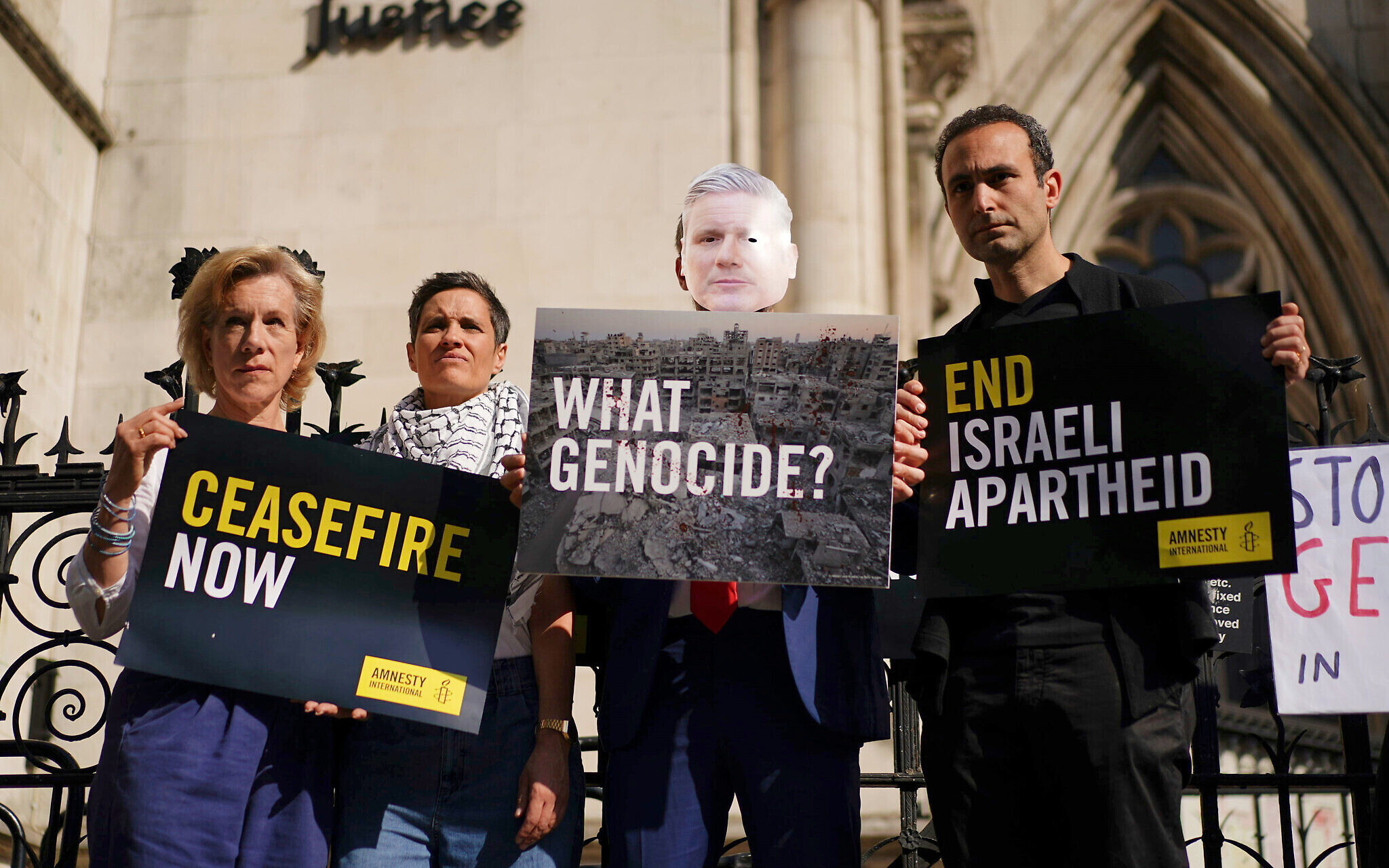
Demonstrators gather outside the Royal Courts of Justice in London, where Palestinian human rights organization Al-Haq is taking legal action against the Department for Business and Trade over several decisions, May 13, 2025. (Ben Whitley/PA via AP)
He expressed worries that tech companies could start leaving Israel, keeping themselves afloat but sinking the local economy. He estimated that he knew of more businesspeople who had moved away or made extended stays abroad in the last year than in the preceding decade.
“Israeli founders have proven that they will do whatever it takes for their company to be resilient and succeed — which could also mean shifting tasks or transferring capital outside of Israel,” Hasson cautioned. “From a national point of view, the separation between the sector and the country is not good news, especially with recent developments.”