
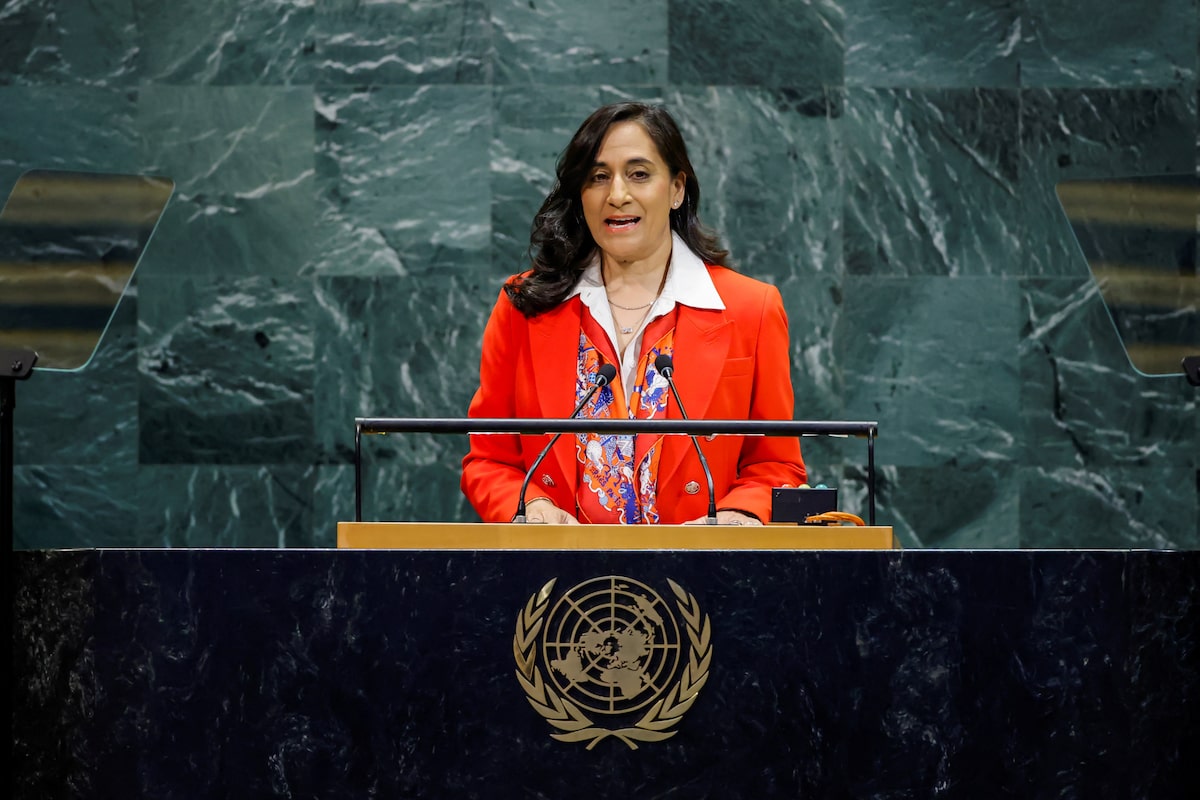
Canada’s Foreign Minister Anita Anand addresses the 80th United Nations General Assembly in New York City on Monday.Eduardo Munoz/Reuters
Defence and security make up the first pillar of Canada’s foreign policy today, the country’s top diplomat told the United Nations on Monday.
Foreign Affairs Minister Anita Anand laid out Canada’s international priorities in a speech to the UN General Assembly, painting the country as a reliable partner in tough times.
She said the rules-based international order is under threat, “with powers shifting in ways that jeopardize our security and prosperity” – challenges she said “no country can address alone.”
The Anand speech is the most recent glimpse into Canada’s foreign policy priorities under Prime Minister Mark Carney, who took office six months ago. In the spring, Mr. Carney pledged to boost annual defence spending by tens of billions of dollars in what would be the biggest increase in military expenditures in more than 70 years.
The minister told the UN General Assembly that at its core, Canada’s foreign policy rests on three pillars: “First, defence and security: keeping Canadians safe, strengthening our sovereignty, being good allies and partners in NATO and NORAD,” she said, referring to the country’s only two military alliances: the North Atlantic Treaty Organization and the North American Aerospace Defense Command.
The second pillar is economic resilience, Ms. Anand said in remarks that appeared to be as much a sales pitch for doing business with Canada as a UN speech. This means Canada’s priority is “diversifying trade, strengthening supply chains, being an attractive destination for capital and entrusted trading partner and advancing rules-based trade,” she added.
The third pillar of Canada’s foreign policy is promoting “core values,” the minister said, including democracy and pluralism, or diversity, as well as gender equality, environmental protections and working with Indigenous people in Canada on sustainable development and prosperity.
Canada lists India’s Bishnoi Gang as terrorist entity
Fen Hampson, a senior Carleton University professor of international affairs, said the way the foreign policy priorities laid out by Ms. Anand are ranked represent a significant shift from Justin Trudeau’s. “It’s a 180-degree turn,” Prof. Hampson said.
It’s only in the third pillar, he said, where one recognizes familiar Liberal Party policies dating back to Lester Pearson, as well as priorities established by Mr. Trudeau.
Ms. Anand’s remarks appear to suggest a more muscular Canada, in terms of its defence and security commitments, at least.
“Canada will be defined not by the strength of our values but the value of our strength,” she said near the end of her address.
Algoma Steel secures $500-million in government loans to help fight trade war
Ms. Anand also talked of how some countries “are turning more inward, looking at protectionism and unilateralism, rather than multilateralism,” meaning working with other countries.
She did not identify the United States or American President Donald Trump as the vanguard of this rising protectionism, despite the fact that since January the U.S. has upended the international trading system with a slew of tariffs on its allies and trading partners.
Canada will not join this trend, Ms. Anand said. “Retreat is not an option. Canada will not turn inward.”
At home, Canada intends to secure its northern territory as an Arctic nation, the minister said; abroad, it will use its resources to help alleviate suffering and advance core values.
“Canada will safeguard its sovereignty, modernize NORAD with the United States, bolster NATO with fellow members and work with Indigenous peoples to ensure that the Arctic remains a region of peace, co-operation and sustainable development.”
The foreign minister said Canada’s support for Ukraine, under attack by Russia, remains steady.
“By supporting Ukraine, we are not just defending a nation. We are defending the fundamental principles of sovereignty, dignity and peace that unite us all.”
Carney defends recognizing Palestinian state despite Trump threat
Canada has already committed $22-billion in multifaceted assistance to Ukraine, and Kyiv “can count on our long-term support,” Ms. Anand said.
“Ukraine is not backing down – nor will its friends, including Canada.”
Canada is trying to rapidly diversify its trade with countries beyond the United States. The Trump administration’s protectionist policies have damaged Canada-U.S. trade and are discouraging business investment in this country.
Ms. Anand noted that in the last six months Canada has signed a new strategic defence partnership with the European Union, a new trade deal with Indonesia and is expanding collaboration with Mexico.