
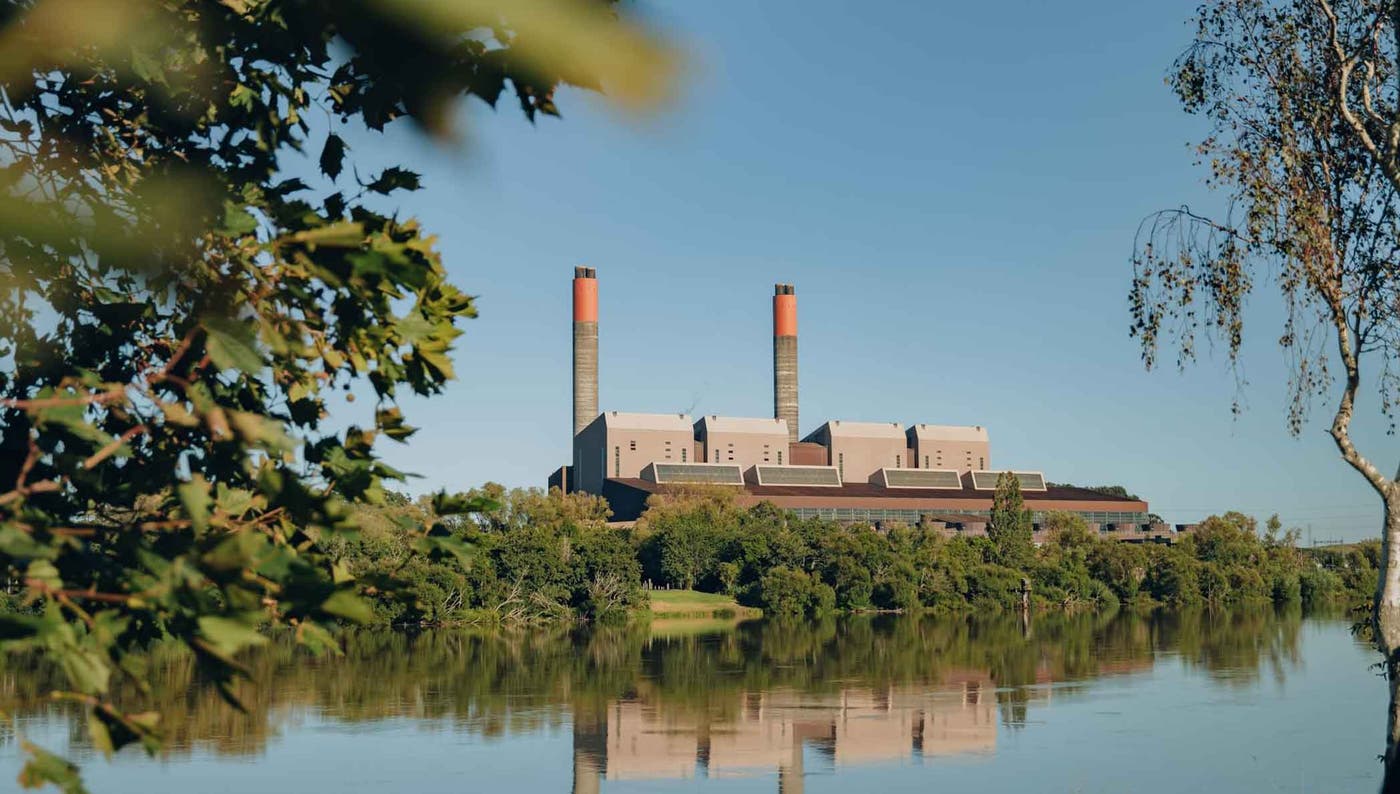
The Commerce Commission is giving plans proposed by the country’s four largest electricity generator-retailers a provisional green light, saying the proposed arrangements “create net public benefits that outweigh any potential lessening of competition”.
In August, Genesis, Mercury, Meridian and Contact shared their plans for a 10-year ‘Huntly Firming Options’ covering 150 megawatts, 50 megawatts each for Contact, Meridian and Mercury.
Genesis also planned to establish a fuel reserve of up to 600,000 tonnes for dry winters with low hydro flows.
The stockpile would be coal but Genesis has previously said the reserve may transition to biomass such as wood products as it becomes available in coming years.
The provisional green light also means one of Huntly’s three coal and gas powered Rankine units (Unit 2), which was set to be retired in February 2026, would still be working. Rankine is a thermodynamic cycle used in power generation.
On Tuesday, the Commerce Commission says it had issued a “draft determination proposing to authorise” the four electricity generator-retailers “to enter and give effect to a series of agreements referred to as the Strategic Energy Reserve Huntly Firming Option”.
This would now move onto the submission stage with a decision expected by February 2026.
“The Commission is provisionally satisfied that the proposed arrangements create net public benefits that outweigh any potential lessening of competition.”
The Commerce Commission also says it “provisionally considers it appropriate to authorise the proposed arrangements for 10 years, until December 31 2035”.
The proposed arrangements give Contact, Meridian and Mercury an option to access certain generation capacity from Genesis’ Rankine Units at the Huntly Power Station until then.
“In exchange, Contact, Meridian and Mercury will pay an annual premium, which Genesis will use to contribute to the cost of maintaining, operating, and resourcing the Rankine Units,” the Commerce Commission says.
The Commerce Commission’s associate commissioner Nathan Strong says authorising the proposed arrangements means Huntly’s Rankine Unit 2 can be made available to the wholesale market during dry winters.
“Our provisional view is that this will improve security of supply and lower wholesale prices while new capacity in the pipeline comes to market, compared to a situation where Unit 2 is retired.”
Strong says Genesis had told the Commerce Commission that 135 megawatts of Rankine capacity were unallocated.
“If these arrangements go ahead, Genesis has said it will design hedge products for the remaining Rankine capacity that are suitable for third parties such as independent retailers and generators, industrial customers and financial intermediaries.”
“We expect Genesis to promptly follow through on this commitment,” Strong says.
Call to adopt new energy policy
The New Zealand Council of Trade Unions – Te Kauae Kaimahi (NZCTU) on Tuesday called for the country’s electricity system to be brought back into public ownership.
NZCTU says this would involve the Government using dividends from its shares in the gentailers to purchase the remaining shares until it reaches full public ownership.
The Government currently has 51% ownership of Genesis, Mercury and Meridian.
NZCTU economist and policy director Craig Renney says: “We need to fundamentally change our approach to delivering electricity.
“Electricity supply and demand should be managed as an economic development and industrial policy problem – not a revenue maximising concern for shareholders.”
The Government is expected to make an announcement about the energy sector this week.