
Would you notice if the person you were speaking to in person suddenly looked and sounded totally different?
Don’t be too confident in your answer.
Two psychology academics submitted their study on a real-life switcheroo experiment on October 1, 1997.
 The experimenter (left) asks a man for directions. (Daniel Simons and Daniel Levin)
And the results were remarkable.
Daniel Simons and Daniel Levin conducted the experiment at a university campus in the US.
One experimenter would ask an unwitting participant for directions, handing over a map.
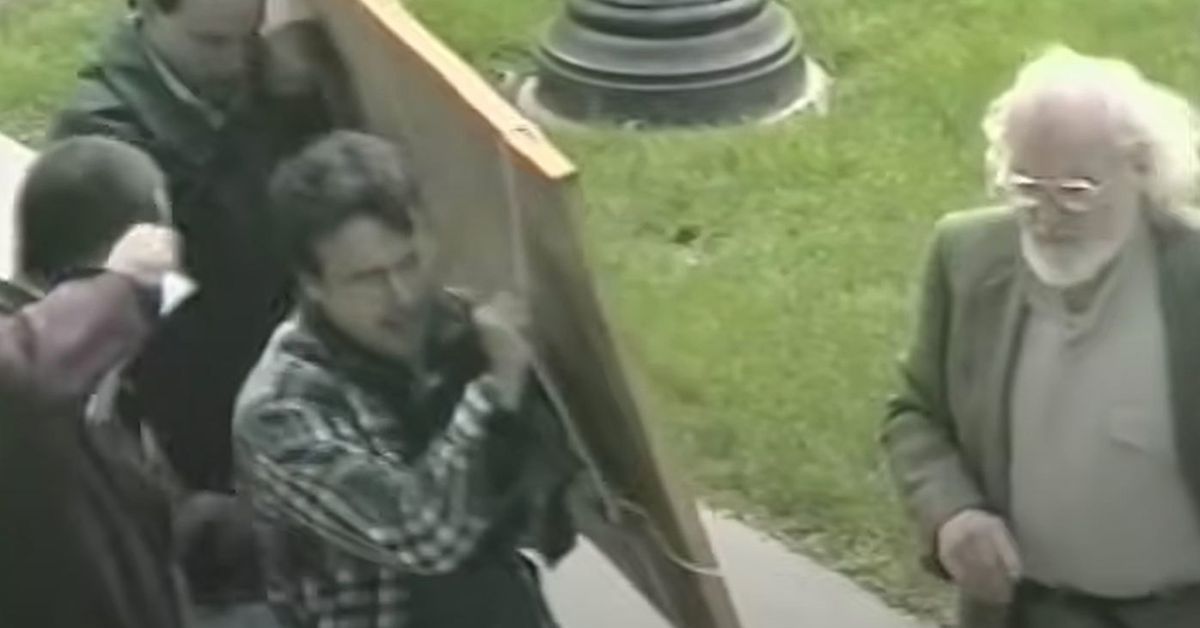
As the unwitting participant looked at the map and talked to the apparently lost man, two workers would walk between them holding a door.
 When a pair holding a door walk between them, the experimenter grabs the door, and another experimenter appears. (Daniel Simons and Daniel Levin)
In the moment the door is between them, the experimenter would switch places with another man.
The unwitting participant would then continue giving directions to a completely different man.
Afterwards, the new experimenter would say: “We’re doing a study as part of the psychology department of the sorts of things people pay attention to in the real world. Did you notice anything unusual at all when that door passed by a minute ago?”
If they didn’t pick the switch, the experimenter would ask: “Did you notice that I’m not the same person who approached you to ask for directions?” they would ask.
 The subject didn’t realise he was giving directions to a different man. (Daniel Simons and Daniel Levin)
Nearly half of the subjects of the experiment did not realise, even when prompted, that something amiss had happened.
When they did a similar experiment while dressed as construction workers, only one in three people noticed the change.
The phenomenon, as described in the Psychonomic Bulletin & Review, is called change blindness.