
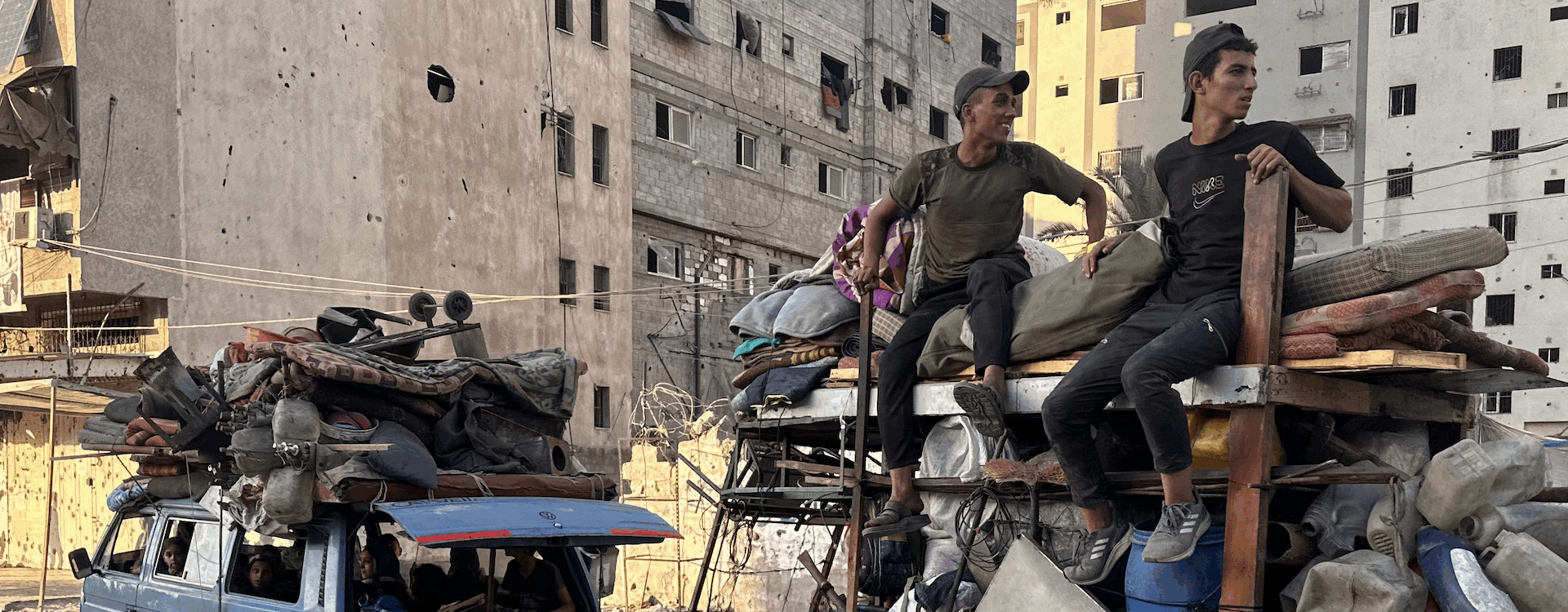
When the Israeli occupation resumed its military assault on the Gaza Strip on March 18 — after a two-month halt since the January 19 ceasefire agreement — Israeli forces ordered the strip’s residents to relocate to Gaza City. The city swelled with the displaced, its population of both original inhabitants and those displaced from elsewhere reaching approximately one million, according to the United Nations Office for the Coordination of Humanitarian Affairs (OCHA). Yet, by August, the Israeli military began encroaching upon the city, ordering its inhabitants to relocate again to the coastal Mawasi region in the south and announcing stage two of Operation Gideon’s Chariots with the aim of fully occupying Gaza City.
As the Israeli military made further inroads into Gaza City, large numbers of its inhabitants indeed fled, with OCHA estimating that over 388,00 people were displaced from the city between mid-August and September 23 alone. Palestinians continue to leave the city, carrying clothing, furniture and any other possessions they are able to transport in vehicles of all kinds, including donkey carts, while others make the journey on foot.
But not everyone is able to relocate. Some Palestinians cannot secure shelter in the south or afford the high cost of transport or even a tent to house their family. Others refuse to be displaced on principle, believing that if they’re forced to leave, they will never be able to return. In all cases, the displacement of large numbers of the population has turned much of the city into a ghost town, entire neighborhoods stripped of everyday life, their silence broken only by the boom of explosions as the Israeli occupation destroys one residential block after another.
Text and images: Zuheir Dola and Mostafa al-Bayed
1. A girl packs her belongings in preparation to move with her family from Gaza City to the south.

2. A family loads its belongings onto a truck in Shati camp as they prepare to move to Deir al-Balah.

3. A child in the Rimal neighborhood of Gaza City, whose family lacks adequate shelter and cannot afford to relocate elsewhere.

4. Vehicles transport families and their possessions via Gaza City’s Rashid Street toward the south.

5. A girl plays beside her family’s tent in central Gaza City, from which her family has refused to move.

6. Jalaa street, a major thoroughfare of central Gaza City, stands empty due to Israeli tanks positioned at its northern end.

7. A displaced family travels by donkey-drawn cart.

8. Despite his injury, 43-year-old Anis Aliyan was displaced from Shifa Hospital and has no access to transportation.

9. Gaza City’s Nasr neighborhood stands deserted amid the nearby advance of Israeli tanks.

10. Ahmed al-Bayed, 45, from Shahaba in central Gaza City, refuses to leave his neighborhood.
