
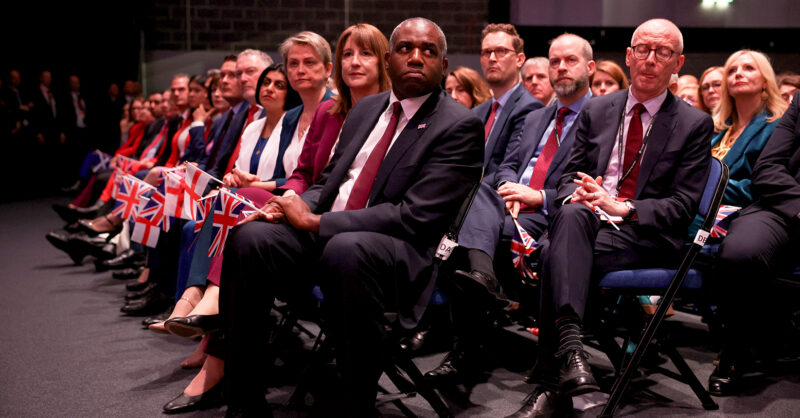
“It’s great to be in Liverpool,” began Sadiq Khan in his speech to the New Statesman’s Labour party conference reception on Sunday night. “I love the city, the people, the football. Oh, and I love the fact that it’s given me the chance to escape Shariah Law for a few days.” Boom boom.
It was nice to see Khan being himself like this; confident and amusing – and willing to poke fun at the most powerful man in the world, Donald Trump, whose fixation on the London mayor has become, frankly, sinister. Still, it has to be said that much of the rest of the Labour Party conference this year has not been quite so easy-going and self-effacing. In fact, the general mood in Liverpool this week, at least until Wes Streeting and Keir Starmer spoke yesterday, was one of low level agitation and annoyance, much of it aimed in the direction of Andy Burnham following his interview in last week’s magazine.
“If I call you ‘lad’ will you give me an interview like that?” snapped one particularly disgruntled cabinet member who felt I’d been soft on the Mayor of Greater Manchester because of his homely northern manner. Still, however annoying Burnham’s intervention had been for No 10, there was a general feeling that it had at least brought the government together at a moment of peril, strengthening the Prime Minister’s position and keeping him in place until at least the local elections in May next year. “It was the best thing that could’ve happened to us,” the same minister put it. For some other aspiring party leaders in the cabinet, of course, the criticism of Burnham has come with the added bonus that it has given them more time to stake their claim for the crown before what many of them still see as an inevitable changing of the guard come next year.
After the Prime Minister’s unusually impassioned speech, the general feeling that Burnham’s intervention had strengthened Starmer in the short term congealed into a deeper sense that this had been a “good conference” for the Prime Minister and the government after all. Starmer’s set-piece speech was certainly more authentic and convincing than his previous outings, setting out the moral and political dividing lines with Reform that he hopes will define the rest of this parliament and the next general election: decency vs division, stability vs chaos and, of course, himself vs Farage. Gone was the Prime Minister who crossed the floor of the Commons to chat amiably with the Reform leader as part of his wider charm offensive not to lose too many voters to Farage. In his place came an apparently crusading representative of progressive Britain locked in a battle for the soul of the country. “I will fight them with every breath I have,” Starmer declared as he reached his crescendo. The crowd loved it.
Yet, it was hard not to leave Liverpool without a gnawing sense that too many in the party remain in denial about the depth of the crisis in which they now find themselves. Burnham’s intervention in the pages of the New Statesman last week caused a stir not simply because of its substance, but because of the fragility of the government and the country at large which it exposed. If the Prime Minister was riding high in the polls and the economy stable and secure, the leadership aspirations and ideological musings of the Mayor of Greater Manchester would matter little in the public debate. The reason Burnham’s intervention did matter – and why the cost of government borrowing surged off the back of his remarks – is precisely because international investors look at the political fragility of this government and take the prospect of a change in prime minister seriously.
Rachel Reeves does not want to be “in hock to the bond markets” any more than Burnham and privately rails against the amount of money being paid out to American hedge funds each year. Yet, the very fact that a quote from a metro mayor can apparently rob her of more than £1bn in fiscal “headroom” ahead of the budget is itself an indictment of the political and economic model that Burnham was raging against and which has led Britain into the position it now finds itself in.
Once the adrenalin of the party conference season has worn off, this central reality of British politics will reassert itself: Britain might not be “broken” but that does not mean the status quo is in any sense functioning. The contrast, then, between the sense of growing relief within the gated conference zone and the reality of the England beyond its perimeter fence remains startling. Inside the Labour Party conference, Starmer had a good conference; outside he remains the most unpopular prime minister in modern history and the Labour Party is hovering below 20 per cent in the polls, on course to be wiped out much like the Tories before them. Fair or not, much of the country appears to have made its mind up about this Prime Minister. To survive, Starmer has to show that first impressions can be changed. The danger for Labour is that the public makes up its mind about the party more broadly first. As Ben Pimlott observed in his biography of Harold Wilson, there is an “iron law” of British politics: “A prime minister whose poll ratings show him (or her) to be failing as a populist leader, automatically comes under pressure.” This iron law remains in place and will not be shifted by one party conference, good or otherwise.

Subscribe to The New Statesman today from only £8.99 per month
Any political relief for Starmer following this conference is also likely to be short-lived. As things stand today, Lucy Powell is likely to win the deputy leadership of the Labour Party, perhaps at a canter according to some polls, standing on a platform which explicitly challenges the government’s authority and direction. Powell and her rival Bridget Phillipson understandably fulminate against the idea that they are merely proxies for their most high-profile supporters, Burnham and Starmer. But the fact that this election is considered by most Labour members to be a judgement on the direction of the government is the central reality of the contest and a victory for Powell will damage the Prime Minister and his control of the party machine.
The result of the Labour deputy leadership election will come in late October. A few weeks later, the Chancellor will deliver her budget, in which she will be forced to raise taxes yet again, putting further pressure on her public and parliamentary support – and that of the Prime Minister. And then in May the government will face the judgement of the electorate in local elections. Keir Starmer may be safe for now, but as long as the country remains as fragile as it is, so will the prime ministers who seek to lead it.
[Further reading: Keir Starmer’s conference speech: our writers’ verdicts]
Content from our partners