
Anthropologists like to debate which came first: bread or beer. Professor Patrick McGovern was always unequivocally on the side of beer. It is easier to make, he said, more nutritional and has a pleasant mind-altering effect — all incentives for hunter-gatherers to settle and domesticate grain. “I keep telling people that beer is more important than armies when it comes to understanding people,” he said.
A world expert on ancient fermented beverages, McGovern was perhaps an unlikely ambassador for prehistoric booze: Dr Pat, as he was known, sported an excessively bushy beard, a thatch of white hair, an array of cardigans and large wire spectacles. He was proper and polite, the epitome of the respectable professor.
Yet he was fervent in his belief that alcohol helped to make us human. The first alcoholic drinks were brewed, he suspected, from accidents of nature, such as the honey from a fallen beehive mixing with yeast in rainwater. He believed that cravings for certain drinks then spurred the domestication of crops, which in turn led to permanent human settlements.
“Grogs”, as he called prehistoric drinks, lubricated social gatherings and encouraged dancing, flirting, singing and cave drawing. They fostered new ways of thinking, facilitated negotiations, resolved clashes, brought the faithful closer to their gods and eased pain and disease at a time when synthetic drugs were not available and lifespans were short.
McGovern’s official title was scientific director of the biomolecular archaeology project for cuisine, fermented beverages and health at the Penn Museum in Philadelphia. More colloquially, he was known as “the Indiana Jones of alcohol” because he travelled across the world to identify and date ancient beverages. He discovered what is widely seen as the world’s oldest alcohol, a cross between mead and wine, on shards of 9,000-year-old pottery in Jiahu, a neolithic village in north central China. Traces of the oldest known barley beer, dated to 3400BC, were found on a dig in Iran’s Zagros Mountains, the oldest grape wine on 8,000-year-old pottery remains near Tbilisi in Georgia.
Since alcohol evaporates quickly, and evidence is largely circumstantial, the process was technically complex. Using a mix of chromatography, spectroscopy and DNA analysis, McGovern pursued what are known as fingerprint compounds: traces of beeswax hydrocarbons to indicate honeyed drinks, calcium oxalate, a by-product of brewed barley, and tree resin or tartaric acid for wine.
His office in Pennsylvania was peppered with ancient bronze drinking vessels and a wreath that his wife fashioned from wild local grape vines. Also on his shelf sat a dusty bottle of Midas Touch, evidence of McGovern’s love for what he called “experimental archaeology”. It was a concoction of Muscat grapes, saffron and honey that he helped to create in the early 2000s with the American brewery Dogfish Head, based on traces on vessels found in a tomb from 700BC associated with King Midas. Some purists said McGovern was “screwing with the history of brewing” when he toured spice stalls in Cairo to source ingredients and mailed samples to a Belgian lab, where the organisms were grown in large quantities. But to unveil our forebears’ drinking habits, he said, was to understand what it meant to be human.
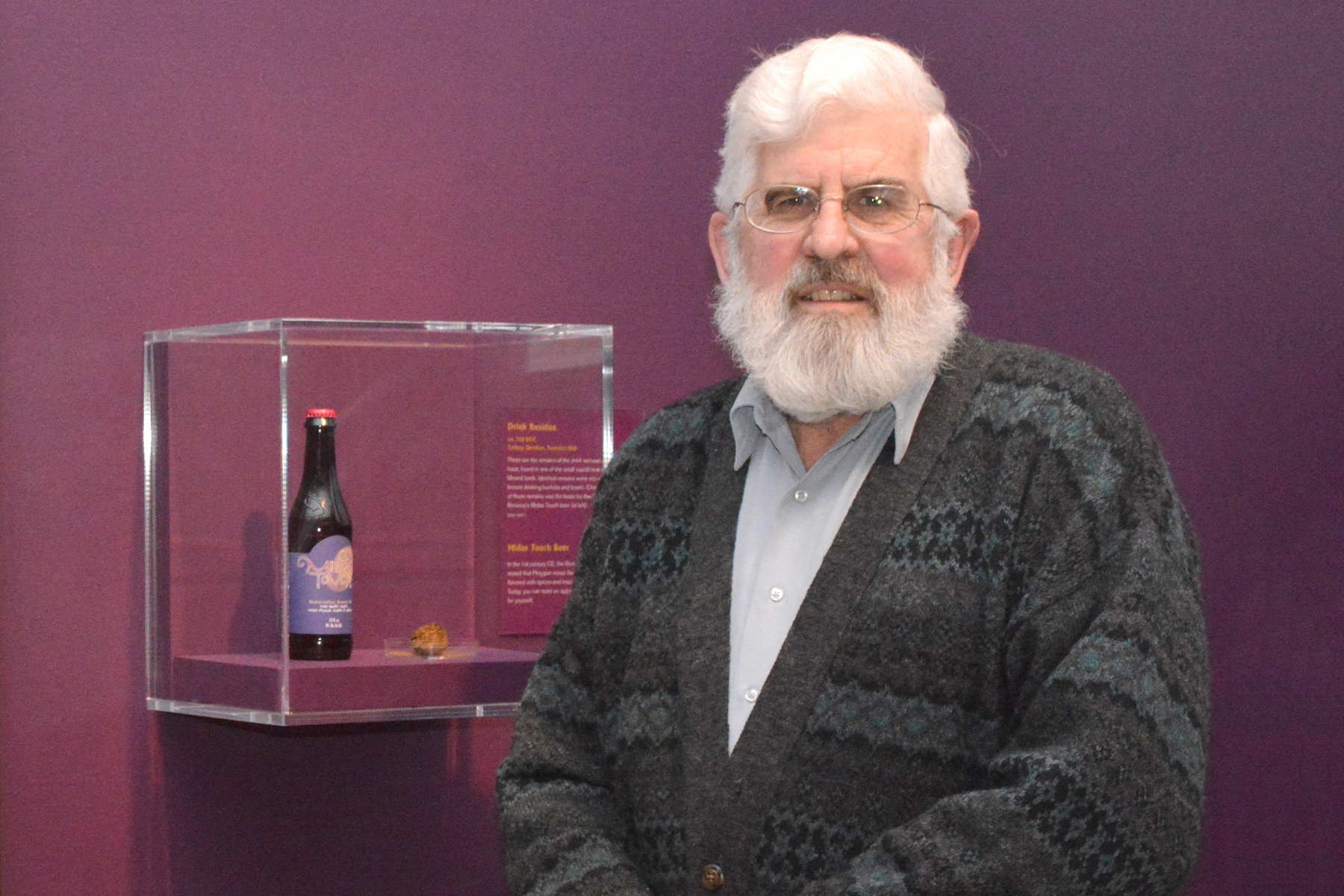
McGovern with a bottle of Midas Touch
PENN MUSEUM
Patrick Edward McGovern was born in 1944 in Texas, the son of Edward and Florence (née Brisbon). He credited his relationship with alcohol to a mixed lineage: in the late 1800s his Irish ancestors opened the first bar in Mitchell, a city in South Dakota; his Norwegian forbears were sober.
Though he studied chemistry at Cornell University, dabbling in neurochemistry and ancient literature, McGovern had little practical experience with alcohol until the summer of 1971, when he was travelling across Europe and the Middle East with Doris Nordmeier, a university administrator whom he married in 1972. As they passed through Germany’s Mosel wine region they got work as pickers for a local vintner, who let them stay in his house. It would be a fast and foggy education in wine. McGovern recalled that “by the end of the evening, when we were totally drunk — the worst I’ve ever been, my head going around in circles, lying on the bed feeling like I’m in a vortex — I knew that 1969 was terrible, ’67 was good, ’59 was superb.”
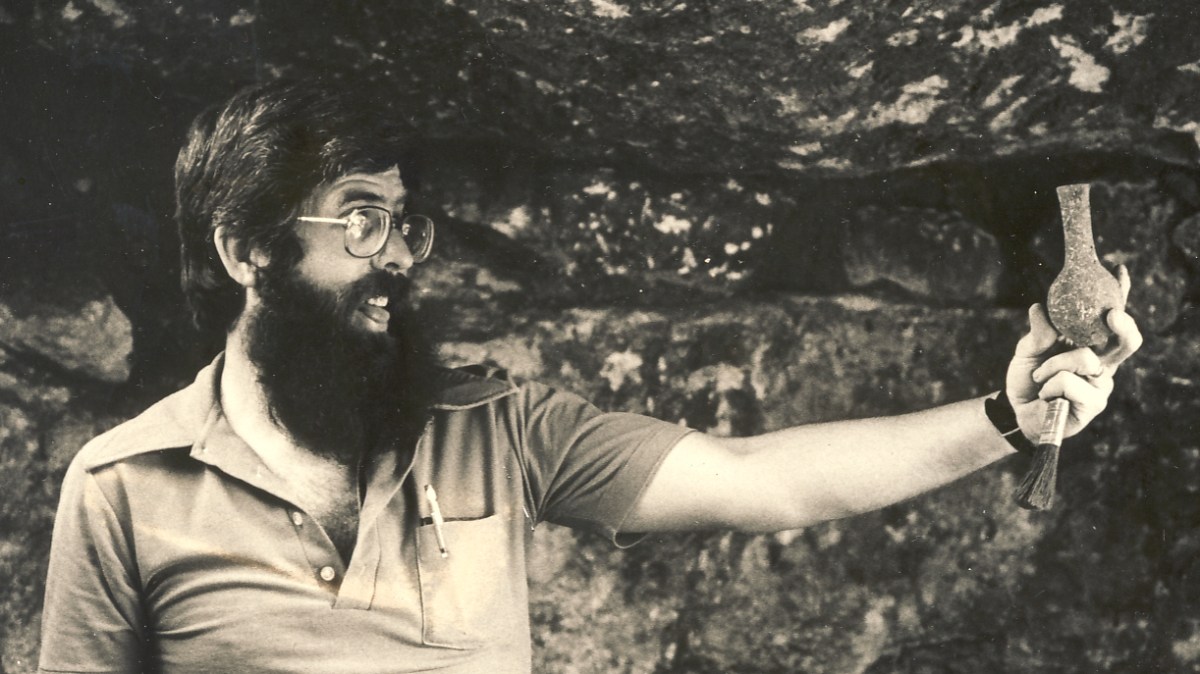
After graduate work in neurochemistry at the University of Rochester Brain Research Center, McGovern completed a PhD in Near Eastern archaeology and history at the University of Pennsylvania. He became an expert on Bronze and Iron Age pottery after directing a dig in Jordan’s Baq’ah Valley for more than 20 years. By the 1980s he was identifying remains of purple dye that the Phoenicians acquired by grinding up a particular species of Mediterranean-dwelling sea snail.
He was working in archaeological residue analysis, a field facetiously referred to by scholars as “drinkology” or “dipsology”, at a time when technology was making it easier to analyse tiny samples of organic matter. The last serious attempt to examine ancient alcohol was a chemical study in the late 1970s, which showed that a Roman shipwreck probably carried wine. In 1988, McGovern was shown a pottery jar from 3100BC with red stains and he used various tests — infrared spectrometry, liquid chromatography — to highlight traces of tartaric acid.
The resulting article McGovern wrote in 1990 was picked up by a Californian wine tycoon called Robert Mondavi, who used it to promote wine as part of “the temperate, civilised, sacred, romantic mealtime beverage recommended in the Bible”. McGovern was game. He helped Mondavi to organise an academic conference in Napa Valley, in which historians, linguists, oenologists and archaeologists chatted over lavish dinners and bottles of wine, and in 2003 they co-authored the book Ancient Wine: The Search for the Origins of Viniculture. “We were interested in winemaking from all different perspectives,” McGovern said. “We wanted to understand the whole process — to figure out how they domesticated the grape.”
If he could, McGovern liked to taste modern replicas of the ancient drinks he discovered, a kind of method archaeology. He once spent eight hours chewing corn to create Peruvian chicha, an apple-cider-like liquid originally drunk from vessels shaped like llama heads, reed boats or the skulls of enemies. There were limits to his methodology, however: in his book Uncorking the Past he wrote that in ancient Peru human sacrifices were “rubbed in the dregs of chicha and then tube-fed with more chicha for days while lying buried alive in tombs”.
Most of McGovern’s samples came from crypts, because ancient revellers were often buried with drinking apparatus so that they could drink for eternity. McGovern himself would have liked to be buried with a Mosel Riesling from the vintage he and Doris helped pick in the summer of 1971. “We had bottles of that wine that we let sit in the cellar for a while, and when we opened them up it was like some sort of ambrosia,” he said. “It was an elixir, something out of this world. If you were going to drink something for eternity you might drink that.”
Patrick McGovern, chemist and archaeologist, was born on December 9, 1944. He died of prostate cancer on August 24, 2025, aged 80