
Unlock the Editor’s Digest for free
Roula Khalaf, Editor of the FT, selects her favourite stories in this weekly newsletter.
Nato must step up its response to Russia’s hybrid war, which is “only the beginning” and is aimed at dividing Europe, the Danish prime minister has warned.
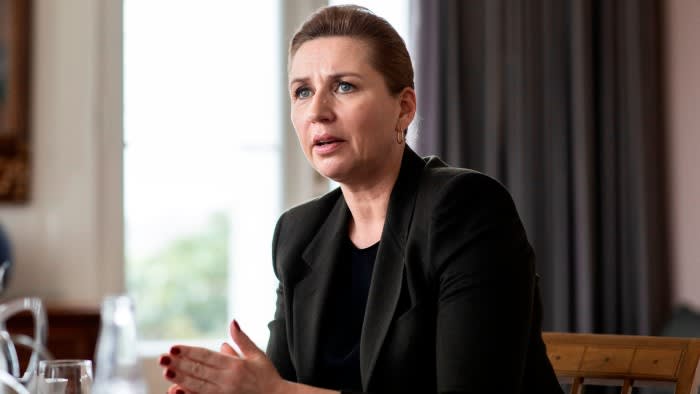
Mette Frederiksen told the Financial Times that there was a need to discuss “more deeply” within the western defence alliance on how to respond to Moscow’s hostile acts, ranging from airspace violations to sabotage.
“We need to be very open about [the fact] that it probably is only the beginning,” she said. “We need all Europeans to understand what is at stake and what’s going on. When there are drones or cyber attacks, the idea is to divide us.”
Drones of unknown origin shut down Denmark’s main airport and several regional ones as well as being spotted over multiple military locations last week in what diplomats have called a wake-up call for Europe.
 Copenhagen has not established who was behind its drone sightings, but the PM has said Europe’s ‘primary enemy’ is Russia © Leonhard Foeger/Reuters
The sightings in Denmark came after Russia repeatedly breached allied airspace with manned and unmanned aircraft this month, prompting Nato fighter jets to shoot down drones over Poland in the first direct encounter between the western defence alliance and Russian assets since Moscow’s full-scale invasion of Ukraine in 2022.
In response to the incidents, Nato held emergency talks twice and condemned Moscow’s “irresponsible acts”. It also launched “Eastern Sentry”, a military patrolling mission in eastern Europe involving additional air and ground systems from allies including Denmark, France, the UK and Germany.
Western intelligence has also pointed to Moscow for sabotage attempts over the past year, including arson attacks, the cutting of undersea cables and cyber attacks in countries such as Germany, Poland, the Baltic states and the UK.
Copenhagen has not established who was behind its drone sightings, but Frederiksen has said Europe’s “primary enemy” is Russia.
Increased European spending on anti-drone and cyber defence equipment alone would not suffice, she warned.
“The idea of a hybrid war is to threaten us, to divide us, to destabilise us. To use drones one day, cyber attacks the next day, sabotage on the third day. So this will not end only by [boosting] capabilities,” she said.
The Danish prime minister this week welcomes leaders from across Europe for two summits focused on bolstering the continent’s security and increasing support to Ukraine. While the first day is an informal meeting of EU leaders, Nato secretary-general Mark Rutte on Thursday will take part in a broader discussion with European leaders, including from Ukraine and the UK.
EU leaders will discuss proposals to expedite national and collective investments in air defences, including a “drone wall” in countries bordering Russia or Ukraine in response to the recent incidents. Denmark has said it would urgently buy new anti-drone capabilities after failing to detect or disable the airborne objects.
The US and several European countries — including Germany, France, Sweden, Norway and Finland — have offered anti-drone capabilities to Copenhagen. One Danish official said receiving technology from neighbouring Sweden, its historic rival, was “particularly humiliating”.
But Frederiksen disputed that, saying it was “not only in Denmark that we have these episodes”.
Diplomats working on preparations for the EU summit said they were confident of “broad consensus” among leaders, with formal sign-off at a follow-up summit in Brussels later this month.
EU officials working on the joint funding for the “drone wall” said they were aware of gripes from western and southern Europe that the bulk of such spending would benefit eastern and northern countries, and are trying to find ways that all members would gain.
Denmark is under pressure not just from its Europe’s adversary, Russia, but also its supposed main ally, the US. President Donald Trump has repeatedly said he wants to take control of the Arctic island of Greenland from Denmark, refusing to rule out using force to do so.
Frederiksen said she was “really proud of how Greenland has been able to handle this difficult situation”. She added that Denmark wanted to deepen its co-operation with all Arctic states apart from Russia when it came to security around Greenland.