
Searches for the companion were initially made using space-based telescopes, because observing through Earth’s atmosphere can blur images of astronomical objects. But these efforts did not detect the companion.
Steve Howell, a senior research scientist at Ames, recognized the ground-based Gemini North telescope in Hawai’i, one of the largest in the world, paired with a special, high-resolution camera built by NASA, had the potential to directly observe the close companion to Betelgeuse, despite the atmospheric blurring.
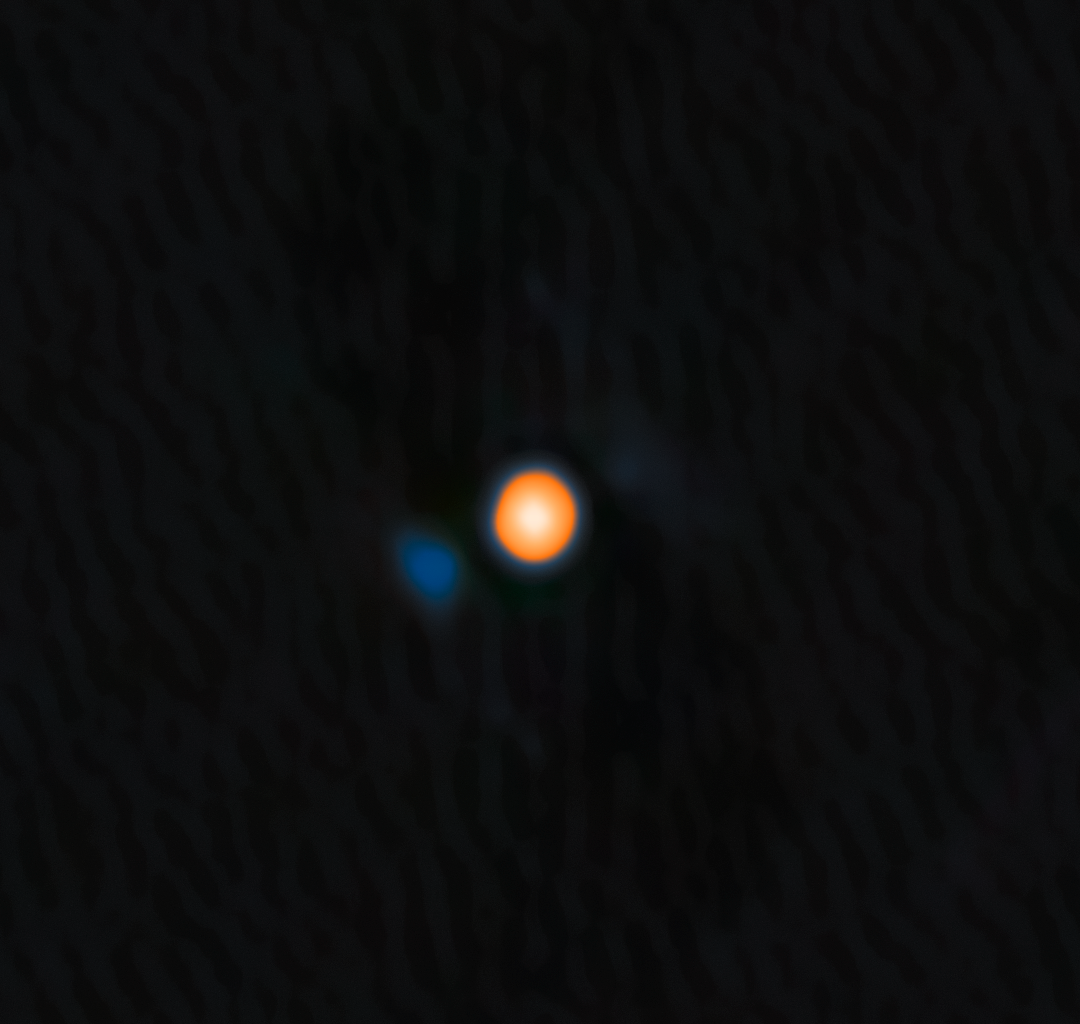
Officially called the ‘Alopeke speckle instrument, the advanced imaging camera let them obtain many thousands of short exposures to measure the atmospheric interference in their data and remove it with detailed image processing, providing an image of Betelgeuse and its companion.
Howell’s team detected the very faint companion star right where it was predicted to be, orbiting very close to the outer edge of Betelgeuse.
“I hope our discovery excites other astrophysicists about the robust power of ground-based telescopes and speckle imagers — a key to opening new observational windows,” said Howell. “This can help unlock the great mysteries in our universe.”
To start, this discovery of a close companion to Betelgeuse may explain why other similar red supergiant stars undergo periodic changes in their brightness on the scale of many years.
Howell plans to continue observations of Betelgeuse’s stellar companion to better understand its nature. The companion star will again return to its greatest separation from Betelgeuse in November 2027, a time when it will be easiest to detect.
Having found the long-anticipated companion star, Howell turned to giving it a name. The traditional star name “Betelgeuse” derives from Arabic, meaning “the hand of al-Jawza’,” a female figure in old Arabian legend. Fittingly, Howell’s team named the orbiting companion “Siwarha,” meaning “her bracelet.”
The NASA–National Science Foundation Exoplanet Observational Research Program (NN-EXPLORE) is a joint initiative to advance U.S. exoplanet science by providing the community with access to cutting-edge, ground-based observational facilities. Managed by NASA’s Exoplanet Exploration Program, NN-EXPLORE supports and enhances the scientific return of space missions such as Kepler, TESS (Transiting Exoplanet Survey Satellite), Hubble Space Telescope, and James Webb Space Telescope by enabling essential follow-up observations from the ground — creating strong synergies between space-based discoveries and ground-based characterization. NASA’s Exoplanet Exploration Program is located at the agency’s Jet Propulsion Laboratory.
To learn more about NN-EXPLORE, visit: