
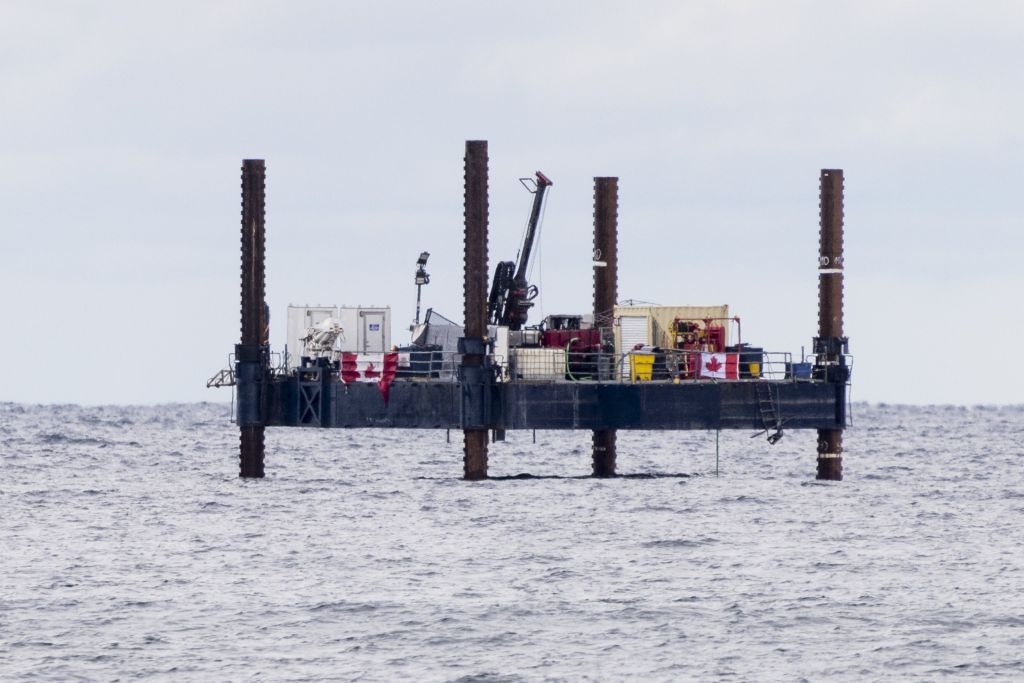
In late June, TC Energy representatives went door-to-door in Meaford, Ont., with flyers informing residents their view of Georgian Bay would look a little different this summer.
The flyers said the company would be bringing a large barge into the bay to conduct an offshore drilling program in what would be the fourth largest lake in Canada, if it wasn’t just a bay of the second-largest Great Lake: Huron.
The floating vessel would be positioned just off the shore of the 4th Canadian Division Training Centre, a military base on top of the protected Niagara Escarpment. Pending the test results of its exploratory drilling into the lakebed, TC Energy is proposing to build a 30-metre-deep, 375-acre-wide reservoir at the top of the escarpment that would hold water, pumped up from the bay and then released back through a pipe with turbines to store and generate energy.
TC Energy has dubbed the pumped storage proposal “one of Canada’s largest climate change initiatives:” a $4.5-billion energy storage project that could power one million homes for 11 hours at a time.
TC Energy pitched the project to the Department of National Defence in 2019, in hopes of using its land. Since then, the company has set up shop in Meaford to engage with residents, city council and the Saugeen Ojibway Nation — representing the Saugeen First Nation and the Chippewas of Nawash Unceded First Nation — to garner support.
In recent months, the provincial government has committed up to $285 million to the company to conduct pre-development studies, including the offshore drilling program.
The barge is a part of TC Energy’s environmental studies, led by engineering company WSP Canada.
“The offshore geotechnical program is one of many important studies we are undertaking to ensure [the Ontario pumped storage project] is designed and delivered to the highest environmental and technical standards,” Sara Beasley, a TC Energy spokesperson, told The Narwhal in an email. “The project will only proceed after successfully advancing through the regulatory process, and will be evaluated on its environmental, social and economic impact.”
Here’s what we learned about the barge on Georgian Bay, and the next steps for a controversial renewable energy project.
What’s with the barge on Georgian Bay?
The barge is a floating vessel used in shallow water bodies, typically up to around 120 metres deep. Where it’s sitting in Georgian Bay is around 100 metres deep.
It was towed into the bay in the last week of July and will stay there until mid-October, according to the company, assuming the weather permits uninterrupted testing.
It is being used to drill boreholes — narrow, deep holes in the ground — below the lakebed “to better understand the soil and rock composition,” Beasley said. She added that WSP has done similar offshore drilling in other areas of the Great Lakes.
Why is TC Energy conducting tests in Georgian Bay?
Beasley told The Narwhal the testing is a direct result of “feedback received from Saugeen Ojibway Nation and Meaford residents to move facilities into deeper water and reduce near-shore impacts” in 2022.
The company had initially proposed that the reservoir would be linked to the bay by a large pipe that would open near the shoreline, close to homes and cottages. The testing is an effort to see whether pushing that pipe farther into the bay and away from residents can be done safely.
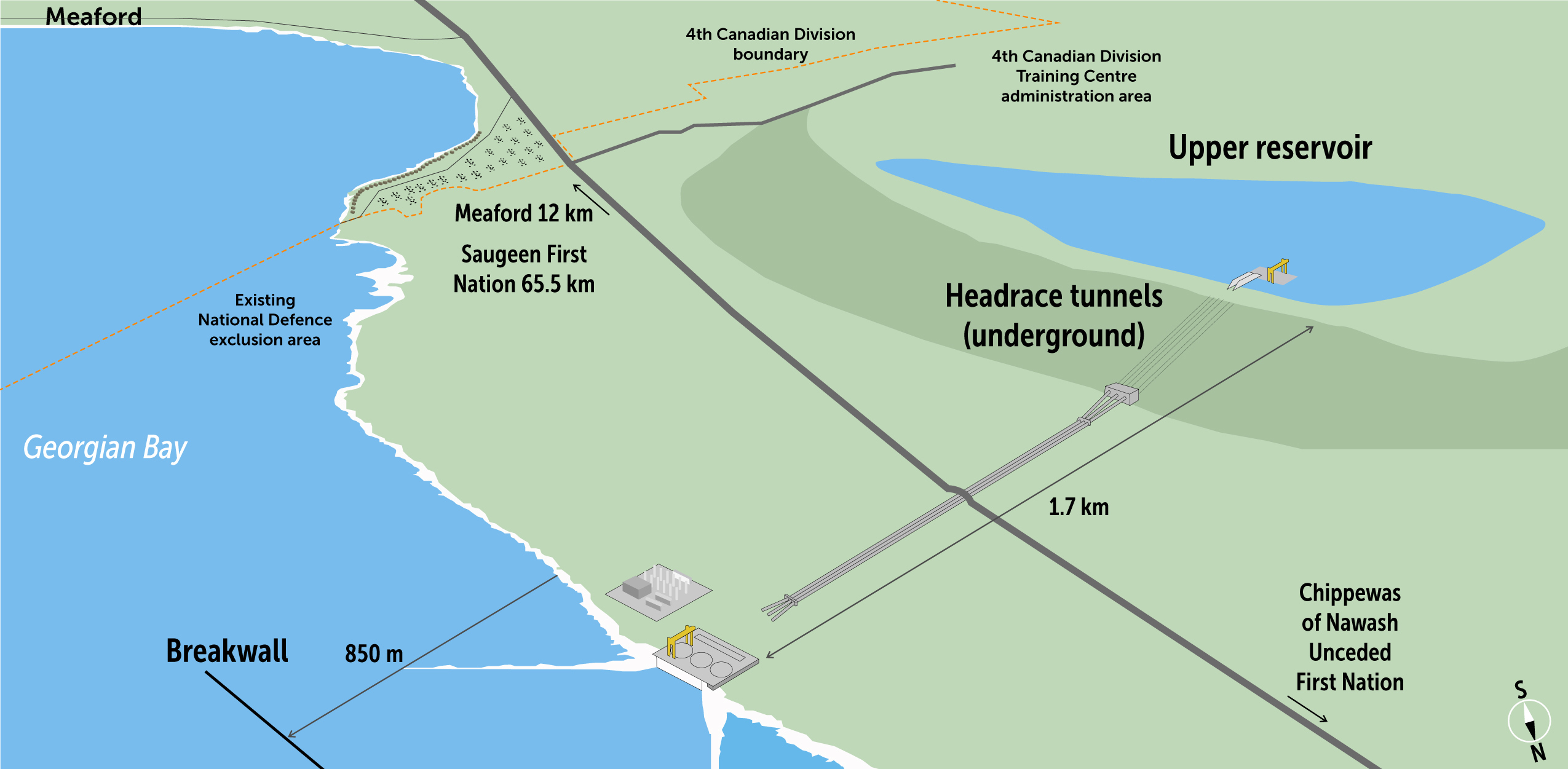 TC Energy’s pumped storage project would pump water from Georgian Bay to a reservoir on the Niagara Escarpment. Then it will release the water back to the bay through a pipe with turbines to generate and store energy. Map: Shawn Parkinson / The Narwhal
Who permitted TC Energy to conduct this testing?
Beasley told The Narwhal the company received authorization from both the Ontario Ministry of Natural Resources and Fisheries and Oceans Canada, also known as DFO, to undergo testing.
“We have also engaged on this with the Department of National Defence and Navigation Canada,” Beasley said.
The Narwhal emailed all four government departments for comment. None responded by the time of publication.
TC Energy said it also engaged with Saugeen Ojibway Nation members to support the geotechnical program. Chief Conrad Ritchie of the Saugeen Nation said the company informed them that they would be conducting tests in the bay. “You have to be able to gather all the right information to assess any project,” Ritchie said.
He added that TC Energy had committed to sharing the results of the testing from the rig.
Will TC Energy’s testing of Georgian Bay have any harmful impacts on the environment?
Beasley said Fisheries and Oceans Canada has issued advice and guidance to the company “to avoid impacts to fish and fisheries,” which includes adhering to a strict timeline and a planned program.
“Protecting Georgian Bay is a key priority for us throughout all phases of project development,” Beasley said. As one example, she said WSP is using a dual-casing system to ensure the drilling process doesn’t impact the waters. That means a smaller steel pipe, which does the drilling, is inserted into the lakebed encased in a larger steel pipe so that any sediment or fluids released during the process are fully contained and removed from the bay.
“Once drilling and testing are complete, each borehole is filled with cement to seal it permanently and prevent any future water ingress,” Beasley said.
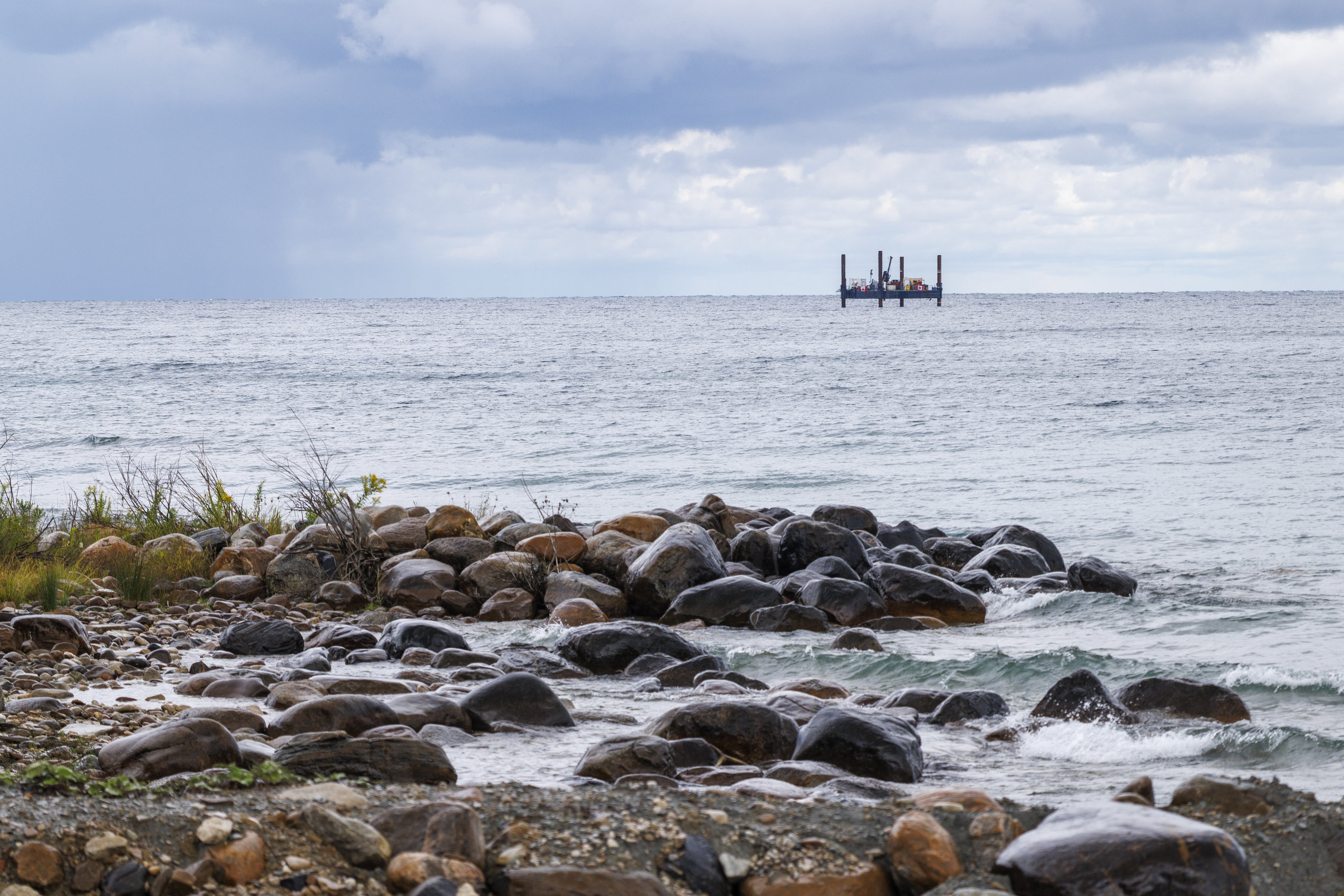 Test results from TC Energy’s temporary drilling rig in Georgian Bay will be used to inform future decisions about the viability of the company’s pumped storage project near Meaford, Ont. An official environmental assessment of the proposal is expected to begin later this year. Photo: Carlos Osorio / The Narwhal
But some residents remain concerned. Georgian Bay has never been disrupted by this sheer magnitude of human activity. Several scientists have previously told The Narwhal it’s a delicately balanced ecosystem with a highly sensitive food web. The bay has so far remained relatively safe from pollution or excess algae, and also testing like the kind TC Energy is doing now.
“I take this barge as a harbinger of what may come with construction on a huge scale in Georgian Bay and on its shores,” Tom Buck, the head of Save Georgian Bay, a residents’ group opposing TC Energy’s pumped storage project, told The Narwhal. “To me, it is a horrible sign of bad things to come.”
“The rig has made the project seem more real,” he added. “When you see a large machine sitting out in the bay from a long way away, it feels like a big deal.”
How will the results of TC Energy’s testing be used?
TC Energy will begin an official environmental assessment later this year, as mandated by federal law. The results of the current testing will be incorporated into an updated design proposal and shared for public review and feedback as part of the regulatory process.
What happens next — and why does this matter?
Ontario is facing an energy supply crunch as it prepares for a future of data centres and industrial electrification. Energy storage, including the project proposed by TC Energy, is being strongly considered by the province as an effective way to bridge the supply and demand gap.
There is increasing concern about how Ontario is addressing its energy problems and who it is listening to. In recent months, the provincial government has adopted an “all of the above” approach to energy generation, encompassing both nuclear and renewable energy sources, as well as the fossil fuel natural gas. However, it has also made it easier for projects like this one to be approved by weakening environmental assessment rules through Bill 5.
While Meaford city council has already declared its willingness to host the project, TC Energy’s pumped storage facility cannot be built without the approval of the company’s board of directors, as well as the federal and provincial governments and Saugeen Ojibway Nation. The results of this testing will likely be part of those conversations.
TC Energy has previously told The Narwhal it will not proceed if the nation isn’t on board. “We’re not doing this project without them,” John Mikkelsen, the director of power and energy solutions, said in 2023. “We’ve put it in writing: we will not do this project if we don’t have the support of the Saugeen Ojibway Nation. We will walk away.”
Ritchie said Saugeen Ojibway Nation continues to consult its community about its partnership with the company on this project.