
Kemi Badenoch has said she wants to be Britain’s Javier Milei as she held up Argentina’s state-slashing president as the economic and political template to revive the UK and her own flagging party.
In an interview with the Financial Times, the Conservative leader was asked whether Britain needed a Milei, who has brandished chainsaws to illustrate his zeal for cutting spending, and whether she was such a politician. “Yes and yes,” she replied.
She also warned her party against following Nigel Farage’s Reform UK down the path of anger and despair. “We cannot be a repository for disenchantment,” she said. Conservatism had to be about “offering hope, fixing problems”.
The Tory leader, whose party is languishing in third place in opinion polls behind Reform and Labour, said she would champion a leaner state and fight Labour’s tax rises, as she sharpens her party’s economic message.
Badenoch said Milei, who has cut spending, liberalised trade and reduced inflation since becoming Argentina’s president in 2023, was honest with voters about his plans and is now delivering results.
“Milei is the template,” she said.
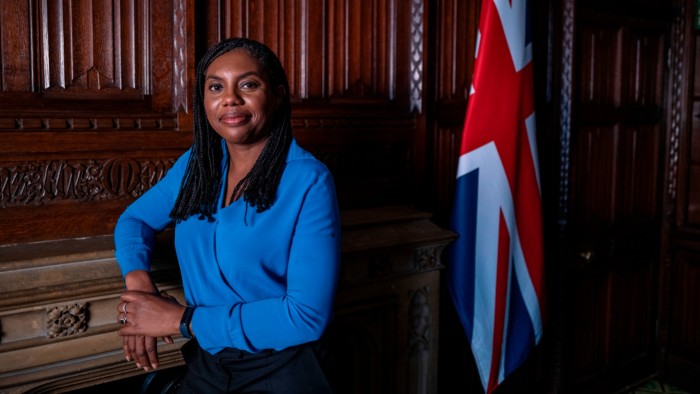
In an interview in her spartan, wood-panelled House of Commons office, Badenoch dismissed Westminister talk that time was running out on her leadership.
“I can’t spend all my time worrying about regicide. I would lose my mind,” she said, adding: “I’m so thick-skinned to the point where I don’t even notice if people are trying to create harm. That’s extremely useful in this job.”
She cited “muscle memory plus trial and error” as helping her grow in the role, although she admitted voters had not forgotten the chaotic end of 14 years of Tory rule: “The public are not yet ready to forgive.”
Badenoch has often been defined in the media — unfairly, she claimed — for her tough language on cultural issues such as trans rights or immigration, but she said her overriding focus now was on the economy — a demand of shadow cabinet members.
“People are hearing more about the economy because I am being very, very relentless in pursuing this particular case, almost to the exclusion of everything else,” she said.
Badenoch sees Sir Keir Starmer’s government, struggling to control state spending and expected to raise taxes in the autumn Budget, as vulnerable to attacks from a party promising a smaller state and lower taxes.
She said she was “terrified” by levels of government debt and the sight of the state “spreading its tentacles everywhere”, crowding out what she believes is the productive, wealth-creating economy.
Apart from a new football regulator, it is less clear what, exactly, Badenoch would cut. She has promised big reductions in health and disability benefits but ruled out scrapping the pensions “triple lock”, which some economists fear will end up overwhelming the public purse with its generous annual increases.
Her party refused to back Labour’s £5bn of cuts in the House of Commons earlier this month, arguing that the plan was ill-conceived and would not have helped move people back into work.
“It’s not about cutting bits of the state,” she said, warning against simply “top slicing” spending. “It’s about looking at what the state does, why it does it.” She has set up a series of policy commissions to draw up plans for government, although some Tory MPs believe she needs to flesh out her agenda soon.
The Tory leader said she was worried that “wealth is being driven out of the country” by high taxes, but was “more worried that young people are leaving as well”.
On the threat from Reform, which Badenoch said was “stealing everyone’s oxygen”, she is pinning her hopes on voters eventually seeing through what she claims is an empty and more leftwing party.
She says the Tories can win back support from a public that will tire of Farage’s “bullshitting”. Farage, she argues, is positioning his party to the left of the Conservatives, with his proposals to nationalise industries and his call for the lifting of the two-child benefit cap, at a cost of more than £3bn.
In spite of her focus on the economy, Badenoch is expected to return to familiar themes of immigration at her party’s annual conference in Manchester in October, with a renewed onslaught on the European Convention on Human Rights.
Recommended

Badenoch insists the Conservatives can be “super tough on immigration without allowing the rhetoric to go out of control” and that it was right that in her first big speech as party leader she apologised for the Tory record on the issue.
Asked about comments by Robert Jenrick, shadow justice secretary, about a fall in the “white British” population in some areas, Badenoch said: “People will use different words from what I would use. I’m not a micromanager.”
Jenrick, like Farage, has become adept at using short TikTok films to get his message across, some would say to further his ambitions to succeed Badenoch should her party decide to oust her.
Badenoch said the Tories had to move “to this new multi-platform era” but, referring to Farage’s highly popular TikTok operation, said: “Time is the factor. If you’re not doing anything else, you can do TikTok morning, noon and night.”