
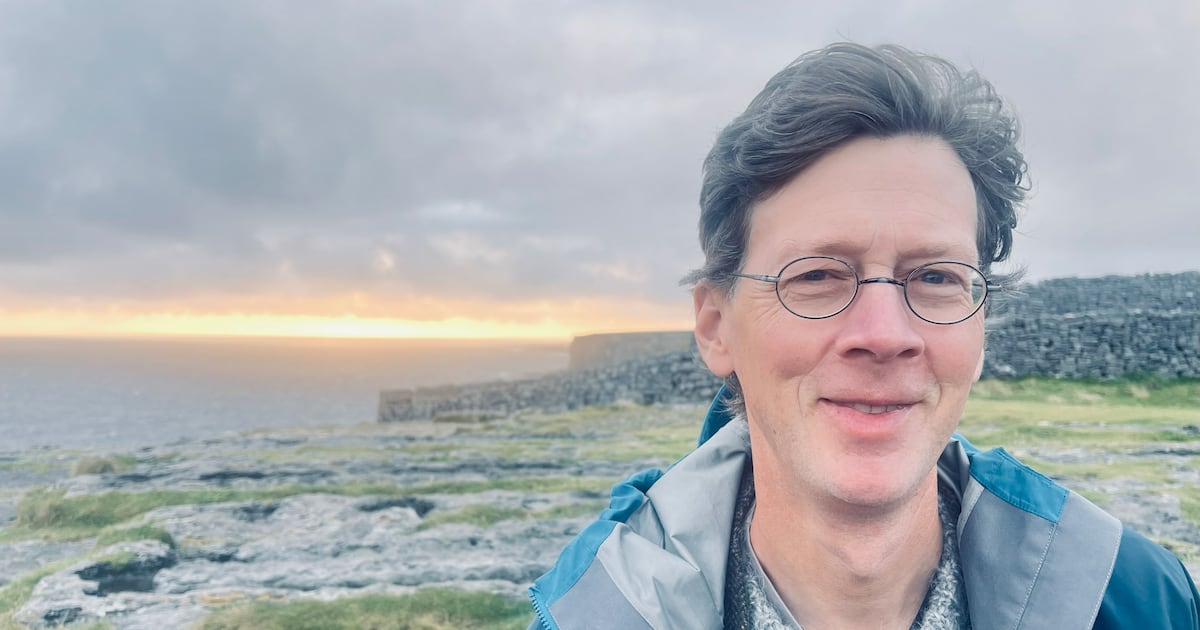
Writer and documentary maker Manchán Magan has died at the age of 55.
The former Irish Times columnist was diagnosed with a rare and aggressive form of prostate cancer, neuroendocrine. He spoke about his terminal condition in a radio interview last month, saying he hadn’t felt much despair or self pity.
His family confirmed he died in Dublin last night.
Mr Magan, a Dublin native, spent summers of his youth in the west Kerry Gaeltacht, nurtured by his “terrier-like” grandmother, a veteran republican who he said viewed him as “another foot soldier in this cultural war”.
For the last quarter century he lived in an oak wood with bees, hens and occasionally pigs, in a grass-roofed house near Lough Lene, Co Westmeath.
He contributed to The Irish Times as a writer on culture and travel.
Irish Times deputy editor Conor Goodman paid tribute to the late journalist, saying: “Manchán Magan was a person of extraordinary vision, talent and sensitivity. As a traveller, writer, broadcaster, naturalist and advocate for the Irish language, he made profound contributions to Irish life.
“His 2020 book Thirty-Two Words for Field was not only beautifully executed, but to Manchán’s surprise and great pleasure it found a loyal audience among readers in their teens and 20s. This and other recent works by Manchán are significant factors in a revived interest in Irish language and culture in recent years.
“He was also true to his principles, building his own sustainable home and forsaking air travel several years ago – sacrificing both the income and the appealing lifestyle of a travel writer.
“We often use the term ‘force of nature’ to denote a very assertive person, but Manchán was a force of nature in a better sense: gentle, yet powerful, inspiring and humbling. Ní bheidh a leithéid ann arís.”
Mr Magan presented an RTÉ podcast called The Almanac of Ireland. His illustrated books include Tree Dogs, Banshee Fingers and other Irish Words for Nature, and Wolf-Men and Water Hounds.
He has made dozens of documentaries on issues of world culture for TG4, RTÉ and the Travel Channel. Many of his programmes were produced with his film-making brother Ruán Magan for TG4 and RTÉ.
Manchán Magan’s two-part radio documentary series Listen to the Land Speak aired on RTÉ One last July.
Mr Magan was also on the board of Hometree, a native woodland and land regeneration charity, and was an ambassador for the Rivers Trust.
Mr Magan’s Thirty-Two Words for Field is a catalogue of lost words to describe the Irish landscape. The book recalls ancient Irish terms such as “scim”, which can mean a thin coating of particles – for example, dust on a shelf – “but it can also mean a fairy film that covers the land, or a magical vision, or succumbing to the supernatural world through sleep”, he wrote.
In a radio interview last month, Mr Magan confirmed he had terminal prostate cancer and that the disease had spread to multiple organs.
During the September 13th interview with Brendan O’Connor on RTÉ Radio 1, he said: “This sort of cancer that I’ve been playing with for the last year and a half suddenly took a bout, a turn, and started spreading through [my body].
“My brother plays a game. He says mention any limb in your body Manchán, and I bet you have cancer in it. So far, that seems to be [the case]. It’s in a bit of my lungs and my brain and my liver, etc, etc, etc.”
As to whether he had been given a timescale on his illness, he said: “We might get a year or two, and we’ll definitely get another few months.”
Mr Magan was there to discuss his latest book: Ninety-Nine Words for Rain (and One for Sun), which is the latest project to emerge from what he described as his “cancer of creativity” over the last few years.
“It’s only prostate cancer,” he said. “It’s like the easiest cancer. But there’s some rare, particular type of prostate cancer that’ll just devour you.”
He said his pain levels depended on the day but most days he could not think or write but he hoped and expected to complete another book he had started.
“For some reason, there hasn’t been much despair or there hasn’t been much ‘Why me? Why me?’ – I don’t know why. There’s a lot of pain, even despite all the oxycodone or whatever painkillers I’m on,” he said.
He said there was a chance he could improve for a period and he hoped to travel again with his wife Aisling.
He is survived by Aisling, his mother Cróine and his three siblings.