
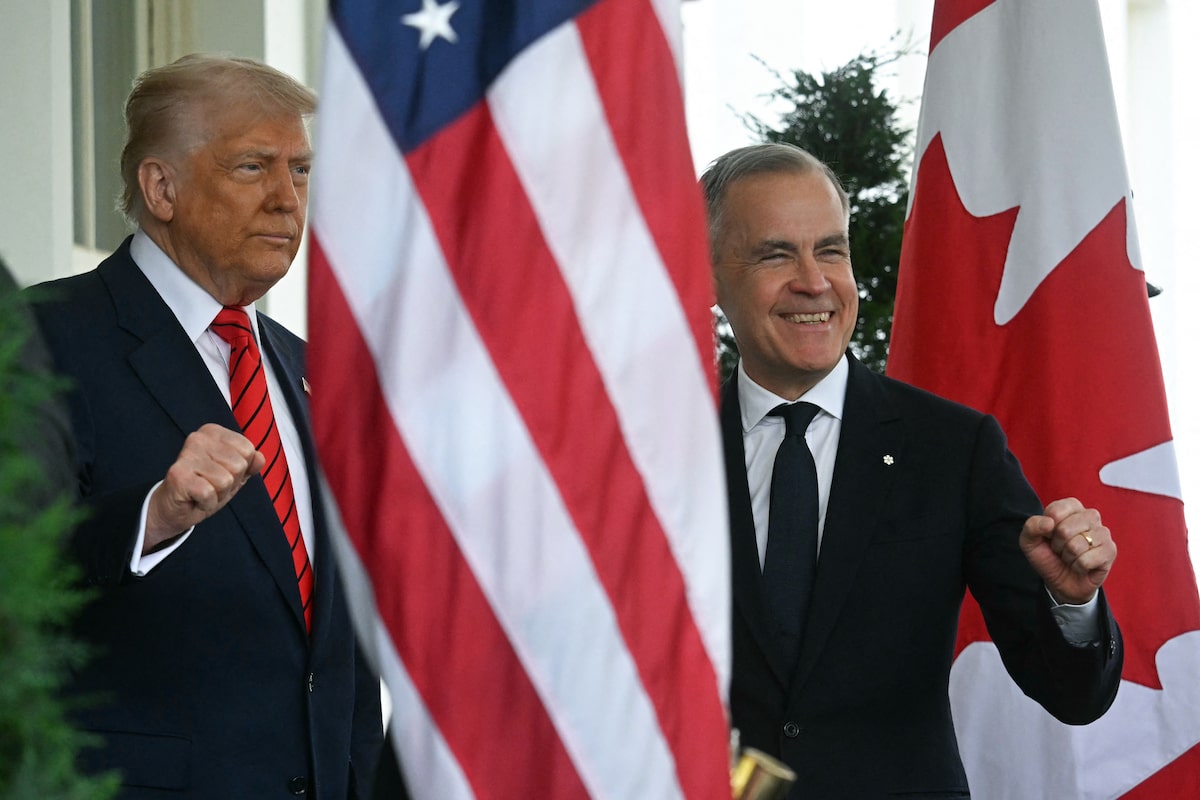
U.S. President Donald Trump greets Prime Minister Mark Carney at the White House in May. Next week’s trip will be Carney’s second time travelling to the U.S. capital since taking office.JIM WATSON/AFP/Getty Images
Prime Minister Mark Carney is flying to Washington Monday for a meeting with U.S. President Donald Trump to seek a deal to end or reduce U.S. tariffs.
Mr. Carney will meet with Mr. Trump at the White House Tuesday before returning home the next day, the Prime Minister’s Office said in a statement.
This will be the Prime Minister’s second trip to the White House since taking office this year. After his last meeting with Mr. Trump in May, Mr. Carney emerged without any measurable progress in ending a costly trade war but also avoided any sign of conflict with the mercurial U.S. President.
“The Prime Minister’s working visit will focus on shared priorities in a new economic and security relationship between Canada and the U.S.,” the Prime Minister’s Office said in a statement Friday.
U.S. tariff revenue piles up as Canada abandons tit-for-tat trade war approach
Canada, Mexico and the United States are preparing for a scheduled review of the United States-Mexico-Canada Agreement, with the Trump administration expected to seek more concessions for U.S. industry.
The Prime Minister’s Office noted Canada and the United States recently launched consultations that will inform the review of the USMCA.
The U.S. envoy to Canada, Pete Hoekstra, recently said the Trump administration had hoped to negotiate a grander bargain with Canada than simply a renewal of the USMCA – a deal that would have encompassed a multitude of issues, including defence, energy and autos.
Canada is in talks with the U.S. over Mr. Trump’s proposed “Golden Dome” missile defence system, which would connect the U.S.’s existing missile defences and expand them, even adding defences in outer space.
LeBlanc hopes to make progress on steel, aluminum tariff relief before USMCA review
Since returning to office earlier this year, Mr. Trump has hit Canada with a string of tariffs: 50 per cent on steel and aluminum, 25 per cent on autos – with a carveout for U.S. parts – and 35 per cent on any goods traded outside the USMCA, with the exception of oil, gas and potash, which are subject to 10-per-cent tariffs.
On Sept. 30, Mr. Trump imposed a new 10-per-cent tariff on Canadian softwood lumber shipments, raising the total levy on softwood from Canada to more than 45 per cent. Upholstered furniture, kitchen cabinets and bathroom vanities also face new tariffs of 25 per cent, effective Oct. 14.
Mr. Trump earlier this week revived his talk of annexing Canada in a conversation with Canadian officials. In his speech to U.S. generals and admirals at the Marine Corps. base in Quantico, Virginia, the President reiterated that Ottawa wants to join his proposed Golden Dome missile defence system.
Trump calls for using U.S. cities as a ‘training ground’ for military in unusual speech to generals
“Canada called me a couple of weeks ago, they want to be part of it, to which I said, ‘well, why don’t you just join our country, you’d become 51, become the 51st state, and you’d get it for free,’” he said in the speech. Mr. Trump did not specify to whom exactly he had spoken in the Canadian government or when the conversation took place. “I don’t know if that made a big impact, but it does make a lot of sense.”
Mr. Trump added that his tariffs on Canada — 50 per cent on steel and aluminum, 25 per cent on autos and 25 per cent on anything traded outside of the USMCA, except oil and gas at 10 per cent — are hitting the Canadian economy and pushing investment to instead go to the U.S.
“They’re having a hard time up there in Canada now because, as you know, with tariffs, everyone’s coming into our country. We have more investment than we’ve ever had before,” he said. “They’re coming in from Canada, Mexico, from Europe, from all over — AI, auto plants — everybody’s coming back to the United States.”