
Breadcrumb Trail Links
Published Jul 23, 2025 • Last updated 13 hours ago • 3 minute read
You can save this article by registering for free here. Or sign-in if you have an account.
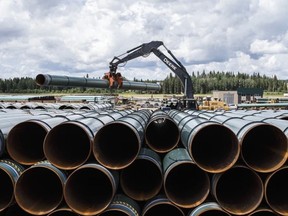 Pipe for the Trans Mountain pipeline is unloaded in Edson, Alta., in 2019. Photo by PNimg /Winnipeg SunArticle content
Manitoba Premier Wab Kinew chose not to sign a new interprovincial trade agreement unveiled Tuesday by Alberta, Saskatchewan, and Ontario, citing the need for Indigenous consensus before moving forward with major infrastructure projects.
Advertisement 2
This advertisement has not loaded yet, but your article continues below.

THIS CONTENT IS RESERVED FOR SUBSCRIBERS ONLY
Subscribe now to read the latest news in your city and across Canada.
Exclusive columns by Ryan Stelter, Paul Friesen, Ted Wyman, Scott Billeck, Lorrie Goldstein, Warren Kinsella and others. Plus newsletters: Gimme Stelter for your beat on the city, The Exit Row for all your Jets news and On the Rocks for curling.Unlimited online access to Winnipeg Sun and 15 news sites with one account.Winnipeg Sun ePaper, an electronic replica of the print edition to view on any device, share and comment on.Daily puzzles, including the New York Times Crossword.Support local journalism.
SUBSCRIBE TO UNLOCK MORE ARTICLES
Subscribe now to read the latest news in your city and across Canada.
Exclusive columns by Ryan Stelter, Paul Friesen, Ted Wyman, Scott Billeck, Lorrie Goldstein, Warren Kinsella and others. Plus newsletters: Gimme Stelter for your beat on the city, The Exit Row for all your Jets news and On the Rocks for curling.Unlimited online access to Winnipeg Sun and 15 news sites with one account.Winnipeg Sun ePaper, an electronic replica of the print edition to view on any device, share and comment on.Daily puzzles, including the New York Times Crossword.Support local journalism.
REGISTER / SIGN IN TO UNLOCK MORE ARTICLES
Create an account or sign in to continue with your reading experience.
Access articles from across Canada with one account.Share your thoughts and join the conversation in the comments.Enjoy additional articles per month.Get email updates from your favourite authors.
THIS ARTICLE IS FREE TO READ REGISTER TO UNLOCK.
Create an account or sign in to continue with your reading experience.
Access articles from across Canada with one accountShare your thoughts and join the conversation in the commentsEnjoy additional articles per monthGet email updates from your favourite authorsSign In or Create an Account
or
Article content
The Memorandum of Understanding (MOU), signed during the Council of the Federation meeting in Huntsville, Ontario, commits the three provinces to collaborate on the construction of new pipelines, rail lines, and trade infrastructure. The goal is to expand market access for Canadian oil, gas, and critical minerals while reducing reliance on foreign trade partners.
Article content
Recommended Videos
Article content
Kinew’s absence from the agreement raises questions, especially given Manitoba’s geographic location as a natural link in any east–west corridor. However, in a public statement, the premier said Manitoba’s decision not to participate was intentional.
Kinew emphasized the need for consensus from Indigenous stakeholders before proceeding with major infrastructure projects. Manitoba previously signed a separate MOU with Saskatchewan and the Arctic Gateway Group.

The Winnipeg Sun’s Daily Headline News
Thanks for signing up!
Article content
Advertisement 3
This advertisement has not loaded yet, but your article continues below.
Article content
Under the new MOU, Ontario, Alberta, and Saskatchewan plan to construct pipelines using Ontario steel to carry western Canadian oil and gas to new and existing refineries in southern Ontario. The agreement also outlines plans to build a new deep-sea port in James Bay and expand rail lines connecting Ontario’s mineral deposits to western ports — projects expected to span multiple provinces.
Ontario Premier Doug Ford described the agreement as a response to growing international uncertainty, particularly the U.S. tariffs imposed by President Donald Trump.
“With the world shifting and unfair tariffs putting pressure on our economy, now is the time to build a resilient and self-reliant Canada,” Ford said. “Ontario, Alberta, and Saskatchewan are taking the lead.”
Advertisement 4
This advertisement has not loaded yet, but your article continues below.
Article content
Saskatchewan Premier Scott Moe said the deal will secure Canadian energy and mineral supply chains.
“This agreement signals that Canada’s energy future will be built by Canadians, for Canadians,” Moe said. “We’re committing to real projects — pipelines, rail links, and processing facilities — that will create jobs and strengthen our economy.”
Alberta Premier Danielle Smith added that the provinces are moving ahead despite regulatory delays at the federal level.
“Provinces that want to build and grow are uniting,” Smith said. “This is about action, not more talk.”
The MOU also includes a shared push for regulatory reform, advocating for a streamlined “One Project, One Process” federal review model and calling for greater deference to provincial authority over infrastructure projects. The agreement reaffirms a duty to consult with Indigenous communities and support equity partnerships in major projects.
Advertisement 5
This advertisement has not loaded yet, but your article continues below.
Article content
Kinew, however, said Manitoba’s approach must begin with Indigenous engagement — not follow it.
“Our government will not treat consultation as a box to check after decisions are made,” he said. “We believe reconciliation requires shared decision-making from the start.”
While the MOU remains open to future signatories, Manitoba’s non-participation leaves a geographic and political gap in the proposed corridor. With Alberta and Saskatchewan pushing east and Ontario looking west, Manitoba’s role in the project is now uncertain.
No timeline has been provided for further negotiations or whether Manitoba may revisit its position if consensus is reached with Indigenous stakeholders.
The agreement marks Ontario’s tenth interprovincial trade pact since April, part of a broader push to eliminate barriers under the Canadian Free Trade Agreement. Manitoba has yet to signal whether it intends to pursue a similar path independently or seek inclusion in future stages of the infrastructure plan.
As Canada looks to reduce external trade risks and strengthen internal supply chains, Manitoba’s decision to pause reflects a different strategy — one that prioritizes Indigenous input but may come at the cost of immediate access to infrastructure investment and trade partnerships. Whether that tradeoff pays off in the long term remains to be seen.
Article content
Share this article in your social network