
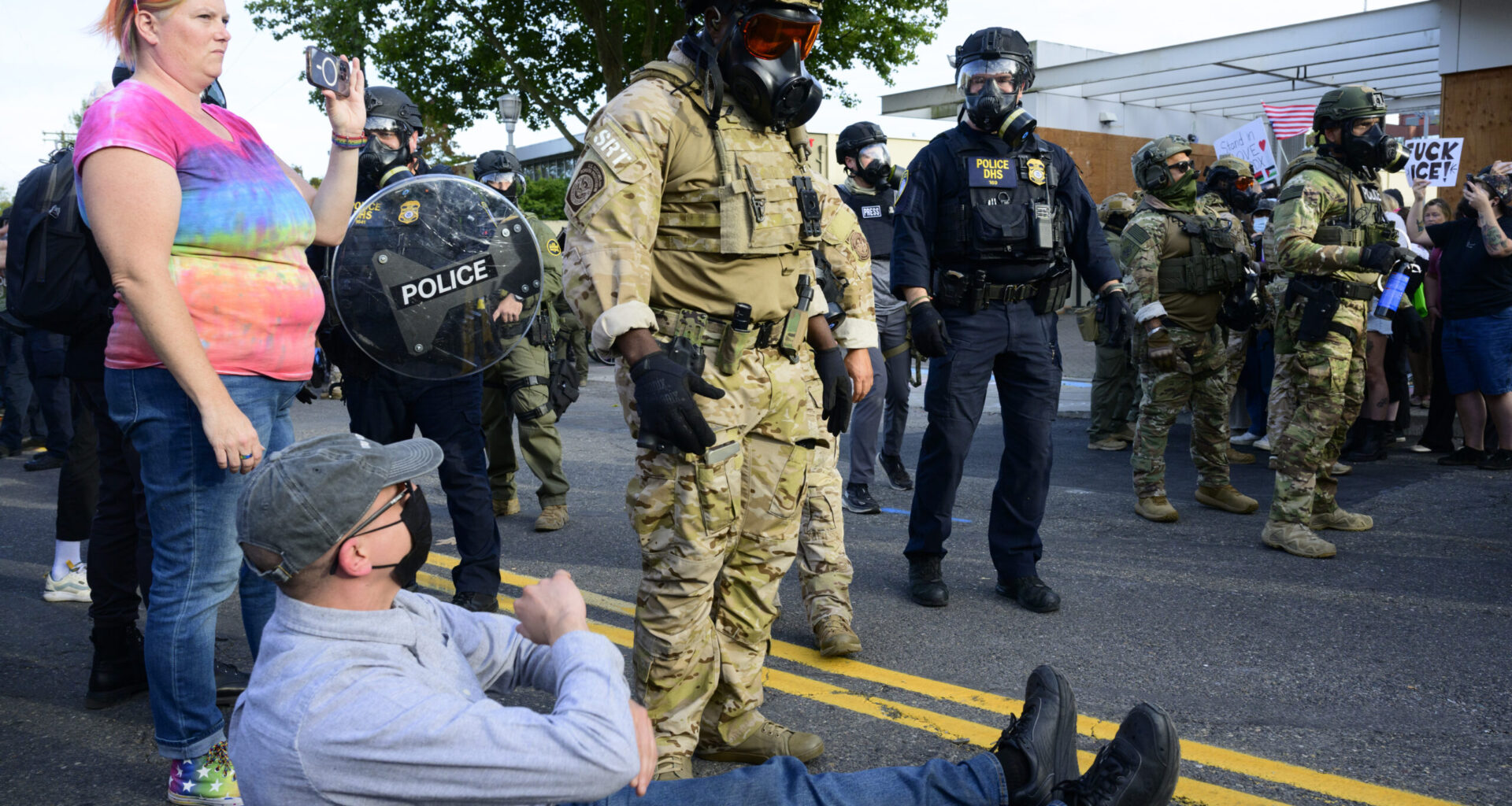
 Federal agents confront protesters outside of an Immigration and Customs Enforcement facility in Portland, Oregon, on Sept. 28. (Photo: Mathieu Lewis-Rolland/Getty Images)
A federal judge in Portland, Oregon, Friday appeared skeptical of the Department of Justice’s (DOJ) defense of President Donald Trump’s recent decision to send hundreds of troops to the City of Roses.
Through social media posts over the weekend, Trump claimed to deploy troops to Portland, asserting that “domestic terrorists” had an Immigration and Customs Enforcement (ICE) facility in the “War ravaged” city “under siege.”
“I am also authorizing Full Force, if necessary,” Trump said in one of the posts announcing the deployment.
In response to the president’s social media posts, Secretary of Defense Pete Hegseth signed a memo claiming to federalize 200 members of the Oregon National Guard for at least 60 days.
Oregon and Portland quickly filed a lawsuit challenging Trump’s deployment, calling it “patently unlawful” and an unconstitutional violation of state sovereignty. Friday’s hearing was over the state and city’s request for a court order temporarily blocking the deployment.
U.S. District Judge Karin Immergut, who was appointed by Trump in his first term, opened the hearing by stressing that a Ninth Circuit Court of Appeals panel held earlier this year that judges have the authority to review a president’s decision to federalize the National Guard under an archaic statute.
However, Immergut also took notice of the fact that the appeals panel also said that a court’s review must be “highly deferential” to the president’s decision.
While questioning the DOJ, Immergut noted that Hegseth’s memo did not cite recent events in Portland. It instead cited the executive order Trump signed in June to deploy at least 2,000 Guard troops to Los Angeles in response to protests over aggressive ICE raids throughout the city.
In his June memo, Trump federalized Guard troops using 10 U.S. Code 12406, an archaic statute that allows the president to mobilize the Guard when the country faces foreign invasion or rebellion or when the president is unable to execute laws with regular resources. Trump claimed that ICE-related unrest in LA amounted to a rebellion against the U.S. government.
Immergut asked DOJ attorneys if it was appropriate to federalize Oregon troops under 10 U.S. Code 12406 while citing events that occurred months ago in an unrelated city in another state.
Deputy Assistant Attorney General Eric Hamilton argued that there were no explicit geographic limitations in the statute that prevented the president from federalizing and deploying troops citing unrest occurring nationwide.
Hamilton also said that Trump’s authority to federalize troops was reflected in a series of social media posts announcing the deployment and describing why troops were needed — not the June LA order that Hegseth cited in his memo.
The judge also questioned Hamilton on whether social media posts could serve as the basis of troop deployment, saying she didn’t know how she could “consider a post-hoc rationalization for an order already issued.”
Hamilton argued that 10 U.S. Code 12406 doesn’t lay out a specific process or form the president has to follow or fill out to determine when a deployment is necessary, adding that the social media posts reflected Trump’s “decision-making.”
In defending Trump’s deployment, Immergut also noted, officials in court declarations and statements relied on protests in Portland from June and July, “old news, so to speak,” that were handled by local law enforcement.
Hamilton said the events from earlier this year were evidence of a “persistent threat” against federal officials working out of an ICE facility in southwest Portland.
Court declarations from Portland and Oregon state police officials earlier this week contradicted the Trump administration’s characterization of the city and recent protests outside of the facility.
Portland police officials testified that demonstrations outside of the facility have been largely peaceful and have only amounted to a few people gathering outside on a nightly basis.
Attorneys for the state of Oregon and Portland argued in Friday’s hearing that the DOJ’s arguments would make 10 U.S. Code 12406 limitless.
The president and secretary of defense could federalize and deploy Guard troops anywhere at any time citing unrest in an unrelated part of the country, the attorneys asserted.
Scott Kennedy, a senior assistant attorney at the Oregon Department of Justice, warned if the DOJ’s argument is upheld, it would threaten to change the balance of federal and state power. Kennedy urged Immergut to grant a temporary block, saying there was a “perception versus reality” problem with Trump’s deployment.
“Trump thinks there’s a war going on,” Kennedy said. “In reality, Portland is a beautiful city.”
Hamilton requested that if Immergut does grant a temporary restraining order that she stay it for 10 days to allow the government to appeal.
Immergut received the case only hours before the hearing. U.S. District Judge Michael Simon, an Obama appointee, was initially assigned to the case but recused himself after the DOJ alleged that his marriage to Rep. Suzanne Bonamici (D-Ore.) “can be expected to cause reasonable members of the public to question Judge Simon’s impartiality.”
“Although the Court does not believe that recusal is required under either federal law or the
Code of Conduct for United States Judges, because it is necessary that the focus of this lawsuit
remain on the critically important constitutional and statutory issues presented by the parties, the undersigned U.S. District Judge hereby recuses himself,” Simon wrote Thursday night.
Before ending the hearing, she asked whether the troops federalized by Trump and Hegseth would receive pay due to the ongoing federal shutdown. The DOJ said the troops would be paid by the federal government but timing on the payments was unclear.
The Oregon National Guard troops began civil response training earlier this week and were not expected to be officially deployed to the city until later this month.
Immergut said she had additional reading to do but expected to reach a decision later Friday or Saturday.
“I understand urgency,” the judge said.