
Unlock the Editor’s Digest for free
Roula Khalaf, Editor of the FT, selects her favourite stories in this weekly newsletter.
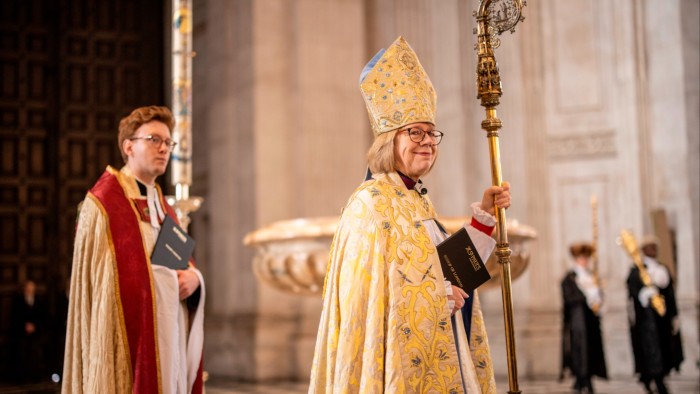
Dame Sarah Mullally has been named the 106th Archbishop of Canterbury, becoming the first woman to hold the Church of England’s most senior clerical position.
King Charles approved the appointment of Mullally, Bishop of London since 2018, to lead the world’s 85mn-strong Anglican community, the Cabinet Office said on Friday.
The historic announcement comes after months of deliberation by the Crown Nominations Commission (CNC) following the resignation of Justin Welby in November last year, with women eligible for the senior position for the first time.
Welby, who was Archbishop of Canterbury for almost 12 years, quit after intense pressure over his role in the Church of England’s failure to halt years of sexual and physical attacks carried out by a child abuser associated with the institution.
Stephen Cottrell, Archbishop of York, temporarily assumed most of Welby’s responsibilities but soon faced calls to stand down himself over his handling of a separate sexual abuse case.
In February, Cottrell conceded that the Church of England was facing “difficult and challenging times” in the wake of multiple safeguarding failings but said he was “determined . . . to make the changes necessary that will prevent these failings ever happening again”.
No candidates were officially named as part of the selection process. But Mullally, who called for “fundamental safeguarding reform” after Welby quit, had been seen as a leading contender in part because her role as Bishop of London made her the third most senior bishop behind Welby and Cottrell.
In an address at Canterbury Cathedral on Friday, Mullally said the Church of England had “often failed to take seriously the misuse of power in all its forms” and vowed to “foster a culture of safety and wellbeing for all”.
“This will not be easy. Our history of safeguarding failures has left a legacy of deep harm and mistrust, and we must all be willing to have light shone on our actions,” Mullally added.
But later on Friday, Robert Thompson, a vicar who worked with Mullally after she became the first female Bishop of London, told Times Radio she was “one of the worst candidates that could have come forward”.
“Although she may have a heart for the things that [survivors of abuse] experience and addressing that culture, she does not have the capacity to stand up to large networks within the church who wield their power,” he said.
Mullally, 63, was previously a cancer nurse and served as chief nursing officer for England. A keen potter, she became a Christian at the age of 16 and was ordained as a priest in 2002.
Mullally, a staunch opponent of proposals to legalise assisted dying in England and Wales, will be officially installed in March 2026. She will be the first woman to serve as Archbishop in the role’s 1,400-year history, after Augustine of Canterbury arrived in Kent from Rome in the year 597.
Recommended

The 17-member CNC — which was chaired by former MI5 head Lord Jonathan Evans and included Cottrell, bishops and lay members — met in May, July and September to discuss candidates.
Women were eligible for consideration for the first time after rule changes approved during Welby’s tenure allowed women to become bishops.
Some Church of England figures had criticised the length of time taken by the CNC, contrasting its months of meetings with the two days taken by the conclave of cardinals to elect Pope Leo XIV as head of the Catholic Church in May.
In a “statement of needs” in June, the Diocese of Canterbury said the next Archbishop would have to be “a person of the utmost integrity” who could speak to “social and political issues which impact the most vulnerable in our society”.
It added that the person would need to “embrace” both supporters and opponents of same-sex marriage, one of the most vexed subjects inside the Church of England.
Unlike some other churches within the 85mn-strong Anglican Communion, same-sex couples cannot marry in the Church of England, although they can receive prayers of blessing.
Mullally, who steered the debate that led to approval of prayers of blessing in 2023, described the change at the time as “a moment of hope”.