
The announcement of a new assessment tool from the University of Melbourne, designed to help determine support budgets for National Disability Insurance Scheme participants, has raised questions about a return to the aborted Coalition-era “independent assessments” trial that sought to deploy cookie-cutter algorithms in pursuit of savings.
Such an approach, which feeds assessment scores into a black box program linked to so-called “typical support packages”, would target types of disabilities instead of individual needs and spit out standard budgets with little flexibility.
The announcement of the new assessment tool comes as the National Disability Insurance Agency is expected to release its new therapy support guideline. The guideline, seen by The Saturday Paper, will now prevent participants from using NDIS funds to gather reports from treating therapists – an expensive exercise – by making these funds “stated” amounts in their plans. Under the NDIS legislative reform, stated supports can only be spent as directed by the agency.
Under the new assessments model spruiked by the Albanese government, these reports won’t be needed. Advocates suspect this is designed to make life easier for the NDIA, not for participants.
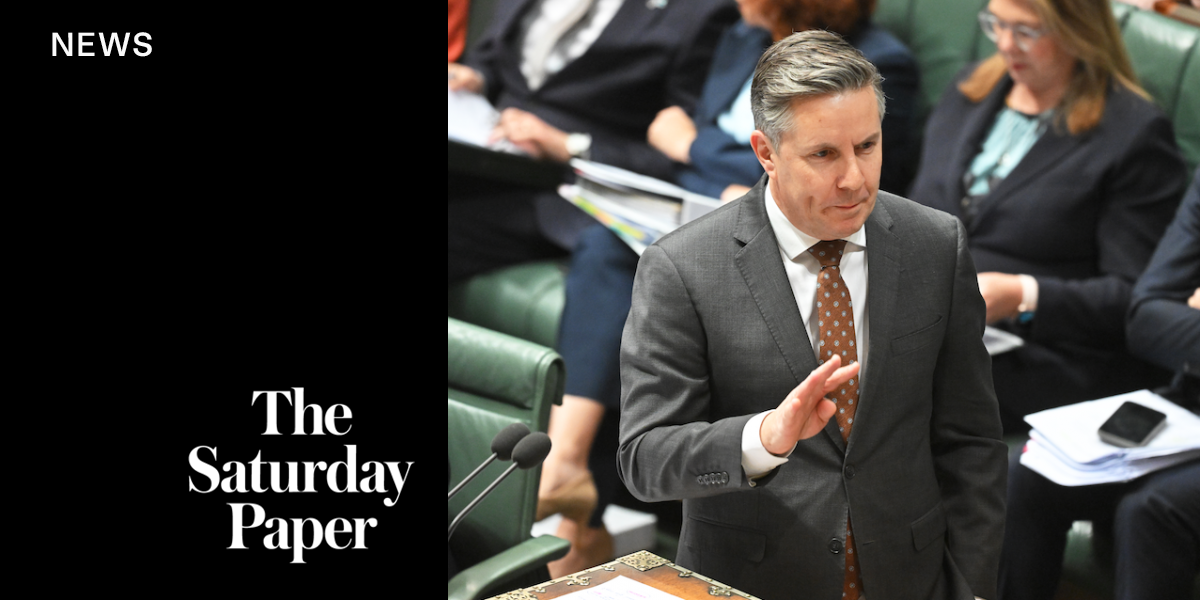
In the broader reform sweeping the scheme, Minister for Health, Disability and Ageing Mark Butler has already singled out children with autism and developmental delay, pledging to remove those with “low and moderate” conditions from the NDIS after building a low intensity support system outside of the scheme.
He has flagged people with serious and complex mental health disabilities will be next, but advocates fear this group is already being forced out of the scheme as the NDIA refuses to wait for reform milestones.
The NDIA is nearing the final stages of a scheme overhaul that will give it unprecedented power to save tens of billions of dollars in its budget by increasingly putting disabled people “back into boxes”. It is in this context that it has announced the new assessment tool licensed from the University of Melbourne and the Centre for Disability Studies.
In 2021, before the disability community and then opposition spokesperson for the NDIS Bill Shorten managed to torpedo the changes, the Coalition had proposed an “independent” assessment regime that would collect scores on particular indicators and sort participants into one of 400 “personas” based on markers such as disability type, age and location.
Little is known about how the agency now intends to use the tool, called the Instrument for Classification and Assessment of Support Needs (I-CAN) version 6, but what purports to be an “evidence-based” approach to classifying support needs is largely based on self-reported questionnaires from participants or their carers.
“If we go and look at how the NDIA is treating self-reported evidence in the Administrative Review Tribunal, you can see that the NDIA doesn’t really trust self-reported evidence. They assume that people are going to be exaggerating their support needs.”
“If we think about what we haven’t been told about the support needs assessment, we have not been told that it’s going to be done by qualified allied health professionals,” researcher and NDIS participant Dr Stevie Lang Howson said in a video response to the announcement. “We have not been told that it’s going to be done in person and involve an in-person assessment of a participant and we have not been told that it is going to have to take into consideration evidence that is presented from a participant’s treating professionals.”
In February this year, the then chief executive of the NDIA, Rebecca Falkingham, told a Senate estimates hearing that her staff “can’t read the 280-page reports that they get”.
“What we are moving towards is a streamlined support needs assessment tool,” she told the hearing. “It negates the need for all of those reports.”
Minister for the NDIS, Senator Jenny McAllister, who has portfolio responsibility for the day-to-day operations of the agency, agreed with this premise when the licence with the University of Melbourne was announced on September 25.
“It can take a long time and cost a lot of money for people to source supporting evidence to have a planning meeting. There is a better way,” she said in a statement.
“This is a crucial step towards ensuring that we use the latest technology to make sure that we meet the needs of Australians with disability.”
However, the lack of these reports has advocates such as Lang Howson questioning what other inputs the NDIA will use to come up with plan budgets. He said he simply does not believe the NDIA “is going to allow a three-hour, self-reported assessment to be the sole basis for the reasonable and necessary budget”.
“That seems very open to manipulation, to me, and if we go and look at how the NDIA is treating self-reported evidence in the Administrative Review Tribunal, you can see that the NDIA doesn’t really trust self-reported evidence,” he said.
“They assume that people are going to be exaggerating their support needs, or maybe there might be factors associated with someone’s disability that make it more difficult for them to self-report.
“What I am concerned is happening, and what I am concerned we are missing as a disability community, is that I do think that there’s evidence, and I do think that it’s being factored into this new framework planning process, but I do not think that it is evidence at an individual level.
“I think that what we are going to see is the application of some kind of reference package framework, where typical packages are generated on the basis of someone’s primary disability, and that then forms the basis for a kind of initial plan that may then be modified up and down based on the support needs assessment.”
The Saturday Paper previously revealed secret proposed changes to the NDIS Act under then minister for the NDIS Stuart Robert, leaked to this newspaper, have largely been adopted under the reforms shepherded in by Shorten.
Another disability advocate and sector source tells The Saturday Paper that the tool itself is now out in the open but was always the likely option: it was the only instrument recommended by Shorten’s NDIS Review and the only one that properly met the requirements for the tender process advertised earlier this year.
“The big concern is the likely algorithm it will feed into and how this will translate to budgets,” the source says.
“The algorithm will likely be impairment-based, too – an impairment-based assumption of need.”
According to the Occupational Therapy Society for Invisible Disability, in its submission to the Joint Standing Committee on the National Disability Insurance Scheme earlier this year, but only published in August, the global experience of assessment tools such as the one now being implemented is that they are used to shrink options rather than enhance them.
“Over-reliance on algorithmic decision making in disability assessments has been questioned from a rights-based … perspective,” the submission says.
“The concern is that these inequities are ‘baked’ into the system through the ‘averaging’ of support packages, grounded for example, in impairment-based assumptions that overlook individualised support needs.”
People with psychosocial disabilities are at particular risk under such a model, especially where their conditions are episodic and not easily captured in an instrumentalised point-in-time interview. According to the new NDIS legislation, the new assessment tool may also be used to help stream people into the full scheme or a new “early intervention” pathway.
“I think the funding cuts at plan reassessment are already happening and psychosocial access [to the scheme] has plummeted dramatically over the past year, down to almost zero in the April to June quarter,” a sector source with knowledge of the issue tells The Saturday Paper.
Indeed, in the financial year 2024/25 just 25 per cent of people with a psychosocial disability who applied to access the NDIS were accepted into the scheme, down from a historic average of 67 per cent. Where once this cohort represented about 11 per cent of all participants, they now account for 9 per cent. In the April-June quarter this year, just 3 per cent of all participants who gained access to the scheme had a mental health disability.
“Something has changed and we don’t know what it is,” the source says.
Late last month, Minister Butler told ABC Radio that the foundational support recommendations from the NDIS Review – designed to alleviate pressure on the scheme by re-creating the less expensive support systems that once existed outside it – also included psychosocial disabilities.
“Another part of the foundational supports recommendation was for adults with severe and chronic mental illness, and that’s a piece of work we’ll have to come to as well,” he said on August 21.
A June report from the Grattan Institute, titled “Saving the NDIS”, recommended not only creating these foundational support systems urgently but raiding funds from the NDIS to do so.
“Transition a modest proportion of individualised funding into a new, ambitious tier of foundational supports – delivered within existing government contributions to the NDIS,” it recommended.
It suggested doing this for both children with developmental delay or “disability” and for “people with psychosocial disability”.
The federal government has already promised the first option.
Butler told The Saturday Paper in a statement that this focus is in line with the NDIS Review.
“The second big piece of work for foundational supports has been identified as those Australians with ongoing, usually quite severe, psychosocial disability who are not getting any support right now,” he said.
“We know those Australians without support are bumping in and out of emergency departments, in contact with justice and police systems, are vastly over-represented in our homeless population and, frankly, deserve better.”
The Department of Health, Disability and Ageing is aware of concerns about access rates for people with psychosocial disabilities and on September 5 the NDIA held a meeting with mental health “stakeholders” to discuss these falling rates.
A spokesperson for the NDIA said there have been “no changes to access eligibility for people with a psychosocial disability” and that the new needs assessments will be used only to create NDIS budgets, not determine eligibility. “As part of the new planning approach, assessments will be conducted by trained and accredited assessors. All assessors will undertake formal training, which will be developed in partnership with the University of Melbourne,” the spokesperson said.
For Stevie Lang Howson, and others with concerns, questions about the assessment process or the way access and planning are handled have not been answered by the NDIA. “I am just not convinced that the NDIA is going to let us self-report our way into our budget in a way that doesn’t include or seek evidence at any stage,” he said.
“So my first question, and the question that I think we all need to be asking, is: what is the evidence basis?”
This article was first published in the print edition of The Saturday Paper on
October 4, 2025 as “Blunt tool”.
For almost a decade, The Saturday Paper has published Australia’s leading writers and thinkers.
We have pursued stories that are ignored elsewhere, covering them with sensitivity and depth.
We have done this on refugee policy, on government integrity, on robo-debt, on aged care,
on climate change, on the pandemic.
All our journalism is fiercely independent. It relies on the support of readers.
By subscribing to The Saturday Paper, you are ensuring that we can continue to produce essential,
issue-defining coverage, to dig out stories that take time, to doggedly hold to account
politicians and the political class.
There are very few titles that have the freedom and the space to produce journalism like this.
In a country with a concentration of media ownership unlike anything else in the world,
it is vitally important. Your subscription helps make it possible.
Send this article to a friend for free.
Share this subscriber exclusive article with a friend or family member using share credits.

Used 1 of … credits
use share credits to share this article with friend or family.
You’ve shared all of your credits for this month. They will refresh on November 1. If you would like to share more, you can buy a gift subscription for a friend.
SHARE WITH A FRIEND
? CREDITS REMAIN
SHARE WITH A SUBSCRIBER
UNLIMITED
Loading…

News
Exclusive: NDIA accused of ‘repeated non-compliance’ as it prepares for autism reforms
Rick Morton
While advocates say they have been ambushed by Labor’s plans to eject autistic children from the National Disability Insurance Scheme, the agency has been accused of ignoring multiple legal orders.