
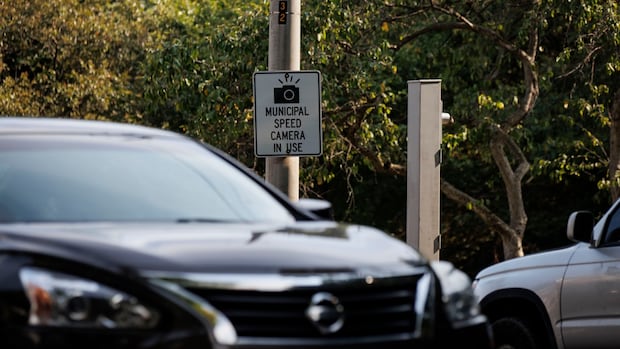
Twenty mayors, a deputy mayor and a county warden from municipalities across Ontario are urging Premier Doug Ford and the transportation minister, in a signed letter, to compromise on automated speed enforcement (ASE) measures in school zones, instead of issuing a province-wide ban.
If a ban is put in place, the 22 municipal leaders from Brampton to Ajax to Parry Sound requested the province “fully reimburse all municipalities for the costs” of cancelling the ASE program.
They said in a letter shared on social media Friday that the reimbursement would cover costs for increasing local policing, staff severance and public safety programs that are currently funded by speed camera revenues.
“For most of us, the intention has always been to install cameras in school zones to protect our most vulnerable residents — our children,” says the leaders’ letter.
“A total ban on ASE would reverse years of progress on safety in school zones. It would place more pressure on police, increase enforcement costs, and most critically, endanger lives,” it says.
The letter lists compromises the municipalities are willing to make to keep ASE measures in school zones, including the following:
Warning tickets for a first-time offence. Setting cameras at a reasonable threshold of speed before a ticket is issued. Cameras only operate during school and community use times. Blackout on additional fines for seven days after a driver receives the first ticket to allow them to change their behaviour.
Leaders said the fees collected from speeding fines would be directed to traffic calming measures, such as speed signs and roundabouts – something “many municipalities do already.”
Ford calls cameras a ‘tax grab’
Last week, Ford said his government will soon table legislation to ban the use of speed cameras — a traffic enforcement tool he has called an ineffective “tax grab.”
Ford has claimed that speed cameras don’t slow people down, and has said the province plans to establish a new fund to help municipalities put in place other “proactive traffic-calming initiatives that stop people from speeding in the first place.” That includes speed bumps, roundabouts, raised crosswalks and curb extensions.
It was Ford’s government that passed regulations in 2019 allowing municipalities to run speed enforcement programs.
WATCH | Ford says he’ll introduce legislation banning speed cameras: 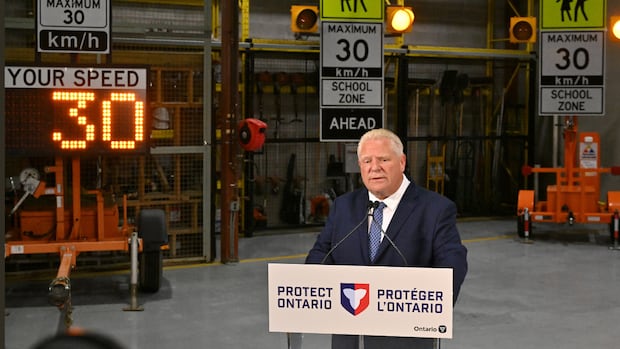
Ford to ban speed cameras in Ontario
Ontario Premier Doug Ford says his government will introduce legislation to ban speed cameras, instead establishing a provincial fund to help municipalities put in place other “proactive traffic-calming initiatives.”
The government has said municipalities will be encouraged to instead use speed bumps, raised crosswalks and roundabouts to slow traffic. Ford said there would be a new fund to help offset some of those costs but couldn’t provide an amount for it. The premier’s office says the province “will look to indemnify municipalities from contractual obligations” related to the cancelled cameras.
Burlington Mayor Marianne Meed Ward, one of the top signatories to the letter, said her city has already spent several hundred thousand dollars for six speed cameras that were about to be installed. Since the cameras have not yet had a chance to issue fines, the city has not recouped any of its costs.
It also has not had a chance to put any fine revenue toward other traffic safety measures, as planned, so now all taxpayers will have to pay for that instead of the speeders, she said.
“I hope that reason and evidence and ultimately public safety prevails,” Meed Ward said in an interview.
“Our letter is really our plea. It’s an SOS to the premier. A ‘save our schoolkids.’ When you get hit by a car at 30 (km/h you have a chance of surviving that. When the speeds go to 40 or 50, your chances of surviving that impact drop dramatically,” she said.
Newmarket Mayor John Taylor said, at a recent York regional council meeting, that municipalities have tried many of the other tools cited by the premier.
“Please don’t talk to me about flashing signs and speed humps,” he said.
“We’ve been there and done that for decades. We know what truly works, what truly is effective and that’s speed cameras. … We’re going to lose the greatest municipal safety tool we’ve ever had, and that’s a shame.”
Some municipalities vote to keep programs
Contrary to Ford’s claims that speed cameras are ineffective, a July 2025 study from SickKids hospital and Toronto Metropolitan University found ASE cameras led to a 45 per cent reduction in speeding vehicles in 250 school zones.
“These are not just statistics — they represent fewer injuries, fewer fatalities and greater peace of mind for parents and communities,” said the 22 municipal leaders, adding there is support for ASE cameras from the Ontario Traffic Council and the Ontario Association of Chiefs of Police.
WATCH | Study finds speed cameras improve road safety around schools: 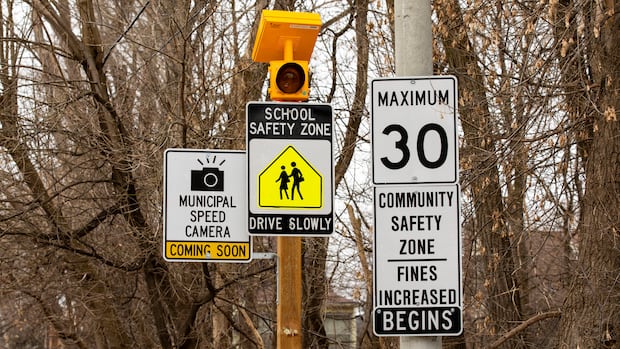
How speed cameras make streets safer for kids
A new study by SickKids hospital shows speed cameras make the streets safer for kids. The hospital’s head of orthopedic surgery, Andrew Howard, spoke to CBC’s Metro Morning about the study findings and how they can improve kids’ safety.
The letter also mentioned a survey by CAA South Central Ontario that found “nearly three-quarters of Ontario drivers support ASE” in targeted areas, including near schools and community centres.
Some municipalities, like Brampton and Toronto, have voted to continue their ASE program in the face of Ford’s objection, but others, like Vaughan, decided to remove municipal cameras, opting instead to focus on “traffic-calming measures.”
Vaughan launched its ASE program in April 2025, but paused it in June after drivers racked up more than 30,000 tickets in three weeks.
Meanwhile, Toronto has struggled to maintain its speed cameras after 47 cameras have been vandalized in less than a year.