
Unlock the Editor’s Digest for free
Roula Khalaf, Editor of the FT, selects her favourite stories in this weekly newsletter.
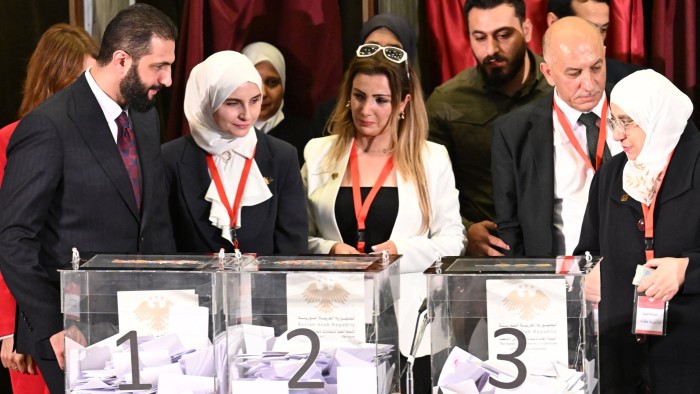
Syria is holding indirect elections to choose its first parliament since former president Bashar al-Assad was toppled last year, offering a litmus test of the interim government’s commitment to an inclusive political transition.
Sunday’s selection of members of parliament follows a tumultuous few months dominated by sectarian clashes and stalled negotiations between Damascus and the country’s minorities that have undermined early goodwill for President Ahmed al-Sharaa.
Nearly two-thirds of members of the People’s Assembly are being elected by regional electoral colleges made up of people selected with approval of a committee appointed by Sharaa, with one-third directly appointed by the president.
Syrians elated by the fall of the Assad regime last December were initially willing to put aside worries about the Islamist ideology of Sharaa’s Hayat Tahrir al-Sham movement, but concerns have mounted as the president seeks to consolidate control over the fractured nation.
While Sharaa has several technocrats in his cabinet, he has appointed a coterie of affiliates to key roles in his administration, the judiciary and security sector. The president’s Sunni Islamist movement was once affiliated to al-Qaeda and designated a terrorist group by western states.
Syria held regular elections under 50 years of Assad rule that were widely considered shams. But critics said Sunday’s election was too centrally managed and undemocratic.
“The process is far from ideal and the authorities have tried to exert far too much control,” said Malik al-Abdeh, a Syrian analyst. “Given MPs will have immunity and privileges to say whatever they want, they’re afraid to get strong Sunni representatives who could become an organised opposition in all but name.”
 Security outside a polling station. About 6,000 electors were choosing about 120 members of the 210-seat parliament © Hussein Malla/AP
Sub-committees appointed by the national electoral committee picked about 6,000 regional electors across the country to elect about 120 members of the 210-seat People’s Assembly.
About 20 further seats will remain empty because the government has indefinitely postponed voting in north-eastern areas controlled by the Kurdish-led Syrian Democratic Forces as well as southern Sweida province, which is controlled by armed factions from the Druze minority.
Sharaa’s government dissolved all political parties, most of which were closely tied to Assad’s regime, and no system is yet in place to register new parties, so candidates are running as individuals.
Authorities stress this system was adopted because millions of Syrians were displaced during 14 years of civil war and many no longer have documentation.
The process was “not perfect, but it is the most realistic at the current stage,” said national electoral committee spokesperson Nawar Nejmeh.
But critics who accept that elections by universal suffrage are not yet possible say the current process is too opaque. They have also condemned the haste with which the elections were organised, which gave candidates only a few days to present themselves and their platforms, and the electoral committee’s unexplained removal of some candidates.
 The election process has been criticised as opaque and too hastily organised © Hussein Malla/AP
No quota has been set for women or minority lawmakers. Women made up just 14 per cent of the 1,578 approved candidates, Syria’s state news agency Sana said. In some districts, women made up 30-40 per cent of candidates, while in others no women ran.
Experts said the system was likely to produce a result dominated by men from Syria’s Sunni Muslim majority. Sharaa, who has stressed a commitment to inclusivity, could use his third to appoint minorities and women, but could also choose to appoint candidates that would help him centralise power.
“However flawed this process is, the silver lining is that there are small green shoots of politics emerging,” Abdeh said, noting that some candidates had been making personal appeals for support from clerical establishments and business people in major cities. “It’s still very elite and you need to be in the know to participate, but at least it’s happening.”
Some polling centres had closed by Sunday afternoon to begin ballot counting, Sana reported. Results from the electoral college votes were expected to be announced on Monday.