
Every Sunday, we share 21 Fantasy Rambles from our writers at DobberHockey. These thoughts are curated from the past week’s ‘Daily Ramblings’.
Writers/Editors: Ian Gooding, Michael Clifford, Alexander MacLean, Puneet Sharma, and Dobber
—
The 2025-26 Fantasy Guide is available for download! Projections by team and by point totals, sleepers, drafted players, rookies, goalies, advanced stats, and much more!
The French-language version of the Guide can be purchased here.
—
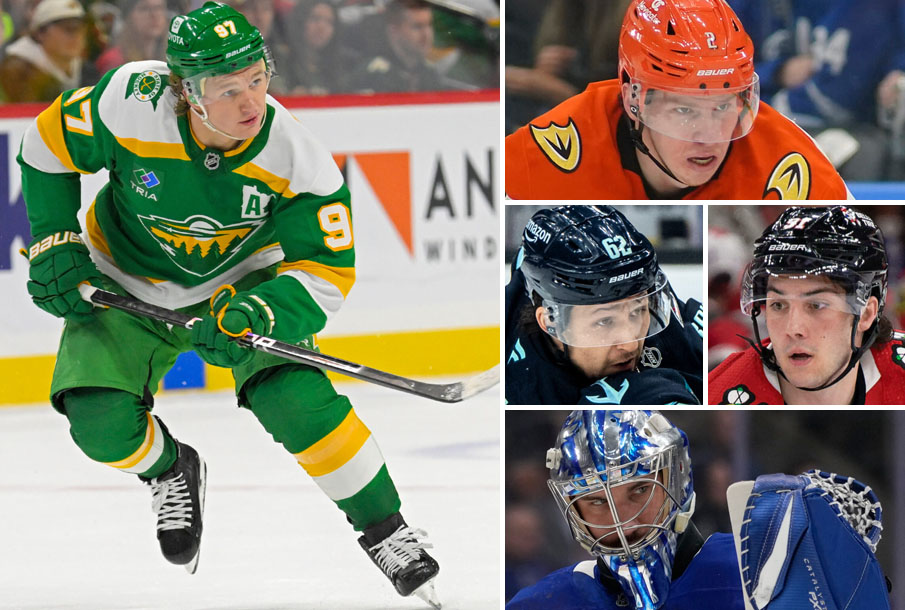
1. Kirill Kaprizov is resetting the contract landscape in the NHL. Leon Draisaitl‘s $14 million price tag already looks like a bargain, Nathan MacKinnon again is on a bargain deal for years to come, and Sidney Crosby is still being paid $8.7 million. Now, next year’s free agent pool with Connor McDavid, Jack Eichel, and so many more, are all going to be using Kaprizov as the bar. I hope you cap league owners already started planning for the future, because the future of cap leagues is already upon us.
Think about it once more. An NHL-record $17 million cap hit, for a player who might not even be a top-five player in the league…
Unfortunately for Kaprizov owners in cap league pools with a H2H setup, your last year with him at his $9 million cap hit comes with Minnesota having one of the worst schedules during the H2H playoff weeks. (oct1)
2. The New Jersey Devils and Luke Hughes reached a decision with Hughes signing a seven-year deal carrying a $9-million average annual value. According to PuckPedia, that ties Hughes with Cale Makar for the 11th-highest cap hit among defencemen in the league. Hughes has 93 points in 155 career games for the Devils.
This makes him virtually un-draftable in cap league formats. He doesn’t have a top PP role (he may take it from Dougie Hamilton at some point, but that’s far from certain), and he has 118 blocks and 44 hits in those 155 career games. A 40- to 50-point defenceman with no peripherals and a secondary PP role just is not worth the 11th-highest cap hit. If he can wrangle Hamilton’s PPQB spot from him, then we can have the conversation, but until that happens, he has very poor value in cap leagues. (oct2)
3. Jackson LaCombe has reached an extension with the Ducks for eight years at $9 million per season. This contract is much higher than expected, especially since it comes off the heels of one particularly strong season. Regardless, the largest contract in team history signals that the Ducks view LaCombe as their top defenseman. Does it mean he will stay on the top power play, ahead of Pavel Mintyukov and Olen Zellweger?
Before last season, Mintyukov and Zellweger were more highly sought after by fantasy teams based on their higher draft picks and perceived upsides. However, LaCombe now has the (much) bigger contract, which also serves as a means of priority. That doesn’t mean LaCombe is a lead pipe lock for PP1 for the next decade, but it should at least guarantee him heavy minutes and the stats that come along with that. Although Mintyukov and Zellweger could very much have a future with the Ducks and could still even take over PP1 at some point, the Ducks could also part ways with either one at the end of the season when both are RFAs. All three are left shots, so their skill set could become redundant and they could be used to upgrade the team elsewhere.
Also on Thursday, the Predators and Luke Evangelista finally agreed to a contract, which is a two-year deal with a $3 million AAV. Evangelista was the last remaining unsigned RFA after Mason McTavish and Luke Hughes were recently signed, so no RFAs will be missing to start the season. Evangelista finished the 2024-25 season with 10 goals and 32 points in 68 games, so he seems like a decent bet to be in Nashville’s top six this coming season. I wrote more about Evangelista in a late August Ramblings. (oct4)
4. The Edmonton Oilers finally added another goaltender to the fold by trading for Utah’s Connor Ingram. The Mammoth retained $800 000 of the $1.95-million cap hit and received future considerations in return.
This both shores up the goaltending, and it muddles things. This is obviously a change-of-scenery trade for Ingram whose numbers fell precipitously in 2024-25 with an .882 save percentage in 22 starts. The mitigating factor here is that Ingram took a leave of absence for a family issue in mid-November of 2024, missing two months. Things didn’t get much better when he returned and he entered the Player Assistance Program after the season. He revealed that his mother had been sick with breast cancer, and that she passed away in early December. He admitted it was something he never was able to move past, and to me, that seems completely reasonable. This is the best hockey league in the world with the top fraction of a percent of elite players on the ice. If a goaltender has his mind elsewhere because of a devastating family issue, that there was a significant negative effect in on-ice performance makes a lot of sense. We can only hope that he is in a good place now.
That down year in 2024-25 shouldn’t mask what had been a great start to Ingram’s career. In his first two seasons with the former Arizona Coyotes – 74 starts and 77 appearances – he had a higher save percentage than names like Sergei Bobrovsky, Jordan Binnington, and Sam Montembeault. When looking at Evolving Hockey‘s Goals Saved Above Expected (GSAx) measure – which accounts for shot quality faced – and adjusted the total to shots faced, Ingram required 91.6 shots for every GSAx. That ranked 8th among 37 goalies with at least 60 games played, and nestled between two starters from playoff teams:

That is just 74 starts, and not enough to make a firm determination one way or another, but it’s certainly a very good start, and reflects several good AHL seasons. There was promise here before what happened in 2024-25..
If Ingram can regain the highs he showed from 2022-2024, not only is he an NHL starter, but he’s a top-half-of-the-league starter. We know the struggles that Edmonton’s goaltending has shown, particularly in the playoffs, over the years. Ingram won’t be the starter for Edmonton’s first game next week, but he could very well be one of the most valuable fantasy goalies in the second half of the regular season. (oct2)
5. Anthony Stolarz and the Maple Leafs finalized a four year, $15 million-dollar extension that carries a $3.75 million-dollar cap hit through the 2029-30 season. The agreement provides cost certainty at a position that has often been an issue for the club. At the age of 31, Stolarz is coming off the best season of his career, where he posted a league leading 0.926 SV%, 2.14 GAA, and a 21-8-3 record while operating in a 1A and 1B system. He also had some playoff success in the first-round playoff series victory over Ottawa, reinforcing his case to enter 2025-26 as the clear number one goaltender. When compared to the current market, where average starting goalies earn considerably more, making this deal a bargain.
Stolarz now holds a secure role with Joseph Woll on indefinite leave, while Dennis Hildeby is the projected backup. This sets Stolarz up to start the lion’s share of games if he remains healthy, though his injury history is the primary concern. From a fantasy hockey perspective, a repeat of last season’s performance would make him one of the best value options in drafts, especially given the strong defensive structure in Toronto. Fantasy managers should view him as a safe number two goalie with upside into low end number one territory, particularly in formats that emphasize save percentage and goals against average. Toronto’s commitment shows their belief in his ability to manage a heavier workload, and if he maintains his consistency from last season, he has every chance to outperform his average draft position. Stolarz remains a calculated risk, but one with high reward potential. (sept29)
Said Alexander MacLean: “Anthony Stolarz‘s new AAV really surprised me, as it’s cheaper than at least 15 other goalies who have signed contracts recently but won’t put up numbers as good as Stolarz will for the next two or three seasons. In cap leagues it’s a huge value deal for his owners.” (oct1)
6. The Pittsburgh Penguins announced that winger Bryan Rust will miss a couple of weeks with a lower-body injury. Considering the season is still four days away, Rust missing a couple of weeks from right now is not a big deal, but it does give a bit more fuel to my ‘Ville Koivunen is being severely undervalued’ argument. In fact, according to Wes Crosby, Koivnen was lined up with Sidney Crosby and Rickard Rakell in practice yesterday with Rust missing. (oct3)
7. More injuries: Ukko-Pekka Luukkonen is set to miss at least one week with a lower-body injury. That rules him out for the Sabres’ opening-night matchup with the Rangers. Either Alex Lyon or Alexandar Georgiev should start that game for the Sabres (seems like Lyon will), as Devon Levi has already been sent to the AHL. Trusting any Buffalo goalie isn’t easy, although I drafted UPL very late in one league (I’ll share the results shortly).
Scott Laughton is listed as week-to-week with a lower-body injury. With David Kampf also placed on waivers, we’ll have to watch for whether Easton Cowan makes the Leafs’ opening-night roster or starts with the AHL’s Toronto Marlies. Debate that one all you want, Leafs fans. There could also be a ripple effect for Nick Robertson – another player whose situation provides fodder for Leafs fans.
Cole Perfetti left Friday’s preseason game with a lower-body injury. After the game, Jets coach Scott Arniel stated that “at first glance, the injury doesn’t look good.” Perfetti will be re-evaluated, but right now it seems that he’s at risk for being out for opening night. (oct4)
8. According to Lane Lambert, Brandon Montour appears ready to be in Seattle’s lineup for opening night following a minor ankle procedure earlier in the month. That is a positive development for fantasy managers who were monitoring his recovery and concerned about his availability. Montour had a decent 2024-25 season in which he suited up for 81 games, recorded 18 goals and 23 assists while logging close to 23 minutes of TOI. He is expected to start the year paired with Ryan Lindgren and is projected to see power play minutes, most likely on the second unit. That role provides him steady opportunities to contribute offensively while maintaining significant usage at even strength.
From a fantasy perspective, Montour provides a dependable floor across multiple categories. He can chip in goals and assists, while also delivering steady peripherals totals in shots, hits, and blocks, which makes him valuable in multi- category formats. His ceiling will not match the elite defensemen and will likely remain below teammate Vince Dunn‘s production, but Montour is still a reliable mid-tier option. Managers can view him as a safe D3 or D4 with room to outperform his draft cost. (sept29)
9. As an Aleksander Barkov owner in two very different leagues, I feel like it might be helpful for me to outline how I’m approaching the injury, specifically for the Barkov owners wondering what to do, but also for those others who will be dealing with long-term injuries.
In the first league, it’s a 24-team salary cap dynasty league. I finished 2nd last year, and had eyes on a repeat finish on the podium this year. However, the Barkov injury certain causes some questions with that plan. The good thing is that I would say my centre depth is unrivaled around that league, with Dylan Larkin, Tage Thompson, Sean Monahan, Mikhail Granlund, Roope Hintz, and a few minors-eligible depth forwards as well. That means that my team can pick up the slack at centre, and I now have $10 million in cap space to address my team’s biggest weakness, which is at LW. My depth chart there currently consists of Jonathan Drouin, Elmer Soderblom, Danton Heinen, and Landon Slaggert. Yes, quite the discrepancy between the two positions.
The plan at this point is to see whether I can find a LW or two that I can acquire for picks and/or prospects without taking pieces off of my main roster, so that I can make up for Barkov on aggregate (side note: go watch the movie Moneyball – fantastic picture, whether you’re watching it for the first time or the 10th).
I’ve checked in with teams that have bigger names on the block, such as Pavel Buchnevich, Alex DeBrincat, and Kirill Kaprizov, and I’m also looking at slightly cheaper options both for cap and the trade cost, along the lines of Rickard Rakell, and Mason Marchment. Moving Barkov as part of the return for one of those higher end players has crossed my mind, but it’s hard to rationalize selling him while his value is at rock bottom.
I did buy Chris Kreider in the meantime from another team who needed to shed cap. I didn’t pay too steep of a price as a result, and I should be able to upgrade on him if I need to as the season wears on.
If I did have a need at centre, then the first player I would have reached out about would be Anze Kopitar, as his announcement that he’s retiring at the end of the season should mean that his owner would be more willing to recoup some value on him now, as a fading though still productive asset.
Overall for this league, my team is good enough that I don’t have to rush into a move, and should still be able to keep my team in the top-eight to make the playoffs this year. (oct1)
10. For league #2, it’s a partial keeper, where six forwards, four defense, and one goalie are kept. I came third last year, though I’m not certain that my team is a top-three team on paper entering the season, even if Barkov was healthy.
One thing that Barkov’s injury does do for me here is solve a positional issue where five of my six keeper forwards were single-position eligibility centers. However, the injury, coupled with a lack of high-end picks in the draft resultant from being a buyer at the deadline last summer means that it will be tough to compete this year.
In the same vein as league #1, I’m going to see what I can do about filling in around a deep C-core, but in this league it’s going to be more of a wait-and-see approach before determining the best direction for the team.
Having only three IR slots is also going to be very tough to balance through the year, because holding Barkov is really going to reduce my ability to deal with injuries in-season.
All of that to say, this could be a year where I look to move someone like Filip Forsberg for Kirill Marchenko and a pick, just as an example. A small downgrade, but also a handful of years younger, and in two or three years, the two of them will likely be relatively even. If I can forego the reset though, then I will look to build up my depth, noting that I don’t want to pay through the nose just to have an issue of too many keeper-level players on my roster at the end of the season either.
In other leagues without keepers, I’m really bumping up Anton Lundell on my draft lists, as he was fantastic last year in games where Barkov was out of the lineup. While I’m sure others are going to be onto that, I still don’t think he’ll often be going as a top-125 or even a top-150 skater, and I think I can get him just above that range for eventual top-100 value by the end of the year. (oct1)
11. A few quick-hit camp storylines: One of the big surprises around the league is the ascension of Emmitt Finnie in Detroit, who was on my radar in the offseason, but more as a player who might be the 15th forward on the depth chart and could produce if injuries hit the main club. Well, instead he has skated with the top line for most of the last week in camp and could be worth a swing as a final pick in some drafts, though Elmer Soderblom was back with Dylan Larkin and Lucas Raymond mid-week. (oct1)
12. Before J.T. Miller left the Rangers skate on Tuesday with his injury, he was part of the top power play runs, along with Artemi Panarin, Adam Fox, Mika Zibanejad, and Vincent Trocheck. Alexis Lafreniere had been getting some rotations earlier in camp, but today he hadn’t seen a sniff of it before Miller left. Just as a word of caution before putting too much stock into a Lafreniere breakout due to the possible power play exposure. (oct1)
13. Berkly Catton is quietly looking like an NHLer, having played on the top line with Seattle throughout camp. He hasn’t looked out of place, and has a top-tier scoring pedigree through the junior ranks. He should be on the radar as a late round pick in most pools this year. (oct1)
14. I definitely don’t mention every roster reassignment transaction during training camp in the Ramblings, since most aren’t fantasy relevant. You can also find what you need in the Frozen Tools Player News. However, one that I’ll mention here is that of the Rangers reassigning Scott Morrow and Gabe Perreault to the AHL.
These two players were mentioned as Calder Trophy candidates in the Fantasy Guide, and they both had plenty of interest in my recent slow auction draft – particularly Morrow, since defensemen receive bonus points for scoring in this league. Both players may not be in the AHL all season, but you should look elsewhere for sleepers if you are in a single-season league. Mike Sullivan has been known to lean on veterans, so this news shouldn’t be totally surprising. (oct4)
15. It looks like the Flyers are experimenting with their lines, and giving us what we want in pairing Owen Tippett, Trevor Zegras, and Matvei Michkov, and early indications suggest the trio is gelling well. Zegras and Michkov provide elite playmaking and offensive creativity, while Tippett can offer finishing ability, making the line a potential scoring threat if it sticks. One would assume that the coaching staff seems open to using them together long term.
There are some concerns about defensive responsibility, as Zegras and Michkov have occasionally struggled in their own zone. You have to also think that this combination carries significant upside. All three players could see increased offensive production, and if the line receives power-play time, their fantasy value would rise further. Tippett in particular could return to his old form, benefiting from higher-quality opportunities alongside Zegras and Michkov, while Zegras and Michkov offer safer high-end upside. Zegras and Michkov have seen most of their ice-time together while Tippet was the new and recent addition to the mix. The main risks still involve defensive lapses, but the line presents a strong opportunity for points across goals, assists, and power-play contributions. At the very least we will get to see some very exciting hockey from this line. (sept29)
16. Chicago’s projected second line headed by Frank Nazar (in between Teuvo Teravainen and Tyler Bertuzzi (carries some intrigue as all three are not only slated for a top-six role but also for spots on the first power-play unit, which gives them meaningful upside. For Nazar, this is a major step forward, after a rookie season with 12 goals and 14 assists in 53 games, he is now being trusted with more ice time and responsibility at center. This could very well translate into a 20-20 type season or better for him, especially if the power play clicks.
Teravainen brings that veteran playmaking presence, the kind of winger who could quietly pile up assists feeding his linemates while also benefiting from man-advantage touches. Bertuzzi has typically done well in his net-front situations and could be the one cashing in on rebounds and dirty-area goals. There is opportunity here with a couple of these players getting PP1 time on a rebuilding team that will be heavily relied upon. All three players were being drafted well after the 200 ADP mark if not further in Yahoo! Leagues.
The risks here are tied to chemistry, Chicago’s overall scoring struggles, and the possibility of line shuffling if things start slowly. Nazar looks like a solid late-round sleeper, Teravainen offers a safe floor of assists, and Bertuzzi is a value pick who could outproduce his draft slot if he locks down his net-front role. (sept29)
17. In my Ramblings yesterday, I wrote about several players with an ADP outside the top-250 that are standing out to me, including Filip Chytil, Jani Nyman, Zachary Bolduc, Frank Nazar, Philip Broberg, and more. Inside that piece are a bunch of links to other Ramblings covering a lot of my preseason coverage on ADP movement, player values, arbitrage drafting, finding this year’s Darcy Kuemper, Zach Werenski, and Dylan Holloway, and a bunch more. For most of my pre-draft analysis, go check that out.
For even more fantasy draft thoughts, including team-by-team analysis, a schedule breakdown, breakouts and downturns, and a whole lot more, go pick up a copy of the 2025-26 Dobber Hockey Fantasy Guide! It also includes a draft list with full projections for over 800 skaters and 80 goalies. It has been updated all through the preseason to reflect things like Aleksander Barkov‘s injury or Luke Evangelista‘s continuing lack of a contract. The Guide is available now in the Dobber Shop.
Today is my last Ramblings before the first day of the NHL regular season, so I want to gather a lot of my big draft thoughts in one place. I understand people don’t want to go back and read 25 000 draft words (though I hope you do!), so this will assemble a lot of my big points here.
In general, I am going to assume multi-category formats including hits and blocks. I am also going to give a general idea of where players are being drafted because that can vary wildly between formats and between websites. See below: (oct3)
18. Overvalued Montreal Canadiens
Almost no matter the site, Nick Suzuki is going somewhere around the 50th pick even though he has never had 190 shots in a season and has had three straight years of under 70 hits. Cole Caufield is going around the same spot, if not earlier, despite losing 1:20 per game of ice time and having yet to reach 100 total hits+blocks in a season. Lane Hutson is being drafted as roughly a top-12 defenceman (give or take a couple spots) and though he’s already a high-end offensive defenceman, he had 91 shots and 40 hits last season. Those are heavy draft prices for players that are just not very good peripheral producers.
On top of that, this Montreal team is deeper than it was at this point a year ago. Patrik Laine is healthy, Ivan Demidov is in the lineup for his first full season, and they traded for Zachary Bolduc. It is reasonable to think that Caufield’s TOI stays stagnant or even declines further while Suzuki (who lost 1:12 per game in TOI himself) sees a small drop. It won’t be a cataclysmic fall, but if you’re asking me to invest a third-, fourth-, for fifth-round pick in a player, and they lack in some peripheral categories as it is, if they’re staring down further ice-time declines, I have concerns.
There is a difference between points-only values and multi-cat values for these three players, so that will change the equation, but I have very few Montreal Canadiens skaters rostered on my fantasy teams (Sam Montembeault is the exception).
Undervalued Carolina Hurricanes
Nikolaj Ehlers is now in Carolina, and despite tremendous per-minute production rates, he’s played under 70 games in three of the last four years. Andrei Svechnikov is coming off a down season, even if he was very good in the playoffs. Add in Seth Jarvis, who is established as the team’s top winger, and an emerging Jackson Blake, and I get that some people are scared off by both the depth and the uncertainty that could mess with roles.
I am not one of those people. The Carolina Hurricanes are one of my most-stacked teams with Svechnikov, Ehlers, and Jarivs all among my top-10 most-drafted players across my 20 teams. A big part of that is the ADPs, particularly on Svechnikov (consistently outside the top-100 players) and Ehlers (often going in the 7th or 8th round). Looking at both left and right wingers, I have Jarvis inside the top-20, Ehlers inside the top-30, and Svechnikov inside the top-40. They are all going later, and sometimes much later, than those rankings, so it’s why I have been drafting them so much.
In Tulsky We Trust. (oct3)
19. Overvalued Dallas Stars
I have said it a couple times, but it bears repeating: Mikko Rantanen lost over three minutes per game in ice timein Dallas compared to his time in Colorado. The Stars have a new coach, but even if he’s at 20 minutes a game, that is a drop of 2:30 per game compared to his role with the Avs. In a best-case scenario, over an 82-game season, Rantanen is going to lose about 200 minutes that he would have played in Colorado. Based off what he did with the Avs on a per-minute basis, we are looking at a drop of 5 goals, 7 assists, and around 28 shots. Now, that is the best-case scenario if he was still skating next to Nathan MacKinnon. But he’s not skating next to Nathan MacKinnon, so things will get even worse. Drafting him around picks 10-14 in a 12-team league feels like punching a one-way ticket to seventh place.
Jason Robertson has one season with 109 points, and three seasons with 80 points or fewer; doing some quick math in my head, three is larger than one, so that’s part of why I’m not high on drafting him. If I had to bet on whether Robertson is a 100-point player, which would take remarkable efficiency for someone playing around 18 minutes a night, or an 80-point player, which is about on par for a high-end offensive player skating around 18 minutes a night, my bet is on the latter, so I have no interest in taking Robertson in the second or third round.
Thomas Harley and Jake Oettinger seem fine for where they’re being drafted, but as for the top forwards being taken in the first, second, or third rounds, that’s going to be a ‘no’ from me, dawg.
Undervalued New York Islanders
Please do not take this as an endorsement of the New York Islanders – I would never do such a thing. But it is an endorsement of Mathew Barzal going somewhere between round 9 and round 12, Bo Horvat a round or two later, and Anders Lee even later than that. We are in on all three. We are SO in. Allow me to explain.
Even in a 2024-25 season where Barzal missed 52 games and the Islanders scored just 25 power-play goals (14 teams had more than twice as many), Horvat finished as a top-125 player in standard Yahoo formats. Barzal is healthy, the power play shouldn’t be as bad (even if they’re still below-average), and in response, Horvat’s Yahoo ranking is one round later than where he finished in 2024-25 with his ADP being three rounds later.
As for Barzal, well, it’s about health. Even in multi-cat formats where he’s a drag on hits, his combination of production, shot volume, and shot blocking means if he plays 75 games, he can be a top-75 player. Heck, if he re-produces his 2023-24 season, he can push to be top-50 player. If the only thing keeping a skater being drafted in rounds 9-12 from performing as a player drafted in rounds 5-8 is whether he’ll play 75 games, that’s a guy I’ll usually buy on.
And then there’s Anders Lee. Like Horvat, he had a very good year (29 goals, 25 assists, 233 shots, 121 hits) despite single-digit power-play points. He has scored at least 28 goals in three of the last four years, averaged 212 shots every 82 games over the last three seasons, and managed at least 120 hits in three straight years. For a guy going anywhere from picks 150-250, that is pretty good multi-cat coverage.
I am not high on the Islanders, but their top players have more fantasy value than they’re being drafted for, and that’s what I’m buying. (oct3)
20. Anaheim Is This Year’s Columbus
At 5-on-5 last year, the Anaheim Ducks were one of the top teams by scoring chance contributions per 60 minutes in the league (per tracking data from All Three Zones). Tthe Ducks were in line with teams like Vegas, Edmonton, and Tampa Bay. Of course, their scoring didn’t always reflect that, but after a slow start, they were 14th in the league by 5-on-5 goals per 60 minutes from January 1st onward. We saw Mason McTavish, Leo Carlsson, and Cutter Gauthier all have sustained hot streaks at some point in the second half, and they are all a year older. With some veteran reinforcements brought in, the emergence of Jackson LaCombe, and a new coach, things are all trending up for the Ducks.
I don’t mean ‘Anaheim is the next Columbus’ in that the Ducks should be right on the fringes of a playoff spot. What I mean is that their top forwards have all shown flashes of high offensive upside, there are a number of young skaters that are a year older, and they are all very cheap in fantasy drafts (the Ducks don’t have a single skater in the top-100 picks). If I am betting on a team to have anywhere from 4-6 skaters being drafted inside the top-200 all outperform their ADPs, and a couple of them by a lot, I am betting on the Anaheim Ducks. (oct3)
21. Mid-Tier Goaltending Reigns
I am not out on the top goaltenders; I have a fair share of Igor Shesterkin on my teams. But once we get past the top few goalies and get to that next tier with names like Sergei Bobrovsky, Ilya Sorokin, and Dustin Wolf, I just don’t have a lot of interest. At that point, I am waiting on the next wave of goalie tiers and going after names like Linus Ullmark, Sam Montembeault, Karel Vejmelka, and Joey Daccord.
For an example here, I just cannot justify taking Sorokin as a top-10 or top-12 goalie when Daccord or Vejmelka can be drafted 5-7 rounds later. To me, there is not much difference between Daccord and Sorokin in terms of talent, and not much difference between the Kraken and the Islanders in terms of team quality. And even if I think Vejmelka is a tier below Sorokin in ability (which I do), the Mammoth are a tier above the Islanders in terms of team quality, so it’s a wash.
While mid-tier goaltending reigns, I should clarify a bit: I have interest in any of the tippy-top names like Connor Hellebuyck, Andrei Vasilevskiy, and Igor Shesterkin. I just have no interest in the tier under them, and would rather load up on skaters at that point and wait to draft goalies I think are similar values much later.
Those are my major draft thoughts. Again, for a lot more detail on specific players, teams, stacks, or ADPs, check out this Ramblings post because a lot of my pre-draft write-ups are all linked in there in one spot. Good luck with your drafts this weekend! (oct3)
Have a good week, folks!
Thanks for continuing to support the website and if you’re bored and need a fantasy hockey fix – visit the gang in the forum here.