
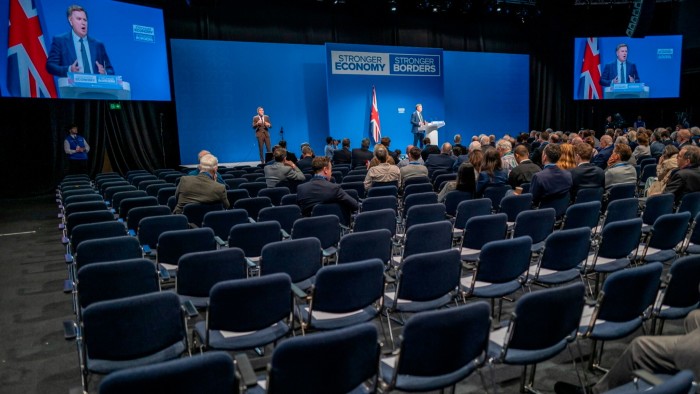
Sir Mel Stride, Conservative shadow chancellor, looked out over a half-empty hall, and declared: “I’ve just come back from another world.” The trip from Silicon Valley, where Stride said he could “touch the future”, to the Tory conference in Manchester was quite the vibe shift.
From the quiet bars and depleted exhibition hall to the empty seats in the main conference hall, this was the Tory gathering where the reality of electoral defeat really hit home. In the cavernous former Manchester Central railway station, the future felt a long way off.
For the best part of 15 years, the Conservatives were in power and basked in business and media attention. Even last year, after their electoral defeat, the conference buzzed with the excitement around the contest to replace Rishi Sunak as leader.
“This conference is more like an old-fashioned English wake in the parish hall with bad sandwiches and people muttering about what a nice send-off it has been,” said one jaded Tory. “At least you can get to the bar.”
Allies of Kemi Badenoch, Conservative leader, insist the party is in good spirits and that business engagement remains strong. New policies are being rolled out and Badenoch’s opening speech on Sunday was well received. “This could be a turning point,” said one shadow minister.
 Delegates arrive for conference on Monday © Charlie Bibby/FT
But around the Manchester Central exhibition centre were tell-tale signs of the Conservatives’ decline and the urgent need for the party to regain relevance, in a multi-party political landscape where Nigel Farage’s Reform UK is grabbing the headlines.
Stride’s speech, in which he promised to axe high street business rates, was delivered in what used to be a side hall, the rows of empty seats a reminder that it will be at least four years — perhaps many more — before a Tory chancellor will be installed in 11 Downing Street.
Andrew Griffith, shadow business secretary, gave a red-blooded Tory speech promising to reverse Labour’s employment rights package and cut taxes on family businesses, but also failed to draw a crowd.
Tory officials claimed a record attendance at the party’s “SME Day” on Sunday and said a total of 168 tickets had been sold for that event and for Monday’s “business day”. They said companies sending representatives to hob-nob with Badenoch’s team on Monday included a raft of top companies, from Airbus to Sainsbury’s.
But one attendee at the event thought there were fewer than 100 business people in attendance, most of them corporate affairs executives rather than bosses. “It was sparse — if you were being polite you’d say it was select,” the person said.
 A stand makes fun of Labour’s tax policies © Charlie Bibby/FT
Another business figure in Manchester said: “I’ve not bumped into a single CEO. The atmosphere is quite flat and it feels like a party still adjusting to opposition.” Many decided to stay away. “Why would I pay when I can see these MPs at Westminster for free?” asked one business lobbyist.
Business figures said tickets for Tory “business day” had been offered for £3,000, less than the £5,000 (excluding VAT) to attend a similar event at Labour’s conference in Liverpool last week.
At last year’s Tory conference in Birmingham the mood was almost surreal and upbeat, as the party chose a new leader and threw off the burdens of office. Even the exhibition hall, where stands were pre-booked by companies before the election, was busy.
This time the huge Victorian train shed housed a few corporate stands — National Grid and Specsavers among them — but swaths of empty space were filled with stands set up by Tory groups, such as “Conservative Friends of Turkey”.
 Delegates look at a display of clothes worn by Margaret Thatcher on display at conference © Charlie Bibby/FT
Stands selling memorabilia relating to Margaret Thatcher, born 100 years ago next week, filled some space, but also served as a reminder of how far the party had fallen since the days of her three consecutive election victories.
Conservative officials say the party remains relevant to business. Bloomberg, the British Venture Capital Association, Intuit, Mastercard and Standard Life were listed as sponsors of this year’s “business day” on Monday.
The Conservatives also raked in more donations than any other big UK political party in the first three months of 2025, recording £3.3mn in gifts. In the same period, Labour received £2.3mn, while Reform and the Liberal Democrats received just £1.5mn.
 Painter Hugh Beattie runs his stand selling Conservative-related paintings © Charlie Bibby/FT
“There’s still an optimism that we can turn this around,” said one person involved in donor relations. “People know that we have business in our DNA. There’s also a bit of disbelief about Reform’s standing in the polls.”
However, party insiders said the “blue room”, reserved for donors, was “sparsely attended”.
Perhaps more worrying for Badenoch was that the party’s “convention” on Sunday — a chance for grassroots activists to compare notes on campaigning or choosing candidates — was also downbeat.
“There were about 200 there in a darkened room,” said one veteran Tory, referring to the footsoldiers. “In the old days you would have 1,000 people in the main hall. It was a big event just before the conference started.”
One public affairs executive said: “I think the business mood is basically that the Tories aren’t relevant at the moment.” Badenoch, who addresses the conference on Wednesday, has vowed to shift that perception.