
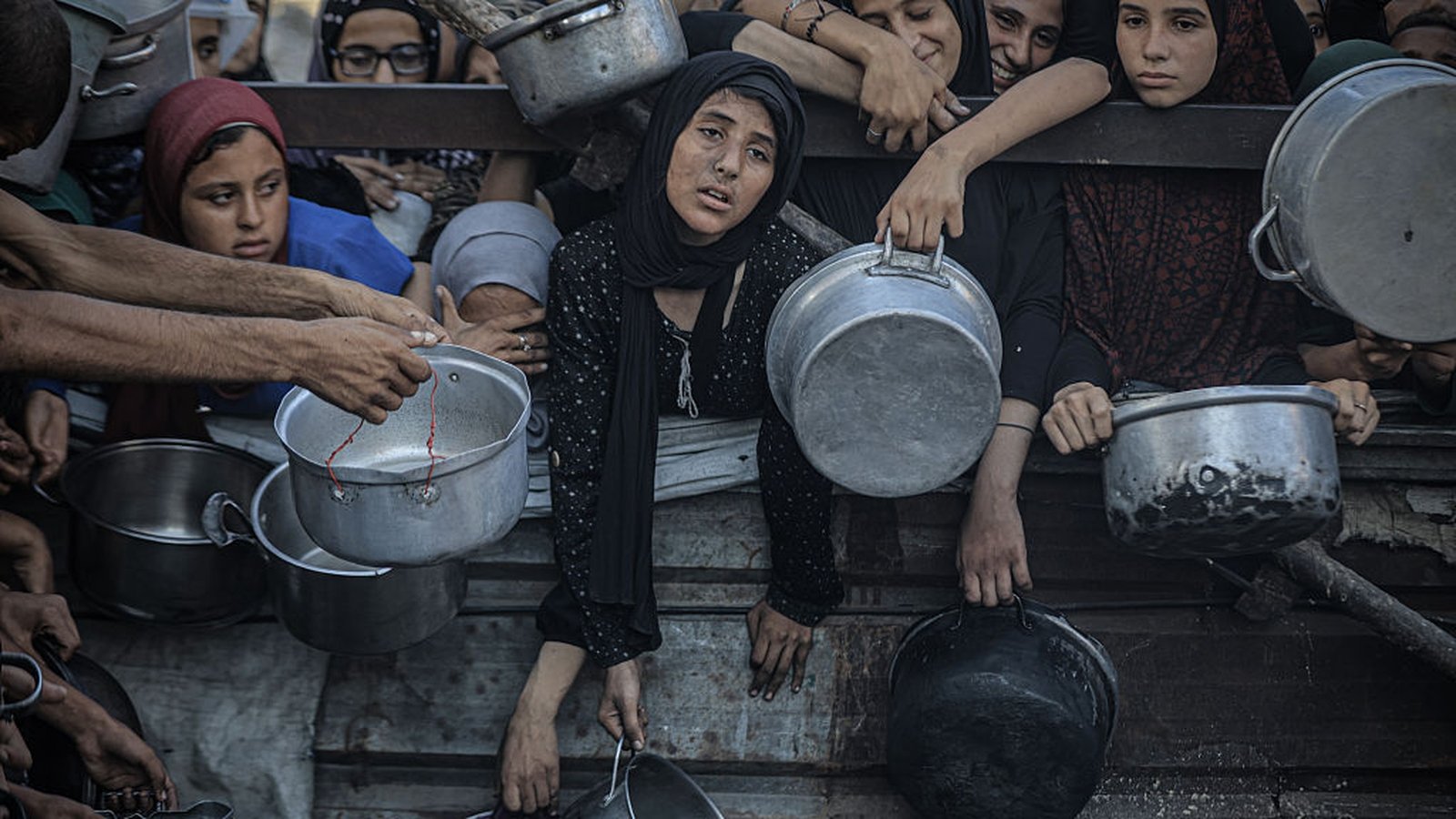
Hamas has confirmed it has responded to an Israeli proposal for a 60-day ceasefire in Gaza, while Israel said it is examining the Palestinian militant group’s proposals.
It comes after more than two weeks of indirect talks in Qatar that so far has failed to yield a truce.
“Hamas has just submitted its response and that of the Palestinian factions to the ceasefire proposal to the mediators,” the Palestinian militant group said in a statement on Telegram.
Israel said it is examining Hamas’s response to a Gaza ceasefire proposal, the office of Prime Minister Benjamin Netanyahu confirmed.
Hamas said yesterday it had submitted its response to mediators but did not disclose the content.
Both sides’ acknowledgement of ceasefire proposals come after a family of seven were among more than 100 people killed yesterday across 24 hours of Israeli strikes or gunfire, according to health officials.
The response by Hamas included proposed amendments to clauses on the entry of aid, maps of areas from which the Israeli army should withdraw, and guarantees on securing a permanent end to the war, according to a Palestinian source familiar with ongoing talks in Doha.
Negotiators from both sides have been holding indirect talks in Doha with mediators in an attempt to reach an agreement on a truce deal that would see the release of Israeli hostages.
Of the 251 hostages taken during Hamas’s 2023 attack, 49 are still being held in Gaza, including 27 the Israeli military says are dead.
But the talks have dragged on for more than two weeks without a breakthrough, with each side blaming the other for refusing to budge on their key demands.
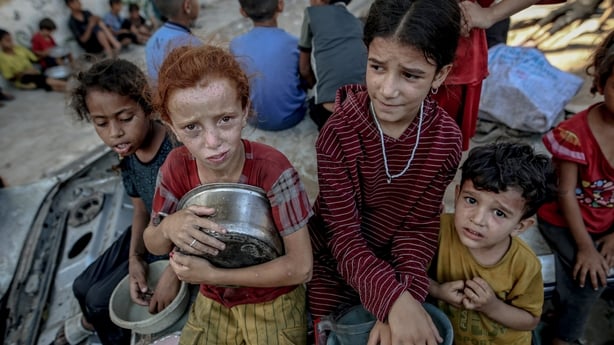
Young children wait to receive hot food distributed by a charity organisation in Gaza City
For Israel, dismantling Hamas’s military and governing capabilities is non-negotiable.
While Hamas demands firm guarantees on a lasting truce, a full withdrawal of Israeli troops and the free flow of aid into Gaza.
Israeli government spokesman David Mencer accused Hamas of obstructing talks.
“Israel has agreed to the Qatari proposal and the updated (US special envoy Steve) Witkoff proposal, it is Hamas that is refusing,” Mr Mencer told reporters.
He added that Israel’s negotiating team was still in Doha and talks were ongoing.
The United States said Mr Witkoff will head to Europe this week for talks on a possible ceasefire and an aid corridor.
More than 100 aid organisations warned yesterday that “mass starvation” was spreading in Gaza.
Israeli forces this morning hit the central Gaza towns of Nuseirat, Deir Al-Balah and Bureij.
Health officials at Al-Awda Hospital said three people were killed in an airstrike on a house in Nuseirat, three more died from tank shelling in Deir Al-Balah, and separate airstrikes in Bureij killed a man and a woman and wounded several others.
Nasser hospital said three people were killed by Israeli gunfire while seeking aid in southern Gaza near the so-called Morag axis between Khan Younis and Rafah. The Israeli military said Palestinian militants had fired a projectile overnight from Khan Younis toward an aid distribution site near Morag.
It was not immediately clear whether the incidents were linked.
US Middle East peace envoy Steve Witkoff travelled to Europe this week for meetings on the Gaza war and a range of other issues.
An Israeli official said Strategic Affairs Minister Ron Dermer would meet Mr Witkoff tomorrow if the gaps between Israel and Hamas over the terms of a ceasefire had narrowed sufficiently.
News agencies desperately concerned for journalists
The meetings come as four news agencies issued a joint statement expressing major concern for their journalists who are currently operating in Gaza.
AFP, Reuters, BBC News and AP said in a joint statement that they are deeply alarmed that the threat of starvation is now one of the hardships endured by journalists in Gaza.
“We are desperately concerned for our journalists in Gaza, who are increasingly unable to feed themselves and their families.
“For many months, these independent journalists have been the world’s eyes and ears on the ground in Gaza. They are now facing the same dire circumstances as those they are covering,” the statement said.
“We once again urge the Israeli authorities to allow journalists in and out of Gaza. It is essential that adequate food supplies reach the people there.”
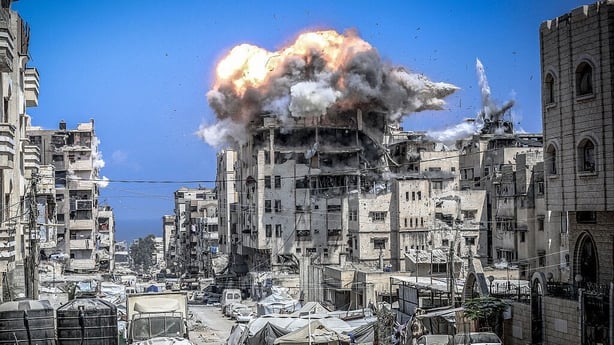
A building is hit during an Israeli airstrike in Gaza
Meanwhile, UNICEF’s spokesperson in Gaza Rosalia Bollen said Gaza “is really one of the most frustrating places on Earth to be working as a humanitarian.
Speaking on RTÉ’s Morning Ireland, she said this is due to the constant bombardment and displacement orders.
“Right now there’s less than 13% of the territory that is not under displacement order or that hasn’t been designated as a military zone, that affects the population, but it also affects our ability to move around and to operate and it means that the population is constantly on the move.
“So the communities that we’re trying to help, that we’re trying to follow, they keep moving and that means that our services have to move to”.
She said that UN agencies are in constant contact with the Israeli Defence Forces to ensure that agency staff can move around, “to ensure that our premises are deconflicted, as we call it, especially with this latest displacement order for Deir al-Balah, which is in the centre of the Gaza Strip.”
She said an attack on a UN warehouse earlier this week was “is absolutely frightening”.
“At the moment, a warehouse is out of order, that gravely undermines humanitarian operations and their ability to bring medicines in.
“So this is this is very bad news for healthcare in in Gaza, which was already really on the brink. Right now what we need is more access, more supplies, which are ready outside of Gaza.
“The solution is there.”
The war between Israel and Hamas has been raging for nearly two years since Hamas killed some 1,200 Israelis and took 251 hostages from southern Israel on 7 October 2023, in the deadliest attack in Israel’s history.
Israel has since killed nearly 60,000 Palestinians in Gaza, reduced most of the territory to ruins and forced nearly the entire population to flee their homes multiple times.