
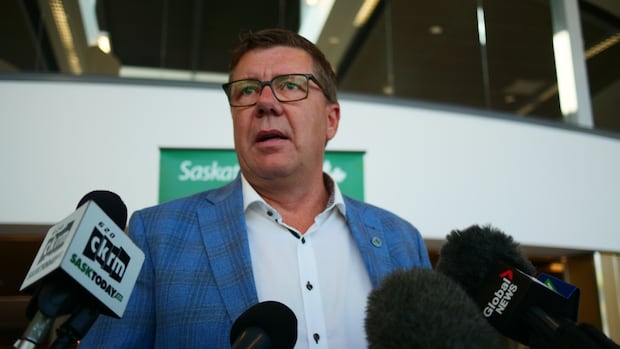
Premier Scott Moe’s comments supporting a proposed oil pipeline project — particularly, that no group outside of the federal government should have a veto over it — are drawing reaction from experts and politicians across the country.
Last week, Alberta Premier Danielle Smith announced the province plans to develop and submit an application to the federal Major Projects Office for a new pipeline that would transport bitumen from Alberta to the northwest coast of British Columbia.
British Columbia Premier David Eby and several Indigenous groups quickly raised concerns about the proposed project, which prompted Moe to offer his own thoughts.
“I would just say that this decision on the approval of this type of very, very beneficial infrastructure lies solely with the federal government,” Moe said on Friday.
“There is no B.C. coast. It’s Canada’s coast. There is no B.C. ports. There are Canada’s ports.”
WATCH | Sask. premier supports Alberta pipeline proposal: 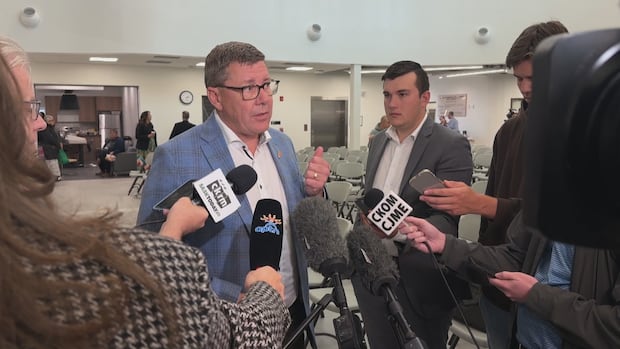
‘There is no B.C. coast. It’s Canada’s coast’: Sask. premier supports Alta. pipeline proposal
Premier Scott Moe voiced his support for Alberta’s latest pipeline proposal, dismissing concerns from the B.C. government and Indigenous groups.
It’s a comment that draws on federalism, or the division of power between the federal and provincial governments.
Peter Graefe, a professor of political science at McMaster University who specializes in federalism, said that as premiers stake out positions, it’s important to remember they are doing it because of political self-interest.
“I think a lot of the decision about what’s a national priority or when provincial jurisdiction needs to be respected is opportunistic,” Graefe said.
“It’s difficult to maintain some sense of national unity because premiers will often be playing to the voters back home.”
That is especially relevant in Saskatchewan, where Moe has previously and repeatedly argued for further provincial autonomy and the use provincial rights.
Under Moe, the Saskatchewan government has opposed the federal carbon tax.
It stopped collecting the carbon tax on natural gas in the province and withheld the remittance to the federal government, a dispute which continues to play out in federal tax court.
Saskatchewan has also rejected Ottawa’s clean energy regulations. The federal government has previously argued that the policies were beneficial to Canadians.
The House12:51Is Canada headed for a stand off over a pipeline?
Danielle Smith’s latest efforts to map out a pipeline from Alberta’s oilsands to British Columbia’s coast is leaving the western provinces at odds over a major project that may or may not get a future green light from Ottawa. The House checks in with B.C. Energy Minister Adrian Dix to get the west coast perspective, as well as Alex Pourbaix chair of Cenovus Energy, who is co-leading the advisory group assisting the Alberta government on its pipeline pitch.
The inconsistency between Moe’s past positions and his argument for the federal government’s supremacy when it comes to the proposed pipeline can make it hard to build trust, according to Graefe.
“I think citizens see some posturing and … say, ‘Can we really trust these premiers to make commitments around sharing costs and risks if they aren’t really consistent in terms of how they talk about federal and provincial powers?'” Graefe said.
Beck, Eby respond
Saskatchewan NDP Leader Carla Beck slammed Moe’s comments in an interview with CBC News on Monday.
Beck stressed that the Saskatchewan NDP would support the project as proposed.
“The way to actually get things built is not to sow more division and take swipes through social media,” Beck said.
Instead, Moe should focus on doing “the hard work” of getting to the table, honouring the duty to consult with Indigenous nations and actually finding a path forward, said Beck.
Eby did not directly address Moe’s comments in a video posted to social media on Monday, but called the pipeline project “fictional.”
Eby said the proposal makes no financial or economic sense, does not have the consent of First Nations, has no private proponent, route or private funding, and would cost taxpayers “billions.”
“What the Conservatives in Alberta are pushing is an entirely political creation in the lead up to their election,” said Eby.
Moe was not made available for an interview on Monday.
Alberta’s plan would see the province commit $14 million toward the proposal and lead a “technical advisory group” that would include pipeline companies Enbridge, South Bow and Trans Mountain. Alberta said it plans to ultimately find a private company or a group of companies to construct the pipeline.
A specific route for the pipeline has not yet been proposed. The province is expected to submit its application in the spring of 2026.
Last month, Prime Minister Mark Carney announced the first wave of “nation-building” projects the federal government plans to fast-track.
The initial projects did not include any pipelines.