
Unlock the Editor’s Digest for free
Roula Khalaf, Editor of the FT, selects her favourite stories in this weekly newsletter.
Israeli officials on Thursday gave a guarded welcome to Hamas’s latest proposal for a ceasefire and hostage-release deal, amid a renewed push by mediators to thrash out an agreement to halt the war in Gaza.
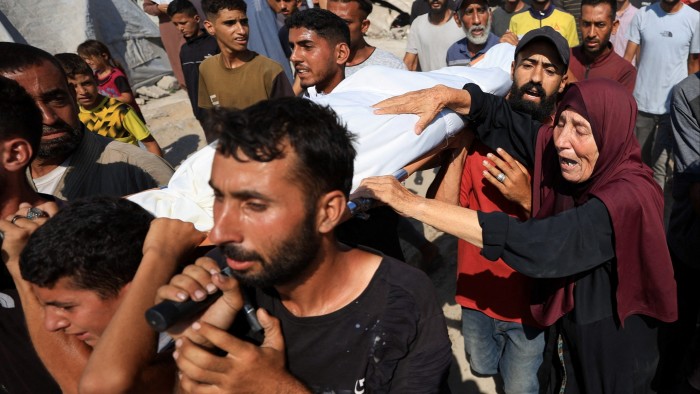
The burst of diplomacy comes amid mounting international horror at the catastrophic humanitarian conditions caused by Israel’s 21-month offensive in the Palestinian enclave, with 28 western countries this week condemning Israel’s “drip feeding of aid” and the “inhumane killing of civilians”.
Hamas said in the early hours of Thursday it had submitted its latest terms for a deal, after mediators rejected out of hand a previous proposal it made earlier this week. The Palestinian militant group gave no details of the terms.
The Israeli prime minister’s office confirmed it had received Hamas’s terms. An Israeli official familiar with the talks said the proposal appeared “at first glance” to be “one Israel can work with”, but added that it was still being studied by the country’s negotiating team.
A diplomat briefed on the talks said Israel’s response was expected in the next two days.
An official from Qatar — which has been one of the key mediators between Israel and Hamas — and US President Donald Trump’s Middle East envoy Steve Witkoff are expected to meet in Italy later on Thursday as mediators work to close the gaps between Israel and Hamas.
Discussions in recent weeks have been based on a draft framework put forward by the US, Qatar and Egypt that would involve a 60-day truce between the two sides, the release of some of the 50 Israeli hostages — less than half of whom are thought to be alive — still held by Hamas in Gaza, and the start of talks on a permanent end to the war.
But despite the flurry of activity, there were still challenges to get a deal over the line, and previous attempts to reach an agreement have repeatedly faltered.
Key outstanding issues, according to a diplomat briefed on the talks, are the details of the redeployment of Israeli forces in Gaza once the ceasefire begins, and the ratio for the number of Palestinian prisoners to be released by Israel in exchange for hostages.
Another long-standing sticking point has been Hamas’s insistence that any deal should permanently end the war — something Israeli Prime Minister Benjamin Netanyahu has repeatedly rejected.
After Hamas agreed to a previous US-brokered ceasefire in January, which envisaged a multi-phased approach to ending the war, Israel resumed fighting after the first 60-day phase of the truce, before the second phase, which would have led to a permanent end to the fighting, could take effect.
The deal under discussion has a clause that provides a certain level of guarantees that the deal will progress to the second phase, during which there should be a permanent ceasefire. Hamas had reacted positively to that proposal, the diplomat said.
Netanyahu’s far-right allies have repeatedly threatened to leave his government if it ends the war before Hamas is completely destroyed. Bezalel Smotrich, the ultranationalist finance minister, said in April that the government would have “no right to exist” if Israel did not occupy Gaza.
But once Israel’s parliament goes into recess next week, their ability to topple Netanyahu’s government — which has already been weakened by the departure of ministers from two ultraorthodox parties this month — will be limited until the next parliamentary session begins in October.
According to Palestinian officials, Israel’s offensive has now killed more than 59,000 people in Gaza. Israel launched the campaign in response to Hamas’s October 7 2023 attack on Israel, during which militants killed 1,200 people, according to Israeli officials, and took a further 250 hostage.