
24 July 2025
COVID-19, education, housing, inflation, international, labour market

Photo: freemixer – Getty Images
Abstract
International students play a significant role in the Australian economy. They contribute to demand through
their spending on goods and services and are an important source of labour for some Australian businesses.
This article shows that international students tend to add more to demand in the economy than they do to
supply in the short run, in large part reflecting their spending on tertiary education fees. In periods of
large swings in international student numbers or when the economy has little spare capacity, this means that
changing international student numbers can affect macroeconomic outcomes, particularly in sectors of the
economy where supply cannot respond quickly. The rapid growth in international student numbers post-pandemic
likely contributed to high inflation over this period, but was not a major driver.
Introduction
International students play a significant role in the Australian economy by spending on goods and services
and providing labour for Australian businesses. The number of international students grew strongly after
international borders reopened following the COVID-19 pandemic; education
exports are currently Australias fourth largest category of export, at approximately
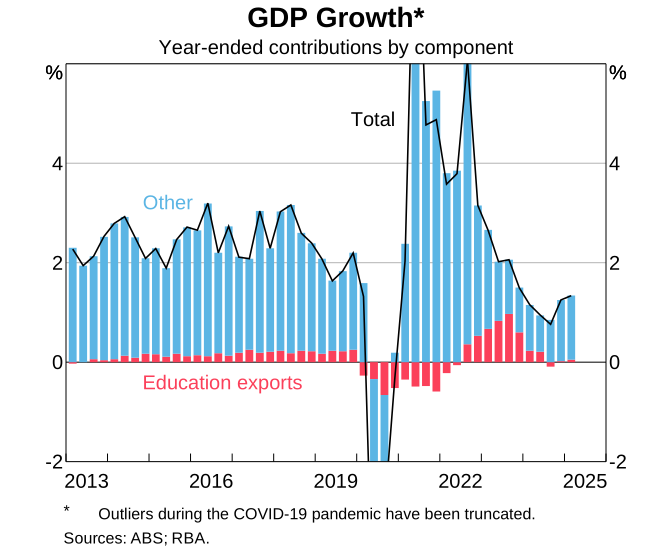
$50 billion in 2023/24. International students have been an important
driver of net overseas migration and GDP growth in recent years (Graph 1).
Graph 1
This article begins by stepping through developments in international student flows since the start of the
pandemic in 2020. It then examines the ways in which international students interact with and contribute
to the Australian economy, first by taking an economy-wide view of how international students contribute
to supply and demand, and then considering their specific interactions with the market for goods and
services, the labour market and the housing market. Finally, it concludes by assessing whether large
changes in international student numbers have affected macroeconomic outcomes in recent years. Throughout
the article, our analysis primarily considers how international students interact with and contribute to
the economy from a shorter run perspective; longer run effects are outside the scope of the work.
Recent developments in international student flows
Global demand for education in Australia grew solidly in the decade prior to the pandemic. This reflected
a range of factors, including rising household disposable income in Asia, the active promotion of
Australia as an education destination, changes to migration policies that enabled higher education
students to work in Australia after their studies, global population growth, and the depreciation of the
Australian dollar after the mining boom (Grozinger and Parsons 2020; Norton 2024). However, with the
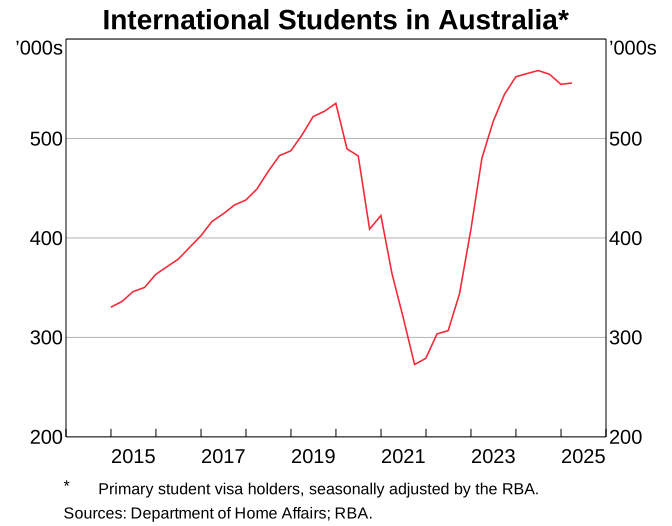
introduction of border restrictions in March 2020 to contain the spread of the COVID-19 virus, new students were unable to enter the country. As a result,
the number of international students onshore fell sharply (Graph 2).
Graph 2
After Australias international borders reopened in late 2021, the number of international students
onshore rose rapidly. While student arrivals quickly returned to around pre-pandemic levels,
departures were lower because there were fewer students onshore to depart. Overall, these
dynamics led to the international student stock rising sharply from just under 300,000 in 2022
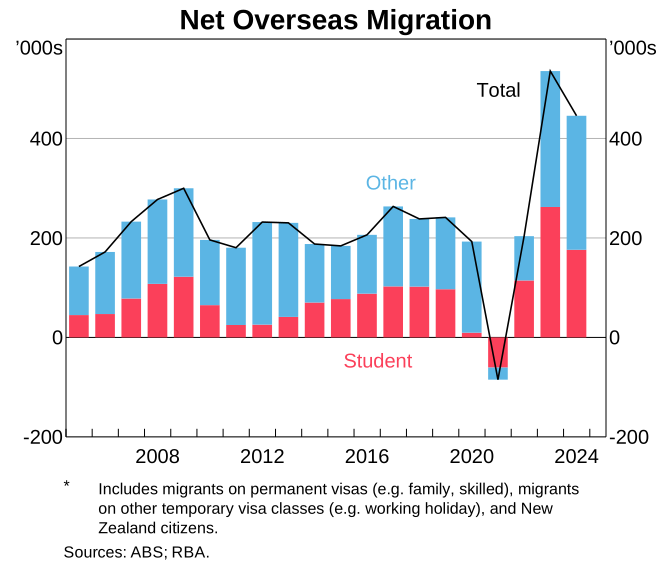
to 560,000 by the end of 2023. Accordingly, international students were an important driver of
net overseas migration during this period, accounting for around half of Australias total net
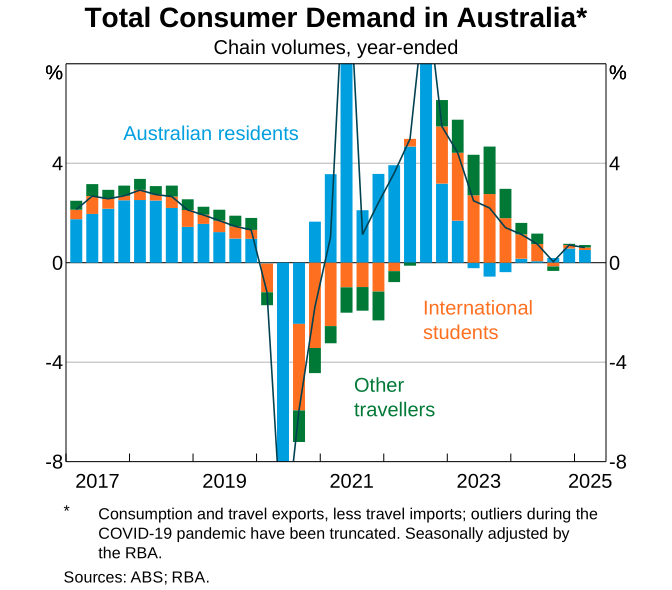
overseas migration (Graph 3). Spending by international students was also an important
contributor to growth in consumer demand in Australia following the pandemic (Graph 4).
Graph 3
Graph 4
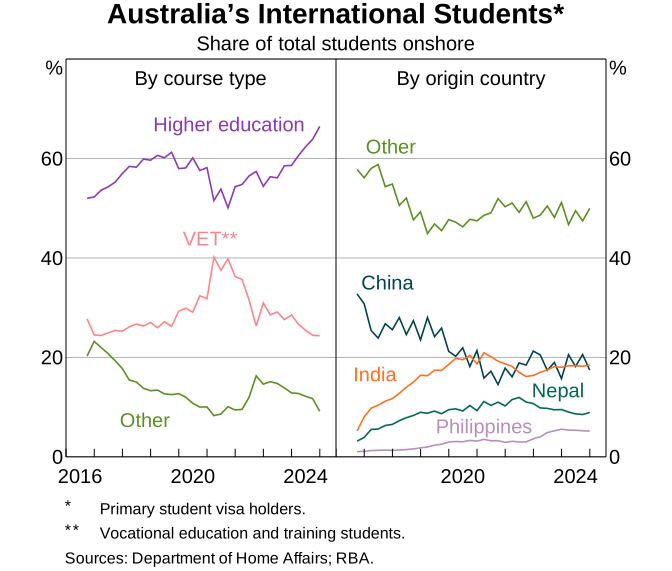
As the student stock has recovered, the share of international students studying higher education courses
has risen, while the share studying vocational education and training (VET) and other types of courses
has declined. Most international students are from Asian countries, with Chinese and Indian students
making up close to two-fifths of those studying higher education courses (Graph 5).
Graph 5
More recently, growth in the number of students onshore has slowed. Student visa grants have fallen,
particularly for VET students since mid-2023, and the contribution of international students to growth in
total consumer demand has fallen after driving growth following the pandemic. During this time, the
Australian Government has tightened processing standards and increased requirements for student visa
applicants, including by increasing proof of savings and English language requirements, raising visa
application fees, and introducing a Genuine Student Test, in which students must demonstrate they are
entering Australia for the purpose of studying (Norton 2024). The Government also reintroduced a
cap on how many hours international students can work (48 hours per fortnight during teaching
periods). Nevertheless, the number of international students onshore is still near record highs, and
timely Australian Bureau of Statistics (ABS) data indicate that student visa arrivals have exceeded
departures in recent months, suggesting the number of students onshore is growing.
How do international students interact with and contribute to the Australian economy?
Given the significant number of international students in Australia, it is important to consider how
international students interact with and contribute to the Australian economy and, in particular, how
they have added to both demand and supply in recent years. To do so, we begin with an aggregate
perspective before turning to the market for goods and services, the labour market and the housing
market. There is significant variation in the working and spending behaviour of students from different
countries and in different courses of study. The analysis below mostly draws on data covering the total
pool of international students, and so likely masks important compositional differences.
The aggregate impact of international students
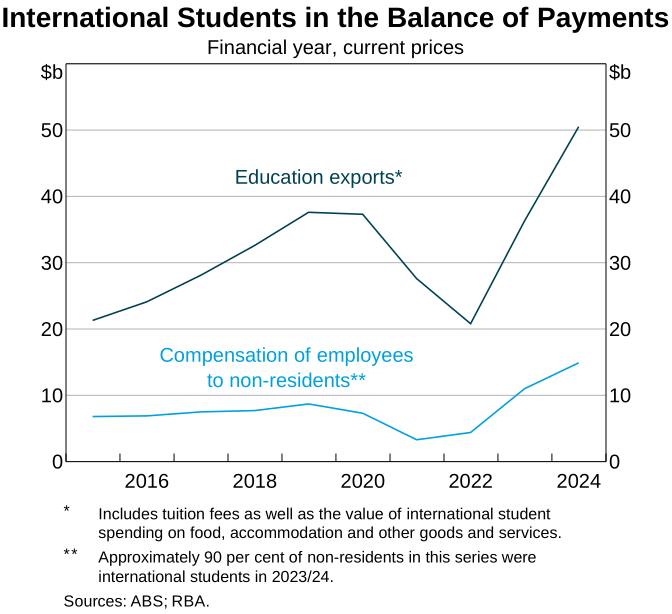
The value of education exports is an indication of the demand that international students add to the
economy. All spending by international students in Australia on tuition fees and all other goods and
services is recorded as an education export in Australias Balance of Payments (ABS 2024).
However, international students also contribute to the economys supply potential because many will
work while they are in Australia. The Balance of Payments (BOP) provides an estimate of the value of this
labour supply contribution. If an international student is employed in Australia
while studying, payments from their employer are recorded in the primary income account as Compensation
of Employees (COE) to non-residents. International students comprised around
90 per cent of COE to non-residents in 2023/2024. Note that this
estimate of student earnings will not capture funds a student may receive from or send overseas
(transactions between non-residents are not captured in the BOP). It will also not include any
cash-in-hand earnings. (This could mean student earnings are underestimated in the BOP:
Coates, Wiltshire and Reysenbach (2023a) provide survey evidence that temporary migrants are much more
likely to be paid below-minimum wages, meaning cash-in-hand work may be prevalent.)
The value of education exports has been consistently higher than measured COE to non-residents, suggesting
that in aggregate international students spend more than they earn in Australia (Graph 6). In 2023/24, education exports were worth $50 billion – more than three
times higher than the estimated $13.4 billion of COE earned by international students.
Graph 6
Spending on goods and services
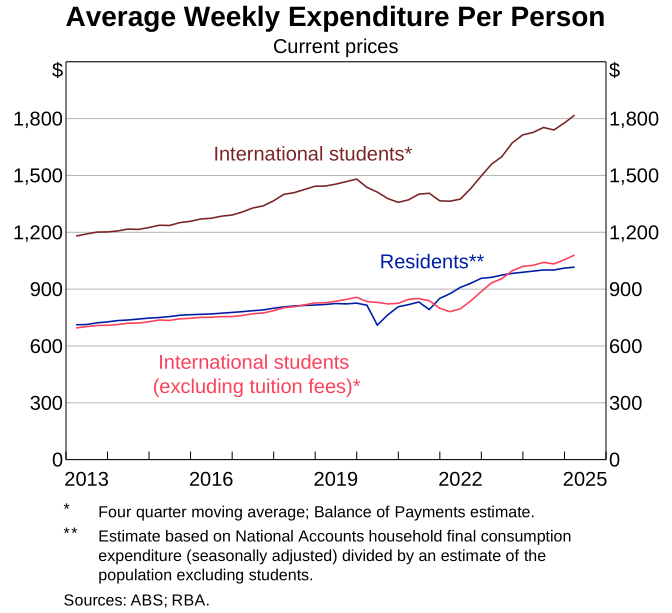
While living and studying in Australia, international students consume goods and services. Our estimates
of the average weekly spend of international students using BOP data suggest that international students
spend twice as much as residents (as measured by consumption per capita in the Australian National
Accounts: National Income, Expenditure, and Product) (Graph 7). A large proportion of this is due to
tuition fees, which account for 40 per cent of international student spending. Excluding fees,
international students spend roughly the same as residents on average. The BOP figures on international
students average spending on goods and services are based on a survey of visitors who have
travelled to Australia for education purposes by Tourism Research Australia, and course fee spending data
from the Department of Education, Skills and Employment.
Graph 7
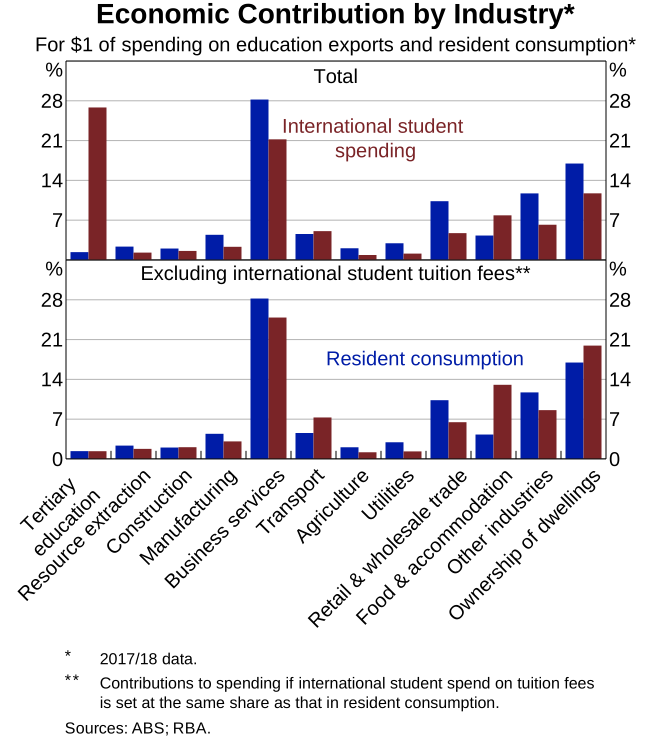
Certain industries face relatively more demand from international students.
Unsurprisingly, international student spending is more concentrated in the tertiary education sector than
that of other residents, given their higher spending on tuition fees (Graph 8). When we exclude
tuition fee spending, international student spending patterns are quite similar to that of residents
– it is broadly based across industries and as such disperses widely through the economy. There
are, however, some slight sectoral differences. Accommodation and food, transport, and housing make up a
slightly higher share of the gross value added associated with education export spending, while business
services, and retail and wholesale trade, make up a lower share.
Graph 8
As mentioned above, international student spending plays a significant role in the tertiary education
sector. International student tuition fees make up a material share of revenues for universities, and
this share has risen over time (Norton 2023). For the major universities, this share ranges from
15 per cent to over 40 per cent of total revenue (including grants) (Sato,
Higgins-Devine and Austin 2024). As such, the fees paid by international students have important
spillover benefits to university research, employment and capital expenditure. International students
have also come to account for a substantial share of enrolments in the VET sector, with enrolments from
this group having risen sharply over the last 10 or so years (NCVER 2024; Norton 2024).
A unique feature of international student spending relates to the savings that international students
bring to set up and finance their life in Australia. Currently, international students need to provide
proof of nearly A$30,000 of savings to receive a student visa; up from around A$25,000 in 2023,
which is higher than the cash savings most Australian residents have in their bank accounts. This could
mean there is a temporal dimension in international student consumption, whereby consumption is strong
upon arrival in Australia as individuals use these savings to set up their lives (i.e. purchasing
furniture and other goods) but then slows afterwards; this same dynamic may hold for domestic residents
moving out of home to attend university. In periods of strong inflows of students, such as just
after borders reopened after the pandemic, this likely had an important effect on aggregate demand in the
economy.
The labour market
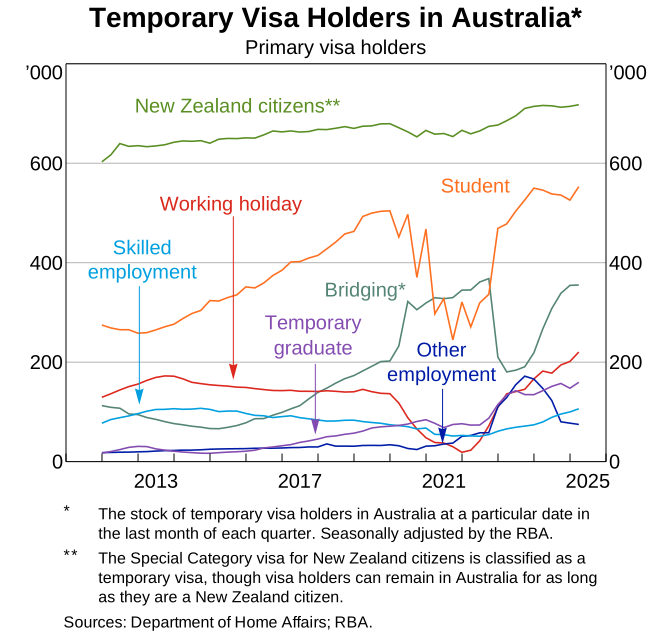
International students make an important contribution to the labour market. While they only made up around
2 to 3 per cent of the labour force prior to the pandemic, they constitute the second
largest group of temporary visa holders with work rights in Australia after New Zealand citizens, making
them a large source of potential labour supply for the Australian economy (Graph 9). There is also a
sizeable cohort of individuals on temporary graduate visas, which allow international students to live
and work in Australia for between one and five years after they have finished their studies.
Graph 9
Prior to the pandemic, the average international student appeared to contribute less to labour supply than
an average member of the working age population and an average member of the entire resident population
(i.e. including those aged 15 years and under and those aged over 64 years). International
students had lower labour force participation rates than working age residents and were limited to
working 40 hours per fortnight. Using experimental estimates derived from the ABS Longitudinal
Labour Force Survey (LLFS), we estimate that the average international student worked around half of the
weekly hours of an average member of the working age population prior to the pandemic, and around
two-thirds of the hours of an average member of the total resident population (Table 1).
In the years immediately following the pandemic, the contribution of international students to labour
supply has risen, reflecting both a rise in their participation rates and a lift in the limit on how many
hours they can work (from 40 hours to 48 hours per fortnight). In 2024, we estimate that the
average international student worked around three-quarters of the hours of an average member of the
working age population, and around the same hours as an average member of the total resident population.
Note that these are likely upper bound estimates since we assume all international students who
participate in the labour force work up to the legal limit. Although these estimates apply to the entire
student population, the propensity of international students to work varies by country of origin, with
students from India and Nepal typically having higher rates of labour force participation (Grozinger and
Parsons 2020; Norton 2023) and those from China having lower rates of participation.
Table 1: Labour Force Participation and Average Hours Per Capita(a)
Pre-pandemic
2024
International students
(2015-2019 average, LLFS estimate)
International students
(2016 Census estimate)
Working age population
Entire resident population
International students (LLFS estimate)
Working age population
Entire
Resident population
Participation rate (%)
44
51
65
53
61
67
55
Average weekly hours per capita
9
10
20
16
15
20
16
(a) Average hours per capita is calculated as total hours worked divided by either the
international student population, the working age population, or the estimated
resident population. Total hours worked for international students is estimated by
assuming all international students in the country work up to the legal limit of
40 hours per fortnight (pre-pandemic) and 48 hours per fortnight in 2024,
and then multiplying this by their participation rate.
Sources: ABS; RBA.
Looking forward, while rules around the number of hours that international students can work are higher
than pre-pandemic, average participation may decline from the levels seen in 2024. This is because the
recent tightening in visa policy has targeted groups of students who were more likely to be seeking to
work; that is, those international students who do receive visas going forward are less likely
to be focused on employment opportunities in Australia on average (Norton 2024).
International students nevertheless make a notable contribution to labour supply in certain sectors. A
greater share of international students work in accommodation and food, as well as retail, compared with
the share of the total labour force (Table 2). Further, an increasing share of students are now
working in health care, consistent with strong labour demand in this sector. This contribution was
important in helping businesses in these sectors facing labour shortages in the tight labour market that
emerged post-pandemic.
Table 2: Sectoral Composition of Employment – International Students vs Labour
Force(a)
Per cent
Retail
Accommodation and food
Transport
Administrative
Education
Health care
Other
2016–2019
International students
13.1
37.4
5.7
8.4
6.9
11.5
18.4
Total labour force
10.2
7.0
5.1
3.4
8.1
13.2
52.9
2023
International students
13.7
23.4
8.7
6.7
5.6
17.0
24.8
Total labour force
9.5
6.6
5.1
2.9
8.3
15.4
52.2
(a) This table shows experimental LLFS estimates of the sectoral composition of
international student (and labour force) employment; note that the ABS recommends
that the Labour Account should typically be used for analysis of employment and jobs
by industry division.
Sources: ABS; RBA.
Many international students will also add to labour supply beyond their direct contributions
during their studies. Over time, many international students transition to temporary graduate visas or
permanent residency. About 30 per cent of international students went on to apply for temporary
graduate visas in the five years to 2022, with this share having risen over time, and international
students making up around one-third of Australias permanent resident intake (Department of
Education 2022).
Coates, Wiltshire and Reysenbach (2023b) discuss the longer term benefits of having the
best students stay permanently in Australia, including in terms of taxes paid over their
lifetimes and spillovers to innovation and productivity growth (the authors note, however, that many
international students may remain in visa limbo on temporary graduate visas, working in
low-skilled jobs and earning lower incomes than domestic students).
The housing market
An important area in which international students contribute to demand and, potentially over time, supply
is in the housing market.
International students are more likely to rent than Australian residents. About 50 per cent of
over 70,000 international students surveyed in the 2023 Student Experience Survey reported that they
rent in the private rental market (either in a private rented house, flat or room) (QILT 2023); by
contrast, around one-third of the rest of the population are renters (Agarwal, Gao and Garner 2023). In
the Student Experience Survey, around 24 per cent of international students reported living
with family or friends, 15 per cent in student accommodation, 3 per cent in a
homestay and 2 per cent in other accommodation. Housing demand from international
students also tends to be geographically concentrated around areas where educational institutions are
based, notably inner-city locations. According to the 2016 Census, international students were twice as
likely to live in inner-city areas than domestic students (Evans, Rosewall and Wong 2020).
Housing market outcomes are determined by the interaction of housing supply and demand. In theory, in the
face of a relatively fixed supply of housing in the short term, we would expect an increase in
international students to put upward pressure on rental demand and rents (all else equal), in the same
way that any kind of increase in the renting population would impact demand.
As a back-of-the-envelope exercise, if we assume that 50 per cent of international students
rent, an additional 100,000 students would increase private rental demand by
50,000 individuals. Models of the housing market used by the RBA suggest that a 50,000 increase
in population would raise private rents by around 0.5 per cent compared with a baseline
projection. The marginal effect of an additional renter may be greater in periods where the rental market
is tight and vacancy rates are low, such as occurred post-pandemic. Nonetheless, the rise in
international student numbers is likely to have accounted for only a small share of the rise in rents
since the onset of the pandemic, with much of the rise in advertised rents occurring before borders were
reopened.
With time, higher demand for housing due to a greater number of international students in Australia could
spur more dwelling investment, in the way it would for an expansion of the population more broadly.
However, capacity constraints, high costs in the construction sector and low levels of building approvals
relative to the population may mean the housing supply response could be slower to materialise compared
with in the past (Hunter 2024). One area where higher international student numbers have generated a
supply response has been in purpose-built student accommodation, with rapid growth in building approvals
for such projects in recent years (ABS 2025). Industry projections are for continued rapid growth in this
area in the years ahead (CBRE 2024).
Assessment and conclusion
Australias BOP suggests that, overall, international students spend more than they earn. In
line with this aggregate finding from the BOP, analysis of how international students interact with and
contribute to key sectors in the economy suggest that international students likely contribute more to
demand than they do to supply, although this gap appears to have narrowed following the pandemic. In the
market for goods and services, the average international student spends more than other
Australians, driven by high average spend on tuition fees. On the other hand, lower average hours worked
and labour force participation rates mean that, at least prior to the pandemic, their labour supply
contribution was less than that of an average member of the working age population and the average
Australian resident. In the housing market, supply is constrained in the near term, so changes in the
number of international students in Australia could impact market outcomes, in the same way changes in
the population more broadly could.
If and how the short-term demand-supply imbalance of international students affects macroeconomic outcomes
will depend on several factors. This could include the degree of spare capacity in the economy and labour
market, the pace of change in student numbers (in addition to the overall level) and developments in the
economys supply side. For example, rapid growth in the international student stock post-pandemic
likely contributed to some of the upward pressure on inflation from 2022 to early 2023, especially as
arriving students frontloaded their spending as they set up in Australia and took time to join the labour
market. However, the increase in international students was just one of many other forces at play in this
time that drove demand above supply in the economy, and hence higher inflation. For instance, supply-side
factors were the biggest driver of the increase in inflation in 2022 and 2023 (RBA 2023; Beckers, Hambur
and Williams 2023) while strong domestic demand arising from supportive fiscal and monetary policy also
played an important role.
References
Australian Bureau of Statistics (ABS) (2024), Recording of International Students in the
Balance of Payments, September.
ABS (2025), Student Accommodation in Australia – Estimates of Student Accommodation
Approvals in Australia, Report No 2021/22–2023/24.
Agarwal N, Gao R and Garner M (2023), Renters,
Rent Inflation and Renter Stress, RBA Bulletin, March.
Grozinger P and S Parsons (2020), The
COVID-19 Outbreak and Australias Education and Tourism
Exports, RBA Bulletin, December.
Bank of Canada (2024), How Newcomers Impact the Canadian Economy, Monetary Policy
Report – In Focus, July.
Beckers B, J Hambur and T Williams (2023), Estimating
the Relative Contributions of Supply and Demand Drivers to Inflation in Australia,
RBA Bulletin, June.
CBRE (2024), Australian Student Accommodation 2024 Edition, Intelligent Investment
Report, July.
Champagne J et al (2023), Assessing the Effects of Higher Immigration on the
Canadian Economy and Inflation, Bank of Canada Staff Analytical Note No 2023-17.
Coates B, T Wiltshire and T Reysenbach (2023a), Short-changed: How to Stop the Exploitation
of Migrant Workers in Australia, Grattan Institute Report No 2023-07, May.
Coates B, T Wiltshire and T Reysenbach (2023b), Graduates in Limbo – International
Student Visa Pathways After Graduation, Grattan Institute Report No 2023-09, October.
Department of Education (2022), Post-study Work Rights Report, Australian Government,
October.
Department of Education (2024), End of the Two-year Extension of Post-study Work
Rights, Australian Government.
Evans R, T Rosewell and A Wong (2020), The Rental Market
and COVID-19, RBA Bulletin, September.
Hunter S (2024), Housing Market Cycles and
Fundamentals, Speech at the REIA Centennial Congress, Hobart, 16 May.
Hurley P (2020), International Students Vital to Coronavirus Recovery, Mitchell
Institute and Victoria University Issues Paper.
NCVER (National Centre for Vocational Education Research) (2024), Total VET Students and
Courses 2023, Statistical Report No 2206-5156.
Norton A (2023), Mapping Australian Higher Education 2023, ANU Centre for Social
Research and Methods.
Norton A (2024), International Students: A Government Changes its Mind, ANU Migration
Hub Insights Paper No 24/3.
QILT (Quality Indicators for Learning and Teaching) (2023), Student Experience Survey.
RBA (Reserve Bank of Australia) (2023), Box C:
Supply and Demand Drivers of Inflation in Australia, Statement on Monetary
Policy, February.
Sato K, K Higgins-Devine and S Austin (2024), Group of Eight Universities Warn They Are
Reliant on International Student Fees as Government Looks to Cap Enrolments, ABC
News, 16 May.
Underlying data for selected graphs.
Other data may be available upon request via our
general enquiry page.