
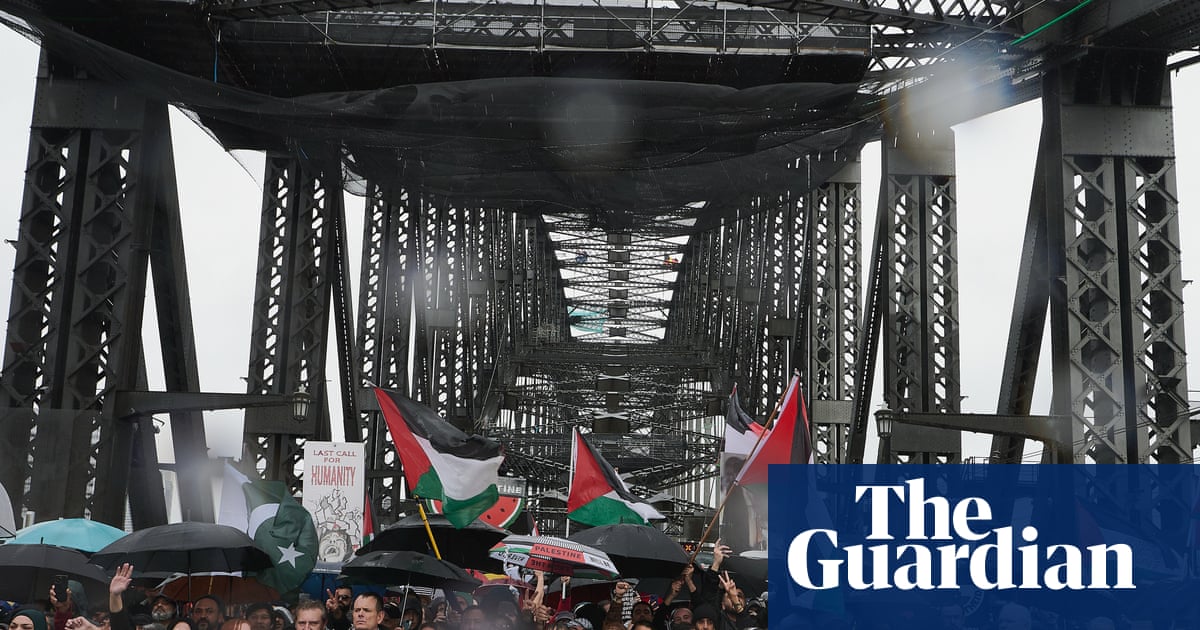
One of New South Wales’ most senior police officers has told a court that a proposed pro-Palestine march to the Sydney Opera House has “disaster written all over it” due to “significant” safety concerns.
Representatives from the Palestine Action Group and Jews Against Occupation remain before the court of appeal in their fight against the New South Wales police over the proposed march from Hyde park to the Sydney landmark this Sunday.
Last week, the group announced its plan to diverge from the normal route of its nearly weekly rallies over the past two years to mark two years since 7 October and call for “an end to genocide in Gaza”. But on Friday the NSW police announced it would knock back the group’s application to march to the Opera House, citing safety concerns.
The court of appeal, which inherited the case on Tuesday from the supreme court due to the urgency of the matter and legal complexities, is now determining if the march will be authorised to finish at the Opera House.
The assistant commissioner Peter McKenna said in his evidence that of particular concern was how the 40,000 people expected to attend would safely enter and exit the Opera House forecourt without the risk of crowd crush. He also questioned the estimate of 40,000 people, saying it could be more.
“We are not anti-protest. We assisted this group with over 100 protests over the last two years and we do about 1,500 protests a year,” he said.
“All the altruism in the world does not assist when we have a physical situation where we believe the numbers are far too excessive to keep people safe.”
Sign up: AU Breaking News email
Palestine Action Group’s barrister, Felicity Graham, put to McKenna that police could stagger the crowd as it leaves from Hyde park. McKenna said police could facilitate this with 10,000 people, but not significantly upwards of that.
“You’re talking significant resources, which I don’t have,” he said.
Under the bylaws which govern the Opera House, it has the power to conduct searches, which could include X-ray equipment and bag searches. The court heard this was standard operating procedure during events that attract large crowds.
McKenna told the court he would advise the Opera House to screen protesters.
“I would still say to the Opera House that being such an iconic location, and where, and I’m careful with what I say here … but there are people who are in our society [that] would love an opportunity to do some things at that location because of the media interest [and] given our current threat in Australia, I would say it would be good to know who is coming in there and what they have on them,” he said.
“Just because there’s a protest, it does not stop other people from coming into that environment.”
Graham asked if that would not be impractical because it would cause the crowd to grind to a halt.
skip past newsletter promotion
Sign up to Breaking News Australia
Get the most important news as it breaks
Privacy Notice: Newsletters may contain information about charities, online ads, and content funded by outside parties. If you do not have an account, we will create a guest account for you on theguardian.com to send you this newsletter. You can complete full registration at any time. For more information about how we use your data see our Privacy Policy. We use Google reCaptcha to protect our website and the Google Privacy Policy and Terms of Service apply.
after newsletter promotion
McKenna responded: “My whole argument is that 40,000 to 100,000 people going there is impractical.”
Andrew Bell, the chief justice of NSW, is one of three judges overseeing the case. He expressed concern at protesters finishing the march in what he called a “cul-de-sac”.
Graham told the court that three exit points had been identified for protesters to leave the forecourt. She also raised the possibility of staggering protesters as they arrive at the Opera House so that only about 6,000 people were in the forecourt at a time.
McKenna told the court the organiser’s expectation that people would leave the Opera House forecourt – which marks the end of the march – as soon as they arrived was “farcical”. He added that people will want to stay to get the imagery they need to get global media attention.
The court also heard submissions from the Jewish community in opposition to the rally.
Barrister Vanessa Whittaker, speaking on behalf of the Executive Council of Australian Jewry, told the court the planned protest’s proximity to the second anniversary and its location would create “further fear of antisemitism, which includes violence, and further distress amongst the Jewish community”.
“The affront is that in reality, in the modern age, in the modern democracy, it is impossible for the Jewish community … to be oblivious to the consequences, the attention and the heat … generated by this kind of protest,” she said.
The matter remains before the court.