
Unlock the Editor’s Digest for free
Roula Khalaf, Editor of the FT, selects her favourite stories in this weekly newsletter.
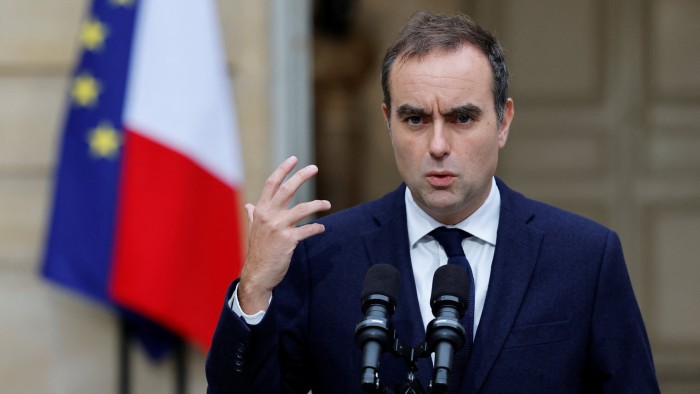
France’s caretaker prime minister Sébastien Lecornu said the prospect of snap elections was receding after holding last-ditch talks with political parties for a budget deal, as allies of President Emmanuel Macron suggested suspending his emblematic pension reforms.
Giving an update on the first of two days of negotiations, Lecornu said on Wednesday he had detected “movement and convergence which, obviously, puts back the prospect of a dissolution” of parliament.
Former prime minister Élisabeth Borne, now education minister, on Tuesday night suggested pausing reforms to raise the retirement age to 64 — a major concession to the left that would dismantle a central pillar of Macron’s economic reforms.
Raphaël Glucksmann, a leading centre-left politician and member of the European parliament said on Tuesday night that Lecornu had “opened the door” to pausing the reform in discussions. “It was impossible a few days ago but it is becoming possible today . . . our demand is not unattainable.”
But making too many concessions to the left risks further alienating the rightwing Républicains, who want to see France’s rising debt levels taken in hand. French bonds and stocks have already sold off this week in reaction to the political uncertainty.
Outgoing finance minister Roland Lescure told France Inter on Wednesday that the suspension of pension reforms was one of the measures being assessed to pass a budget but that the move would need to be financed by other means.
“In today’s situation and given the urgency, there are ways of moving forward, but . . . changing the pension reform would cost hundreds of millions in 2026, and billions in 2027,” he said.
Lecornu said all parties in Tuesday’s talks agreed that the 2026 budget should cut the deficit to below 5 per cent of GDP, saying it was essential for France’s credibility.
The reforms to progressively raise the retirement age in France from 62 to 64 were passed in 2023, but a suspension would stop the gradual increases. The measures were bitterly opposed by opposition parties and unions and sparked major protests.
Borne, who introduced the reforms to parliament, told Le Parisien newspaper on Tuesday the law should not be considered a “totem” in efforts to find a way out of the crisis.
Lecornu, who resigned on Monday after less than a month in post, has been tasked by Emmanuel Macron with leading final discussions to explore whether compromise to pass a 2026 budget can be sought in the country’s divided parliament.
Olivier Faure, head of the Socialist party, initially welcomed suggestions of a pause to pension reforms but said after meeting Lecornu on Wednesday that “we haven’t had any assurances on the reality of this suspension . . . no one is guaranteeing that it is the case.”
Recommended

He also ruled out “a common government” between socialists and Macron’s centrist bloc.
Scaling back Macron’s pension reform has been a key demand of the left and the far right but it is still unclear whether a budget including the measure would win sufficient support in France’s fractured National Assembly.
Marine Le Pen of the far-right Rassemblement National party said she would be “happy about this suspension if it happens”, having called for the repeal of the measure in previous elections.
But the conservative Républicains are objecting to the measure, with Valérie Pécresse, a senior party member and president of the Île-de-France region warning it would “let the deficits of the pensions system explode” and put the burden on the next generation.
France’s borrowing rates have already increased in the past month since the previous Bayrou administration fell in a confidence vote on deficit reduction measures for next year’s budget.
Rating agency Fitch, which was the first to downgrade France’s sovereign debt last month, warned that “failure to implement fiscal consolidation measures” could leave the country facing further credit downgrades.