
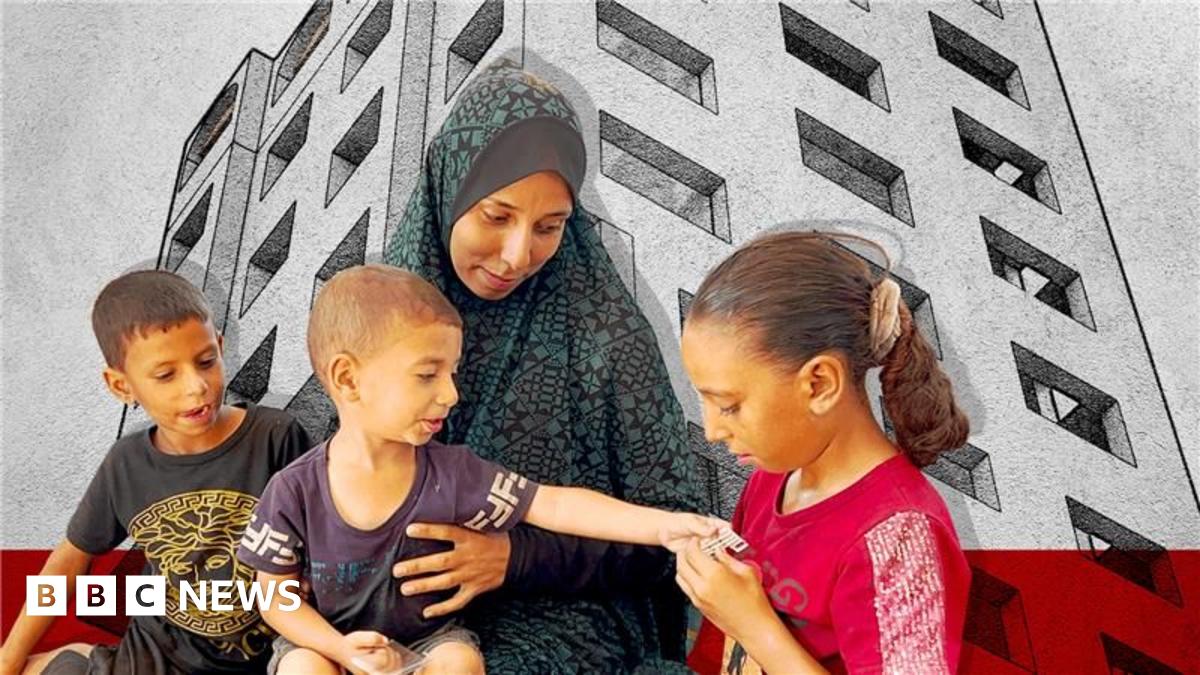
In the apartment above Hadeel’s, 59-year-old Muna Amin Shabet plays with her grandchildren beneath large bullet holes punched in the wall.
“Two days ago, bullets hit here, inside the building,” she explained. “I grabbed the children and ran with them over there, where it’s safer. We sat there praying to God that it would be OK. The children were terrified.”
Muna is also from al-Tuffah neighbourhood. She’s been living here since August with her husband, three of her children, and her grandchildren. They aren’t paying rent. The family lost everything, Muna says, when their home was destroyed weeks into the war.
“They levelled the entire al-Tuffah area – all of it, not one house was left,” she said. “We are starting life again, collecting spoon by spoon, plate by plate. Famine came, and we ground pigeon-feed to eat, and lived on wild greens,” she told us. “After two years of war, I say I am not alive, I am one of the dead.”
Another resident, from the northern town of Beit Lahia, told us his area was now a “wasteland”, after Israel’s army razed it to the ground. “There are no houses, or even any signposts left, to tell you there was once a neighbourhood here,” he said.
The UN says 90% of Gaza’s residential buildings have been damaged or destroyed. Whole neighbourhoods – with their shared history, family ties, and social support – demolished.
But the idea of home is harder to destroy than bricks and mortar.
When our cameraman visits Muna’s apartment, two of her granddaughters are drawing a picture. It’s an idyllic story-book image of a house – small and neat, with a sloping red tile roof. The sun is perched on the horizon, the sky is pink and blue, there are trees and plants.
It looks nothing like where they live.
And the widespread destruction of housing and communities has often meant families splintering to survive.
Of Muna’s five sons, two have moved to the south, another has gone to stay with his in-laws. The others, she says, have come and gone. Even she and her husband spent months apart before moving to the Skeik building, while Muna sheltered with relatives.
The extended family that once surrounded her and anchored her world is fraying.
“We are scattered. The separation is the hardest thing,” she said. “Life has been stripped away. My health is gone. Our home is gone, and the dearest people to our hearts are gone – nothing is left for us.”