
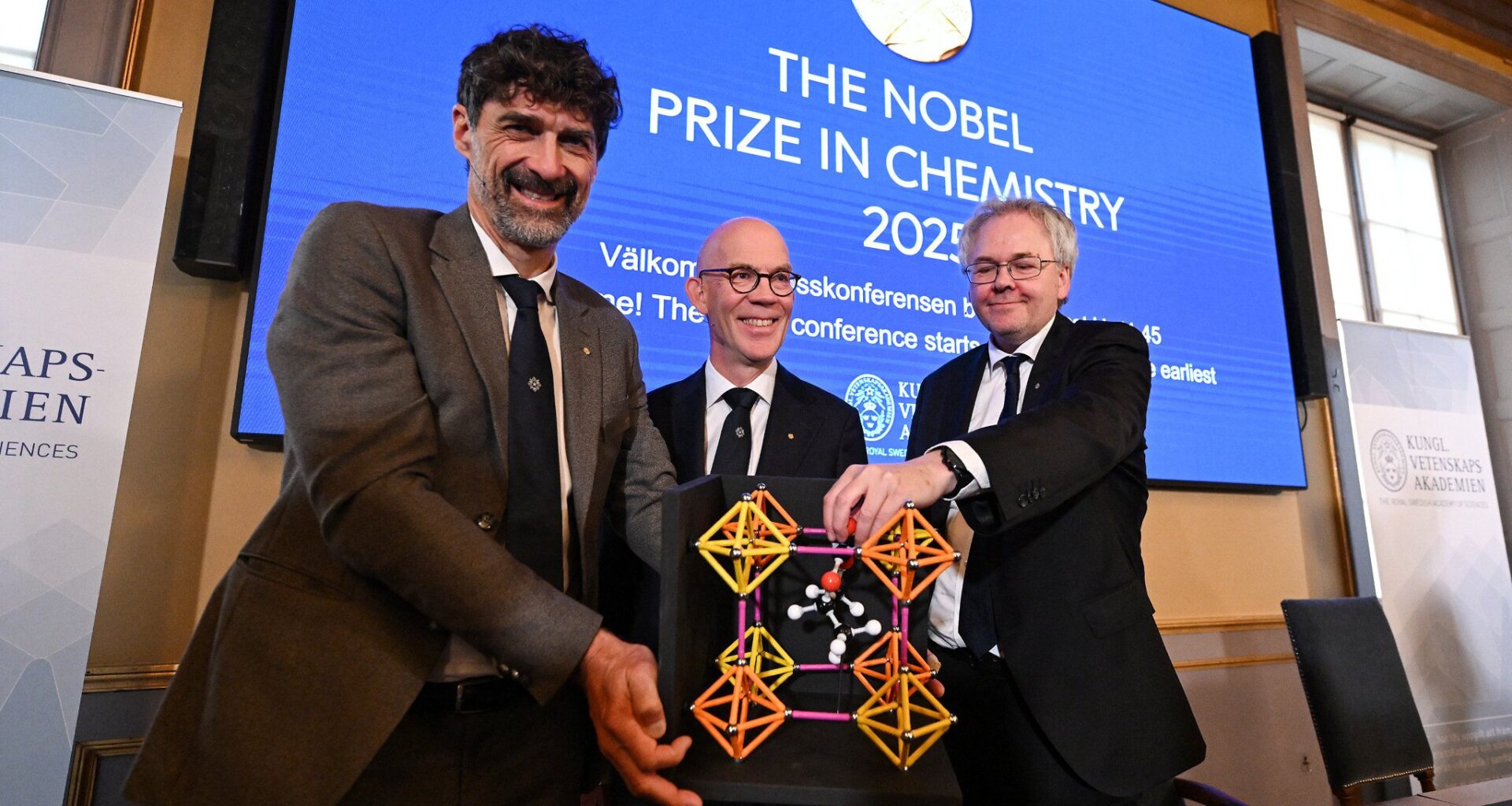
Scientist Omar Yaghi was one of three winners of the 2025 Nobel chemistry prize, the first Nobel laureate of Palestinian descent since PLO leader Yasser Arafat won the prize in 1994.
Yaghi shared the award with Susumu Kitagawa and Richard Robson for developing a new form of molecular architecture, yielding materials that can help tackle challenges such as climate change and lack of fresh water.
Yaghi was born in 1965 to Palestinian refugees in Jordan, where his family shared a one-room home with the cattle the family was raising.
“It’s quite a journey and science allows you to do it,” he said in an interview published on the Nobel website, adding that his parents could barely read or write. “Science is the greatest equalizing force in the world,” he said.
Yaghi, who said he was astonished and delighted to win the award, was 10 years old when he found a book on molecules in the library. It was the beginning of a lifelong love of chemistry.
Get The Times of Israel’s Daily Edition
by email and never miss our top stories
By signing up, you agree to the terms
“As a child born to a refugee family, I firmly believe that each one of us is blessed with having an opportunity, a chance, a probability to succeed in our chosen endeavor,” he said in 2017, upon accepting an award named for Albert Einstein. “I stand before you as a product of those slim odds and of a life of hardship that such odds entail. I was born to a family who started with absolutely nothing, except their will to build their lives anew.”
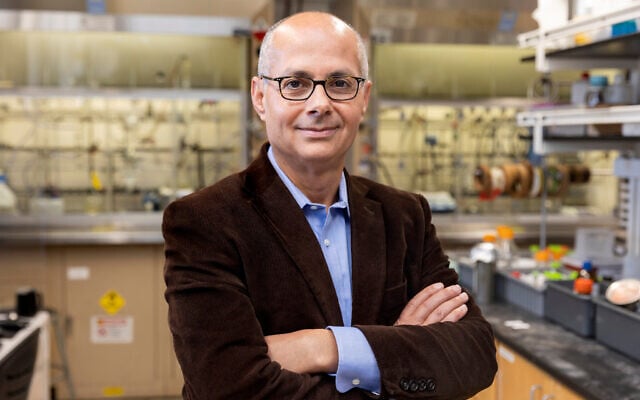
This undated image provided by the University of California, Berkeley shows Omar Yaghi, of Palestinian descent, who was one of three scientists awarded the Nobel Prize in Chemistry. (Brittany Hosea-Small, University of California, Berkeley via AP)
Yaghi’s win comes 31 years after Arafat shared the Nobel Peace Prize with then-prime minister Yitzhak Rabin and foreign minister Shimon Peres. The trio won the award for the 1993 Oslo Accords, which were thought at the time to be an opening to Israeli-Palestinian peace.
That prize has since been seen as controversial, especially as Arafat appeared to encourage the Second Intifada, which saw a rash of deadly attacks on Israelis, in the early 2000s. Beginning then, there have been calls from Jewish activists and groups to rescind the prize from Arafat, who died in 2004.

Yitzhak Rabin, left, chats with Yasser Arafat and Shimon Peres after the three received the Nobel Peace Prize in Oslo in 1994 (photo credit: courtesy GPO)
Yaghi moved to the United States at age 15 and is now a professor at the University of California, Berkeley. He has won several awards for his work prior to the Nobel, including an Israeli prize in 2018.
That year, he won the Wolf Prize in Chemistry, awarded by the Israel-based Wolf Foundation. He shared the prize with Japanese chemist Makoto Fujita.
The Nobel is the field’s highest honor. This year’s three laureates worked to create molecular constructions, known as metal-organic frameworks or MOFs, with large spaces through which gases and other chemicals can flow and that can be utilized to harvest water from desert air, capture carbon dioxide or store toxic gases.
Describing the “unheard of properties” of these materials, the award committee said some had a remarkably large surface area — a porous material roughly the size of a small sugar cube could contain as much surface area as a large football pitch.
“A small amount of such material can be almost like Hermione’s handbag in Harry Potter. It can store huge amounts of gas in a tiny volume,” Olof Ramstrom, member of the Nobel Committee for Chemistry, said, referring to a small bag in the fantasy series that contained huge objects.
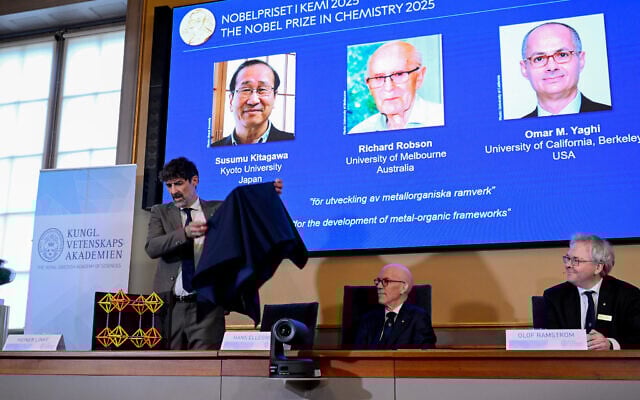
Chair of the Nobel Committee for Chemistry Heiner Linke makes a demonstration, next to Secretary General of the Swedish Academy of Sciences Hans Ellegren, and Member of the Nobel Committee for Chemistry Olof Ramstrom, right, after they announce Susumu Kitagawa, Richard Robson and Omar Yaghi, on screen behind, as the recipients the Nobel Prize in Chemistry, at the Nobel Assembly of the Karolinska Institutet, in Stockholm, Sweden, Wednesday, Oct. 8, 2025. (Fredrik Sandberg/TT News Agency via AP)
The more than a century-old prize is awarded by the Royal Swedish Academy of Sciences and the winners share 11 million Swedish crowns ($1.2 million).
After the discoveries, chemists have built tens of thousands of different MOFs, some of which “may contribute to solving some of humankind’s greatest challenges,” the Academy said, adding that additional uses included separating toxic PFAS, or “forever chemicals,” from water and breaking down traces of pharmaceuticals in the environment.
Kitagawa is a professor at Kyoto University in Japan, while Robson is a professor at the University of Melbourne, Australia.
The Chemistry Nobel was the third prize announced in this year’s crop of awards, in keeping with tradition, following those for medicine and physics announced earlier this week.
Nobel was himself a chemist and his developments in that field helped underpin the wealth he amassed from his invention of dynamite in the 19th century.
Is The Times of Israel important to you?
If so, we have a request.
Every day, even during war, our journalists keep you abreast of the most important developments that merit your attention. Millions of people rely on ToI for fast, fair and free coverage of Israel and the Jewish world.
We care about Israel – and we know you do too. So today, we have an ask: show your appreciation for our work by joining The Times of Israel Community, an exclusive group for readers like you who appreciate and financially support our work.
Already a member? Sign in to stop seeing this
You appreciate our journalism

You clearly find our careful reporting valuable, in a time when facts are often distorted and news coverage often lacks context.
Your support is essential to continue our work. We want to continue delivering the professional journalism you value, even as the demands on our newsroom have grown dramatically since October 7.
So today, please consider joining our reader support group, The Times of Israel Community. For as little as $6 a month you’ll become our partners while enjoying The Times of Israel AD-FREE, as well as accessing exclusive content available only to Times of Israel Community members.
Thank you,
David Horovitz, Founding Editor of The Times of Israel