
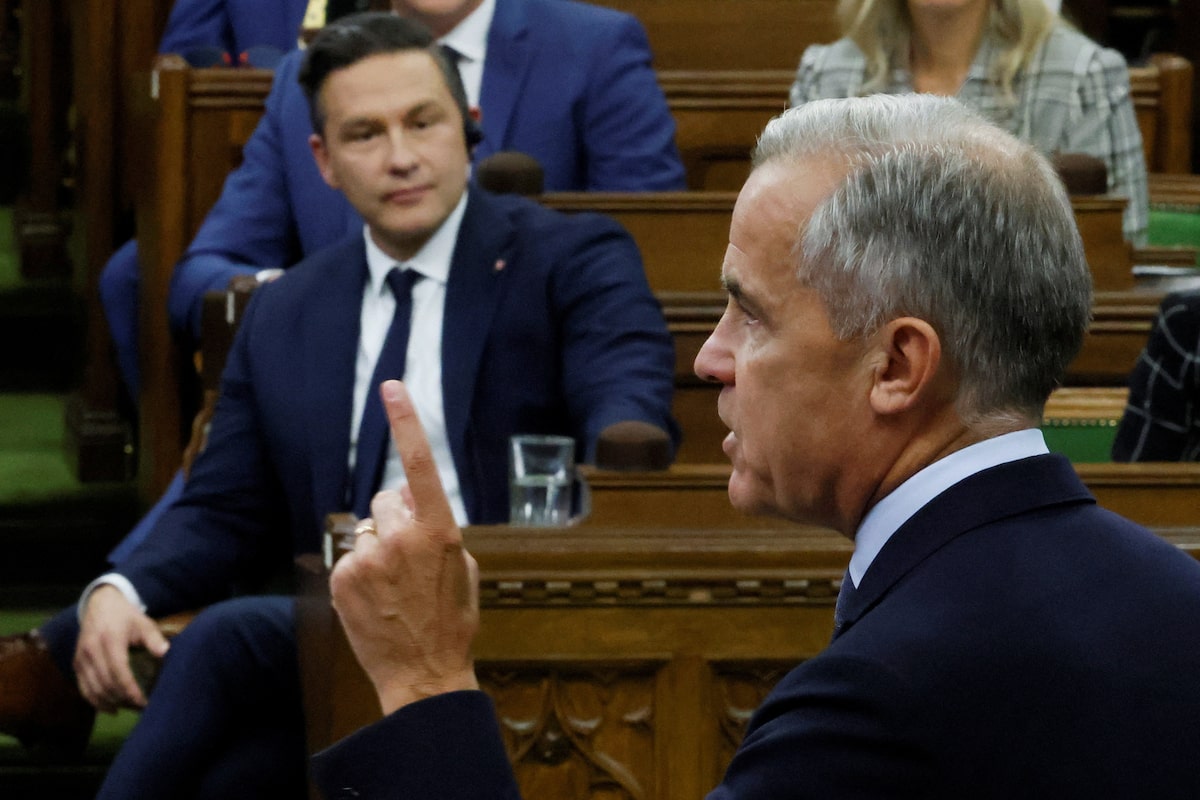
Prime Minister Mark Carney has received mixed reviews for his trip to the White House.Blair Gable/Reuters
Prime Minister Mark Carney said there will be bilateral deals with the U.S. alongside the continental free trade agreement, but Canada is also thinking about where it is smart to remain integrated with the U.S. economy, and where it isn’t.
Mr. Carney made the comments at the end of a day where he took sustained political heat from his rivals over the fact his trip to Washington yielded no new agreements with the U.S, specifically in industries like steel and aluminum that are now heavily tarriffed.
He told the BMO Eurasia US-Canada Summit in Toronto that there was a “very granular” discussion between him and U.S. President Donald Trump around those industries, and progress is being made on deals.
“There’s going to be in my view, some bilateral deals – there already are – alongside USMCA, it’s not an either or necessarily, and that’s one of the realities of the negotiations,” he said, referring to the U.S.-Mexico-Canada free trade agreement that is also up for review next year.
Mr. Carney also gave some insight into the talks around the “section 232″ tarrifs, those the President has imposed on national security grounds, and in particular, aluminum.
Mr. Carney said that Canada supplies the U.S. with the majority of the aluminum it needs, but it is now tarrifed at 50 per cent.
If the U.S. wanted to produce at the same level, the amount of energy required would be substantial, Mr. Carney said.
“Is making aluminum really the first best use of that power at a time when you’ve got the AI revolution, you’re reshoring manufacturing, you want to keep people’s electricity costs down at home, all those factors in the U.S.? I would think that’s an area where it’s pretty incentive aligned. That’s part of the discussions we’re having,” he said.
There are other sectors – Mr. Carney cited aerospace and defence – where alignment with the U.S. makes sense, but others also where it doesn’t, he said, although didn’t give specific examples.
“We think about growth areas, growth sectors,” he said.
“We do ask ourselves the question, now, do we really want to integrate those sectors with the US, because that could lead to similar issues down the road. Or is it better to build them out with other partners?”
Mr. Carney appeared remotely at the summit, and was interviewed by Gerald Butts, a former adivsor to Prime Minister Justin Trudeau and who also played a role in Mr. Carney’s leadership campaign.
Earlier on Wednesday, Mr. Carney faced sustained criticism from his rivals for a trip to Washington that didn’t end with a new trade agreement, even as he told MPs deals are being negotiated for relief from U.S. tariffs on steel and aluminum exports.
Provincial premiers offered mixed reviews, with Ontario Premier Doug Ford in particular urging a more forceful approach as the trade dispute between the two countries drags on.
For his part, Conservative Leader Pierre Poilievre accused Mr. Carney of betraying Canadian workers by telling U.S. President Donald Trump on Tuesday that Canada would make US$1-trillion worth of investments in the United States in the next five years if Canada gets the deal it expects.
“The Prime Minister went pathetically to the White House to offer a trillion-dollar gift, bowing before the President in weakness,” Mr. Poilievre said during a fiery Question Period Wednesday. He asked where deals were on softwood lumber and autos, both of which Mr. Trump’s administration has tariffed heavily.
“Where, in his platform, did he promise to give a trillion of our investment dollars to the Americans?”
Opinion: It’s humiliating to kowtow to Trump. But what choice does Carney have?
Opinion: Carney’s better off without a big Trump trade deal. Just ask the Europeans
Mr. Carney appeared to give a short sigh. He responded to Mr. Poilievre by saying that investment would come from the private sector – a phrase he put in air quotes. The answer drew loud cheers from the Liberal benches.
He also said Canada already has the best deal – a reference to the U.S.-Mexico-Canada free trade agreement – and that a better one is coming.
Mr. Carney’s government attempted to tamp down expectations ahead of his Washington trip, where he and Mr. Trump were expected to discuss the punitive tariffs the White House has imposed on exports from Canada and much of the rest of the world. Mr. Carney did not win any new relief from those levies, though Mr. Trump did hint during Tuesday’s visit that a deal was possible.
Bloc Quebecois Leader Yves-Francois Blanchet called the trip nothing but an opportunity for nice words.
“The great negotiator is again coming back into the country, the tail between his legs. When will he stun us? When will he impress us?” Mr. Blanchet said, speaking in French.
Mr. Carney framed the meeting in positive terms.
“I am happy that the U.S. President and I had a meeting of the minds about a deal for the steel, aluminum and energy sectors,” Mr. Carney said in French.
“That is why our teams are working on just such a deal as we speak.”
In Toronto on Wednesday, at the BMO Eurasia US-Canada Summit, Ontario Premier Doug Ford said that Canada should retaliate if Mr. Carney cannot secure tariff relief from Mr. Trump.
He appeared particularly incensed by Mr. Trump’s repeated comments during the Oval Office meeting with Mr. Carney that the U.S. does not want to buy cars from Canada.
“You aren’t going to annihilate our steel sector. You aren’t going to annihilate manufacturing in Ontario. And you sure the heck aren’t going to annihilate the auto sector,” Mr. Ford said.
“If we can’t get a deal, we have to hit him back twice as hard.”
Ontario Premier Doug Ford says that if Prime Minister Mark Carney can’t reach a deal to end the U.S. tariffs, Ottawa should start hitting back hard with retaliatory measures.
The Canadian Press
He said that Ontario would not put U.S. alcohol back on Liquor Control Board of Ontario shelves “until we get a deal.” And he said that Canada should cut off exports of critical minerals to the U.S. if Mr. Trump persists in trying to cripple the Canadian auto sector and other key industries.
“If he wants to destroy our auto sector and destroy our steel sector and for Quebec the aluminum sector – there won’t be a grain of critical minerals going south of the border. There won’t be one ounce of energy coming from Ontario.”
Alberta Premier Danielle Smith took a more positive view of the meeting between Mr. Carney and Mr. Trump, lauding the Prime Minister’s more conciliatory tone and his focus on the U.S.-Canada energy relationship.
“What I have told Prime Minister Carney when he came in is, stop threatening to sell the U.S. less energy, and let’s promise to sell them more. Because I think that’s the right pathway to a solution. And that seems to be the nature of the conversation,” she said at the BMO conference.
“I think even the Prime Minister was framing yesterday as more of a social visit, trying to downplay expectations,” she added. “But that’s good. We should be cheering the Prime Minister on. We want him to have a good personal relationship. We want him to be able to stay at one of the presidential residences when he goes down there. We want them to have private dinners and conversations together. That is how deals get made with this particular president.”
Prime Minister Mark Carney told Mr. Trump that Canada would make an estimated $1-trillion worth of investments in the United States in the next five years, if Canada gets the ‘deal we expect to get’ from the U.S.