
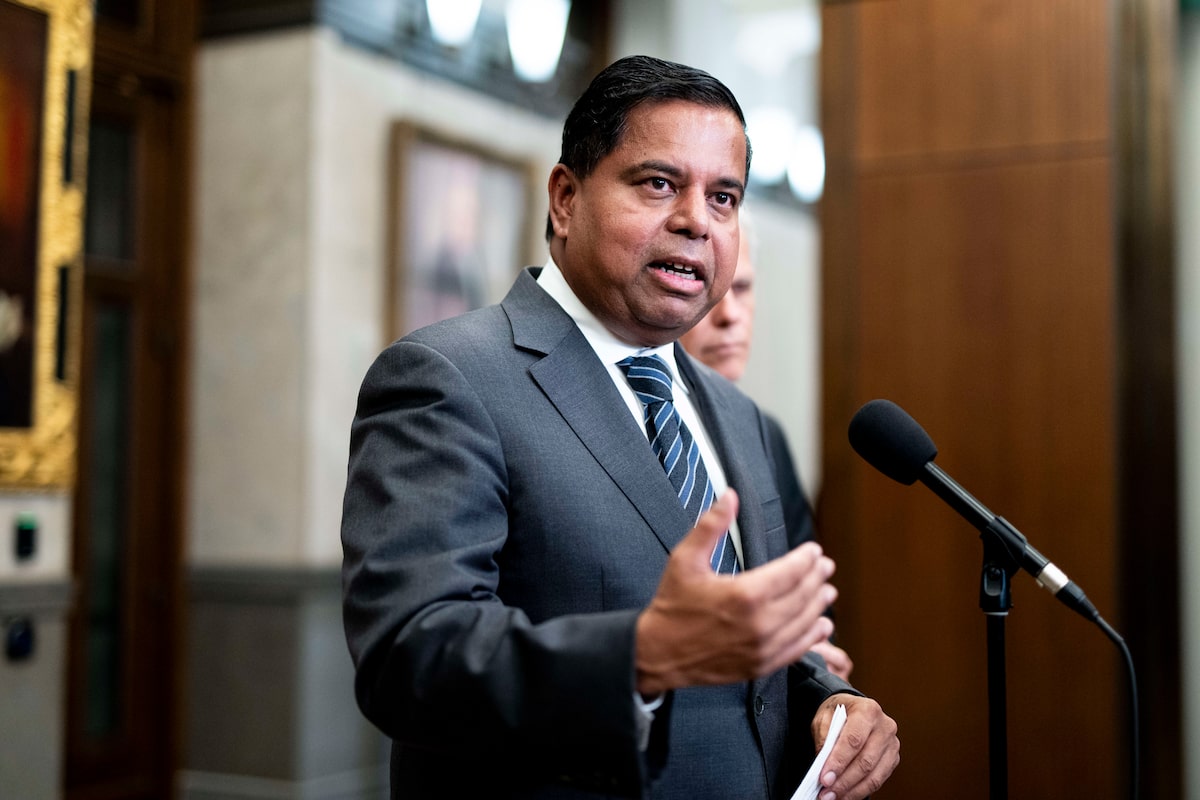
Public Safety Minister Gary Anandasangaree said Bill C-2 would not be withdrawn and would continue its passage on a parallel track with Bill C-12.Spencer Colby/The Canadian Press
Public Safety Minister Gary Anandasangaree gutted the government’s strong-borders bill and introduced a watered-down version Wednesday, removing controversial clauses that were sharply criticized for threatening personal privacy and potentially breaching the Charter of Rights and Freedoms.
Bill C-2 would have enabled police and the Canadian Security Intelligence Service to demand to know if people had used services, such as a telecom provider, hotel or doctor, without needing a warrant. But the new slimmed-down variant, known as Bill C-12, would not grant law enforcement these powers.
Speaking to reporters in Parliament, the Public Safety Minister said that after consulting MPs, senators and expert groups, the government felt that “putting forward a second bill that carves out the more contentious elements of Bill C-2 will enable us to get swifter passages.”
“I am comfortable in saying that this should get broader support,” he said.
Introducing a new version of a bill partway through its passage through Parliament is unusual. But the original bill was attracting a slew of criticism from civil-liberties and open-internet groups, and steep opposition from the Conservatives and the NDP. The Justice Department warned that it could clash with Charter rights.
Public Safety Minister set to table new version of strong borders bill after slew of criticism
Conservative House Leader Andrew Scheer said it was “pretty embarrassing” for the Public Safety Minister to have to introduce a new strong-borders bill. Bill C-2 was the first substantive piece of legislation that the government introduced after the general election.
“This was their signature response to pressures and requests from the U.S. government to improve the situation at our border, and they got it so wrong, so badly, right off the bat,” he told reporters.
Mr. Scheer said the Conservatives had signalled that Bill C-2 was an example of overreach that violated the privacy rights of Canadians. He said his party would study the new version of the bill before deciding whether to support it.
Earlier this week, Conservative Leader Pierre Poilievre said the government must either make significant changes to the bill or introduce a new version that corrects its flaws if it wants his party’s support to pass it into law.
Jenny Kwan, the NDP’s public safety and immigration critic, had also expressed serious concerns about Bill C-2. At its second-reading debate last month, she called for it to be withdrawn entirely.
Bill C-12 still includes measures tightening up the immigration system and restricting access to asylum, which refugee advocates have criticized.
The new bill dispenses with controversial clauses allowing postal workers to open people’s mail. The minister has also removed clauses designed to combat money laundering, which would have made it an offence to accept a cash payment of more than $10,000, including a donation. The measure raised concerns that some people without bank accounts, including in remote communities, may have been unfairly affected.
He also removed a section allowing the federal government to issue orders potentially requiring social-media companies, e-mail and cellphone providers, and other digital services to re-engineer their platforms to help CSIS and the police access information.
In addition, it would have prohibited electronic service providers from warning each other of vulnerabilities found in their systems. Such information-sharing can help providers bolster their defences against hackers.
Mr. Anandasangaree said Bill C-2 would not be withdrawn and would continue its passage on a parallel track with Bill C-12.
What’s included in Bill C-2, the border security bill
Bill C-2 has yet to progress to the Commons committee stage or to the Senate for closer scrutiny. Since the Liberals have a minority government, it would need the support of MPs from other parties to move forward.
Michael Geist, the University of Ottawa’s Canada Research Chair in Internet Law, predicted that Bill C-2 would, without cross-party support, become a “zombie bill,” which would not progress.
He welcomed the changes in the new version of the bill but said the government has “burned a significant amount of trust.”
“There has been a pretty consistent message that privacy is just not a priority for this government,” he said. “You had MPs and ministers consistently defending this bill and now they are tossing it overboard. It is pretty clear they wanted to try to sneak this in and hoped nobody would really notice, without any kind of study.”
Refugee advocates and immigration lawyers have expressed concern about measures in Bill C-2, including restricting access to asylum hearings, that remain in the new version of the bill.
Karen Cocq, co-executive director of Migrant Workers Alliance for Change, said that when it came to immigration, “this new bill is the same as Bill C-2.”
“PM Carney’s government remains aligned with conservative Trump-like anti-migrant sentiment,” she said in an e-mail.
“No one’s safety is served by measures that block refugees from hearings, impose retroactive time limits on safety, and grant mass status-cancellation powers that violate due-process protections for the most vulnerable.”
Matt Hatfield, executive director of OpenMedia, an organization dedicated to keeping the internet open and surveillance-free, said “Bill C-12 remains legislation in search of a clear justifying purpose” and said it seemed to have been drawn up “to remove ‘irritants’ in Canadian law to President Trump.”