
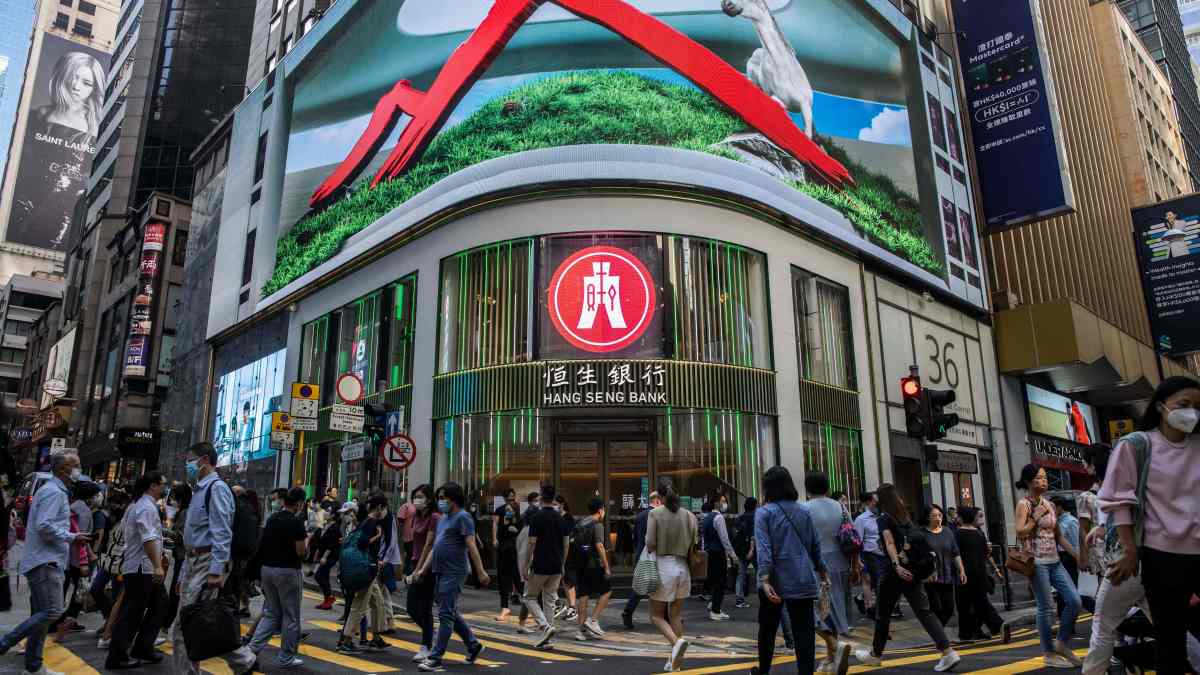
HSBC has announced plans to fully take over the Hong Kong bank Hang Seng by buying out minority shareholders in a £10.7 billion deal.
The FTSE 100 lender has offered to buy the 36 per cent share of the bank it does not already own for cash of HK$155 per share, valuing the stake at about HK$106.1 billion (£10.7 billion), or a 30 per cent premium to Hang Seng’s closing price on Wednesday.
HSBC said it would suspend share buybacks for at least three quarters so that it could fund the deal while maintaining its capital buffers within a target range set by the board, sending its shares 5.8 per cent, or 61p, lower to £10.04 in London.
• Business Live blog: all the corporate, economic and markets news updated as it happens
Hang Seng has been hit by its exposure to faltering property markets in the city and mainland China.
Georges Elhedery, chief executive of HSBC, said, however, that the level of non-performing loans in Hang Seng’s book was a short-term issue. The bank’s impaired loans reached 6.7 per cent of its gross loans in June 2025, up sharply from 2.8 per cent at the end of 2023.
Elhedery said: “Some areas are recovering, and some areas are yet to recover. Over the medium to long term we remain constructive.
“We will review buybacks on a quarter-by-quarter basis … This is a better use of our capital. It is more capital generative and it’s more accretive than a share buyback. We will make sure everyone does their math to make sure they understand what the opportunity is here.”
HSBC has said it would maintain Hang Seng as a separate banking brand and would outline possible synergies from the deal at a later stage.
Elhedery said it was “premature and presumptuous” to quantify the synergies at this stage of the transaction but that the group had good ideas for how to save costs and drive revenues in the combined entity. He said the figures for synergies may be provided in the second half of 2026.
Gary Greenwood, analyst at Shore Capital, said: “It will take time to work through this announcement and interpret the details. However, we think that this could possibly be a politically motivated transaction, as much as a financially motivated one, given most of the minority stake is held by Hong Kong and Chinese retail investors, while noting that the group already had control of the business, so this is not about driving out synergies and savings.
“With that in mind, the acquisition multiple looks punchy in our view, relative to the profitability and return on equity generated by the business.”