
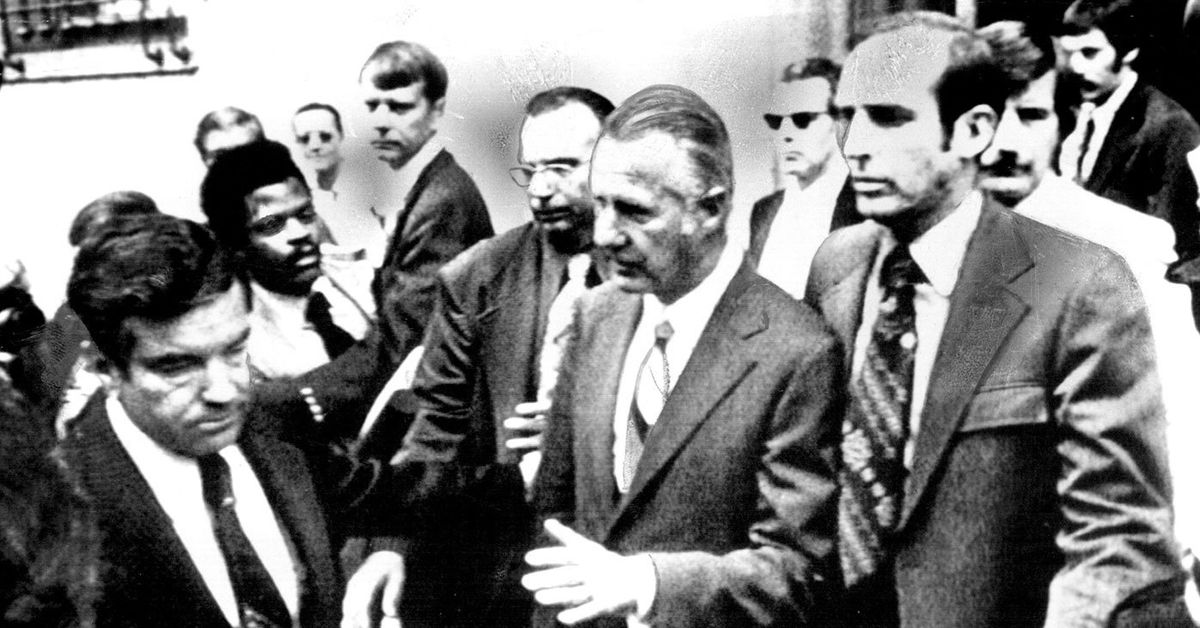
US Vice President Spiro Agnew resigned in disgrace from office on October 10, 1973.
Agnew had his resignation to the Secretary of State Henry Kissinger delivered at 2.05pm that afternoon.
Minutes later, he pleaded no contest to tax evasion charges in a Baltimore courtroom.
 Spiro Agnew after pleading guilty to tax evasion. (AP)
He was sentenced to three years’ probation and handed a $US10,000 fine.
But Agnew was also being investigated for bribery, extortion and taking kickbacks.
That investigation was dropped in exchange for his resignation.
The judge told Agnew he would be heading to prison were it not for the intervention of the attorney-general.
But despite being caught red-handed with a crime that would typically see a person locked up, Agnew was in a position of unprecedented power.
Because while he was facing prison time, he was simultaneously preparing for the prospect of being elevated to the presidency.
While Agnew was under criminal investigation for tax evasion and corruption from his time as governor of Maryland, President Richard Nixon was also facing the prospect of going to jail.
 Spiro Agnew with Australian opposition leader (later prime minister) Gough Whitlam. (AP)
If Nixon were to resign the presidency, as he was under pressure to do, Agnew would become both the president and a likely prisoner.
Under a deal made with Agnew and the Department of Justice, he would resign the vice presidency if he could be spared prison.
Nixon then had to find a replacement not just for Agnew, but most likely for himself.
With Democrats in power in Congress, they put forward a candidate Nixon could get confirmed – minority leader Gerald Ford.
“We gave Nixon no choice but Ford,” House Speaker Carl Albert said later.
 Richard Nixon appointed Gerald Ford as his vice president, aware he was under investigation himself. (AP)
Ford was widely seen as an honourable and inoffensive representative who was completely unconnected to Agnew and Nixon’s crimes.
Ford told his wife Betty that being named vice president would be a “nice conclusion” to his political career.
Less than a year later, Nixon would resign in disgrace over the Watergate scandal and Ford would be elevated to the presidency.
Nixon would also avoid jail after Ford granted him a full pardon.
Out of office, Agnew was disbarred from law and had to sustain himself with loans, initially from Frank Sinatra and later from the Crown Prince of Saudi Arabia.